
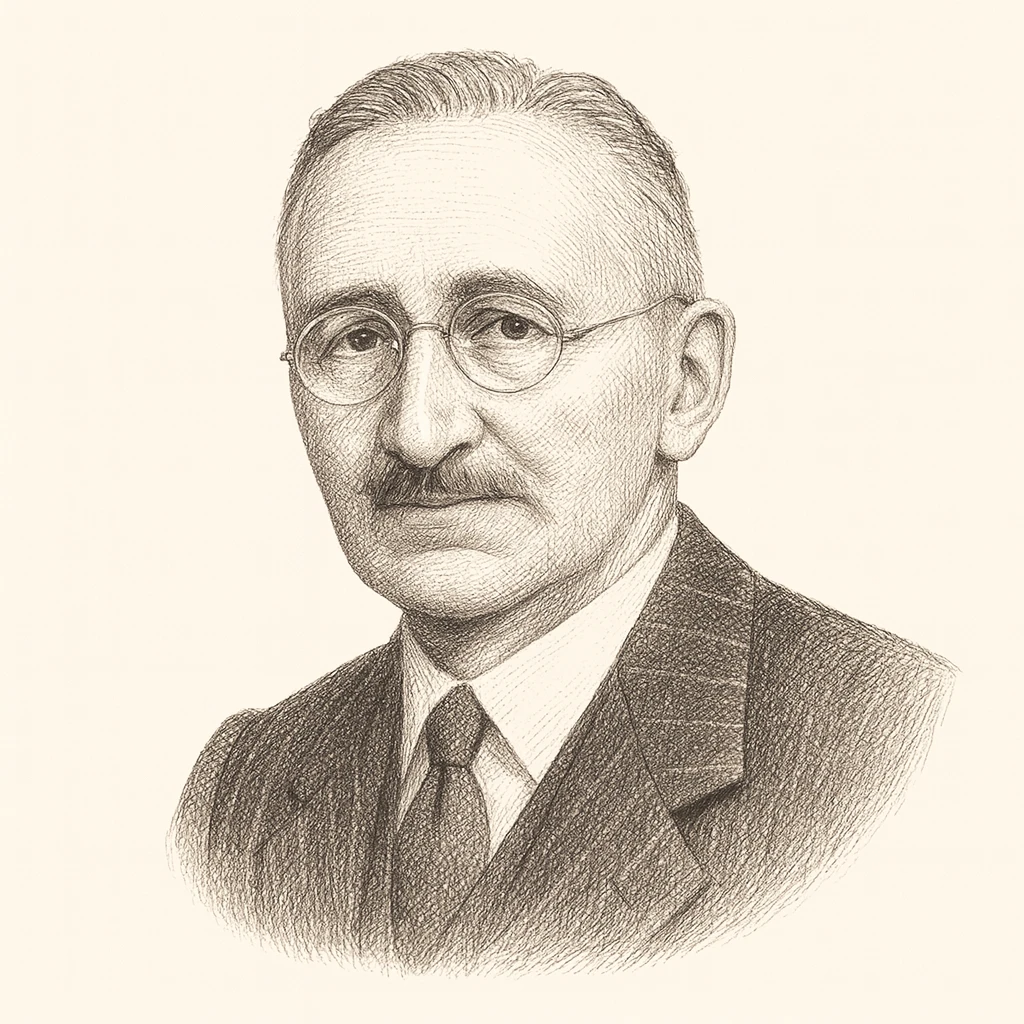
Friedrich Hayek had two great insights, and the second one was bigger than the first. The first was that prices in a market economy are a kind of communication system — they transmit information about scarcity, demand, and opportunity to millions of dispersed actors who could not possibly gather that information any other way. The second was that this insight was an example of a much more general phenomenon: human societies are full of complex orders that emerged without anyone designing them, that work better than anyone could design them, and that get destroyed when planners try to replace them with deliberately constructed alternatives. The first insight made Hayek a major economist. The second made him one of the most important political philosophers of the 20th century.
Hayek was born in Vienna in 1899 to a family of academics and civil servants. He served briefly in the Austro-Hungarian army at the end of the First World War, then studied at the University of Vienna, where he became a member of Ludwig von Mises's private seminar — the legendary informal gathering of Austrian School economists, philosophers, and intellectuals that met in Mises's office for over a decade. Mises was the towering intellectual influence on the young Hayek, and the relationship between them shaped Hayek's entire career. In 1931, on Mises's recommendation, Hayek was invited to lecture at the London School of Economics, where he stayed for nearly two decades. He arrived in London just as Britain was beginning to debate the Keynesian revolution in economic policy, and he spent the 1930s as one of John Maynard Keynes's most prominent intellectual opponents.
The famous Hayek-Keynes debate of the 1930s was a defining moment in 20th century economics. Keynes was arguing that capitalist economies could become stuck in prolonged depressions and that government intervention was needed to manage aggregate demand. Hayek was arguing that government intervention would distort the price signals that allowed markets to coordinate themselves and would eventually make depressions worse rather than better. Keynes won the immediate battle — his ideas dominated economic policy for the next forty years — but Hayek's arguments would gain new relevance in the 1970s when Keynesian policies seemed to fail to handle stagflation.
Hayek's most famous book is The Road to Serfdom (1944), written during World War II as an argument that the kind of economic planning being adopted by wartime Britain and praised by left-wing intellectuals would, if extended into peacetime, eventually lead to totalitarianism. Hayek wasn't claiming that British socialists wanted totalitarianism. He was claiming that the logic of central economic planning required ever-more-comprehensive control over individual lives, that this control would face increasing resistance from people with their own preferences, and that the planners would eventually have to choose between abandoning the project or using force to overcome the resistance. The book was enormously controversial — denounced by socialists, embraced by anti-socialists, and turned into a Reader's Digest condensation that sold over a million copies in the United States. It made Hayek famous in a way no other Austrian economist had been before, and it established his reputation as a public intellectual outside the academic economics profession.
Hayek's most important academic work, though, came later. The Constitution of Liberty (1960) developed his political philosophy systematically. Law, Legislation and Liberty (three volumes, 1973-1979) extended that philosophy into a comprehensive theory of how legal institutions, social customs, and economic markets all function as forms of "spontaneous order" — complex systems that emerge from human action without human design and that contain forms of accumulated wisdom no individual planner could match. The framework drew heavily on Hume, Smith, and the Scottish Enlightenment, but Hayek extended it into something distinctively his own. Spontaneous order, in Hayek's hands, became a powerful framework for thinking about why markets work, why traditions matter, why constitutions should be slow to change, and why grand schemes of social engineering tend to fail.
Hayek won the Nobel Prize in Economics in 1974, sharing it with Gunnar Myrdal — the only economist to share the prize with someone whose views were almost entirely opposed to his own. The Nobel committee cited Hayek's earlier monetary and business cycle work, but the recognition came at exactly the moment when his broader political philosophy was returning to influence after decades in the wilderness. Margaret Thatcher famously slammed a copy of The Constitution of Liberty down on a table at a Conservative Party policy meeting and declared "This is what we believe." Ronald Reagan cited Hayek as a major intellectual influence. The neoliberal turn in economic policy that defined the 1980s and 1990s drew heavily on ideas Hayek had been developing for decades.
Hayek died in 1992 in Freiburg, Germany, at ninety-two. He had lived to see his ideas vindicated in ways that would have seemed impossible during the long decades when Austrian economics was treated as a scholarly relic. His relationship with Mises is one of the great intellectual partnerships of the 20th century — Hayek was the more politically successful of the two and the better writer for general audiences, but he never stopped insisting that Mises had taught him the most. The contemporary libertarian and classical liberal traditions are unimaginable without Hayek, and his concept of spontaneous order has become one of the most influential ideas in modern political and economic thought.
Friedrich Hayek is associated with Classical Liberal. See the archetype