
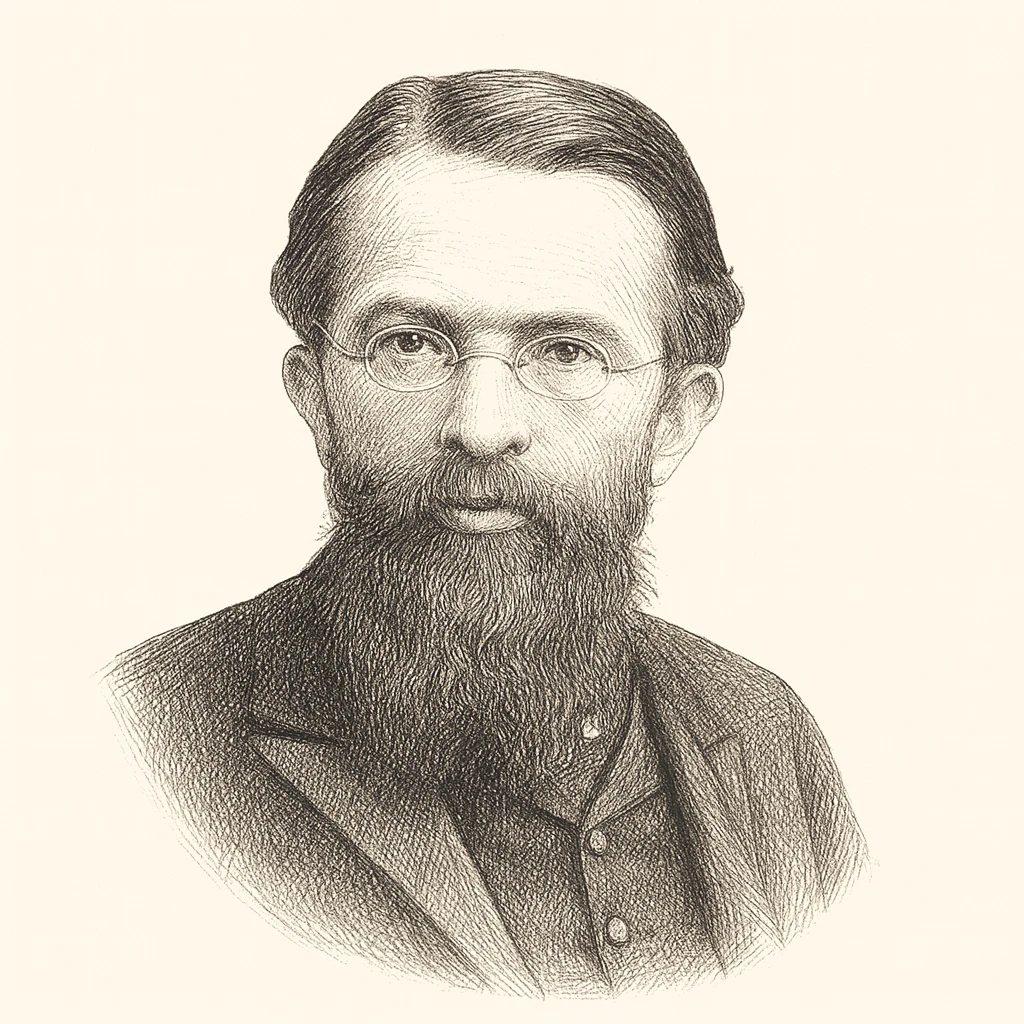
Carl Menger is remembered as the founder of the Austrian school of economics, whose work in the early 1870s helped launch what is often called the marginal revolution. Against the classical view that value derived from the labor or cost embodied in goods, Menger argued that value is subjective: it arises from the judgments of individual actors about how goods satisfy their wants at the margin. This reorientation placed the choosing, valuing individual at the center of economic explanation, a methodological individualism whose implications reached well beyond price theory into how one thinks about social order.
Though Menger himself was not primarily a political polemicist, his ideas carried a distinct political charge that later thinkers drew out. His account of the origin of money and other institutions as unplanned outcomes of countless individual actions—rather than deliberate design or state decree—prefigured the idea of spontaneous order that became central to classical-liberal thought. This emphasis on institutions that emerge and evolve without a single designing mind offered an intellectual foundation for skepticism toward centralized economic planning and grand schemes of social engineering.
Menger also became a central figure in the Methodenstreit, the dispute over method with the German Historical School, which favored historical and statist approaches to economics. Menger defended the search for general theoretical laws and the value of abstract, deductive reasoning about human action. This defense of theory over historicism, and of the individual over the collective as the unit of analysis, shaped the intellectual character of the school he founded.
His greatest political influence came through his successors. The line that runs from Menger through Eugen von Böhm-Bawerk to Ludwig von Mises and Friedrich Hayek turned his subjectivism and his insights about dispersed knowledge and unplanned order into a sustained critique of socialism and interventionism. For classical liberals, Menger is thus a foundational figure less for explicit political argument than for supplying the analytical vocabulary—subjective value, methodological individualism, emergent institutions—on which a whole tradition of market-friendly, anti-collectivist thought was built.
Carl Menger is associated with Classical Liberal. See the archetype