
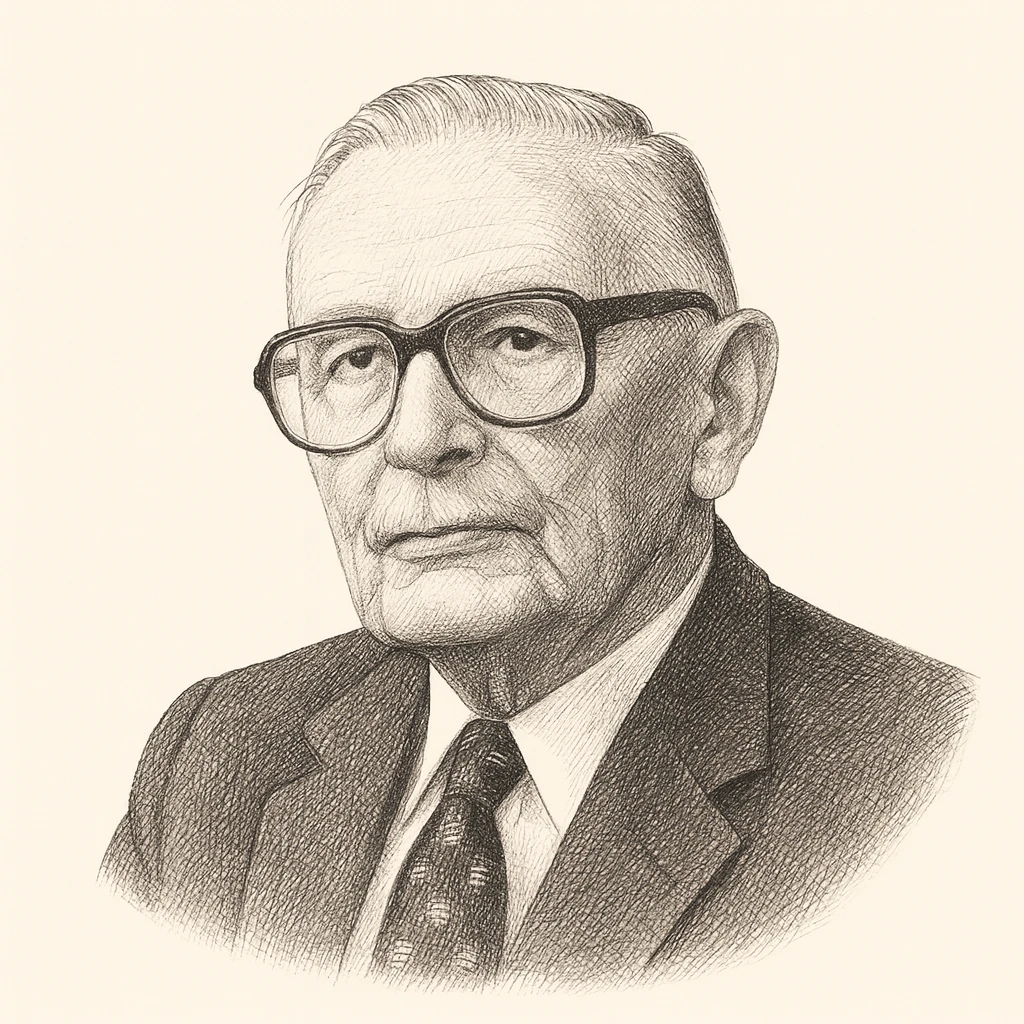
James M. Buchanan was an American economist best known as the founder of public choice theory, an approach that analyzes political decision-making using the assumptions and methods of economics. His central move was to strip away the idealized picture of government as a benevolent servant of the public interest, and instead treat voters, politicians, and bureaucrats as self-interested actors responding to incentives, much as economists model behavior in markets. He summarized this program as "politics without romance": the insistence that public officials be modeled with the same skeptical realism applied to private actors, rather than assumed to be selfless guardians of the common good.
Working often in collaboration with Gordon Tullock, Buchanan developed constitutional political economy, which shifts attention from particular policy outcomes to the underlying rules and constraints that govern collective choice. On this view, because ordinary political processes generate incentives toward deficit spending, special-interest capture, and the growth of the state, the crucial task is to design constitutional rules that limit what majorities and officials can do. This concern led him to advocate constraints such as balanced-budget requirements and to argue that the legitimacy of collective action rests on the consent expressed at the level of rules rather than on the outcomes of day-to-day majoritarian politics.
Buchanan was awarded the Nobel Memorial Prize in Economic Sciences in 1986 for this body of work. His ideas became foundational to modern classical-liberal and libertarian thought, offering an analytical case for skepticism about government intervention grounded not in ideology alone but in the study of political incentives. He spent much of his career in Virginia, and the tradition he helped build is often associated with the "Virginia school" of political economy.
Buchanan's legacy is contested. Critics, most prominently in Nancy MacLean's book "Democracy in Chains," have argued that his project aimed to constrain democratic majorities in ways that served entrenched wealth, and have linked his early career to the era of resistance to school desegregation in Virginia. Defenders and many scholars have sharply disputed MacLean's interpretation and use of sources. What is not in dispute is that Buchanan's work reshaped how economists and political theorists think about the limits and failures of government.
James M. Buchanan is associated with Classical Liberal. See the archetype