
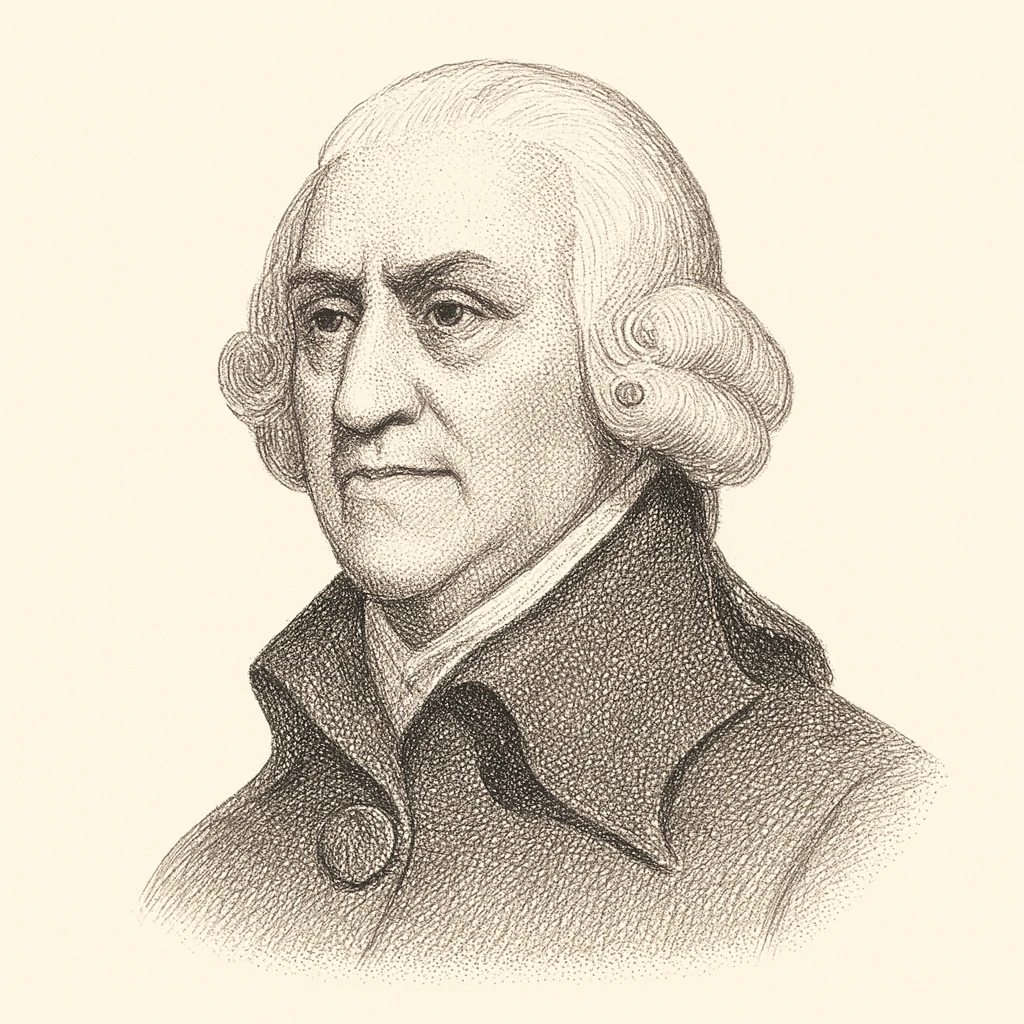
Adam Smith is famous for one book and remembered for the wrong reason. The Wealth of Nations, published in 1776, is the founding text of modern economics, and most people who have heard of Smith know him as the man who explained how markets work and coined the phrase "invisible hand." What they usually miss is that Smith was a moral philosopher first and an economist only secondarily, and that he wrote another book — The Theory of Moral Sentiments (1759) — that he considered at least as important and that complicates almost everything people think they know about him.
Smith spent his early career as a professor of moral philosophy at the University of Glasgow, lecturing on ethics, jurisprudence, and what he called "police" (the management of civic life). His first book, The Theory of Moral Sentiments, opens with a sentence that no one expects from the supposed prophet of self-interest: "How selfish soever man may be supposed, there are evidently some principles in his nature which interest him in the fortune of others, and render their happiness necessary to him, though he derives nothing from it except the pleasure of seeing it." Smith believed that human beings were fundamentally social, that we naturally sympathize with one another, and that the entire fabric of moral and economic life was woven from this basic capacity for fellow-feeling.
When Smith later wrote The Wealth of Nations, he was not abandoning that view — he was extending it. The famous passage about the butcher, the brewer, and the baker is not a celebration of selfishness; it's an observation that even strangers who don't love each other can produce mutually beneficial exchanges through a market. Smith thought this was a remarkable feature of social life, but he never thought it was the only feature. He worried about the dehumanizing effects of factory labor decades before Marx. He distrusted merchants and warned that "people of the same trade seldom meet together, even for merriment and diversion, but the conversation ends in a conspiracy against the public." He supported public education, progressive taxation in some forms, and government provision of infrastructure that markets wouldn't supply.
The "invisible hand" — a phrase Smith used only three times across all his work, and never as the centerpiece of his economic theory — has been turned by later interpreters into a kind of magical formula for laissez-faire. Smith would have been puzzled by this. He believed markets generally worked well when they were embedded in moral institutions, civic norms, and reasonable laws, and that they could fail badly when they weren't. Reading him today, what's striking is how little of his actual writing supports the cartoon version of "Adam Smith the free-market evangelist."
Smith died in 1790 in Edinburgh, having spent his last years revising The Theory of Moral Sentiments — adding rather than subtracting from its arguments about human sympathy. He asked friends to burn most of his unpublished manuscripts before he died, which they did. What survived is enough to establish him as one of the founding figures of liberal political economy, but also as something more than the caricature: a Scottish Enlightenment moral philosopher who thought economics was a branch of ethics, not a substitute for it.
Adam Smith is associated with Compassionate Libertarian. See the archetype