
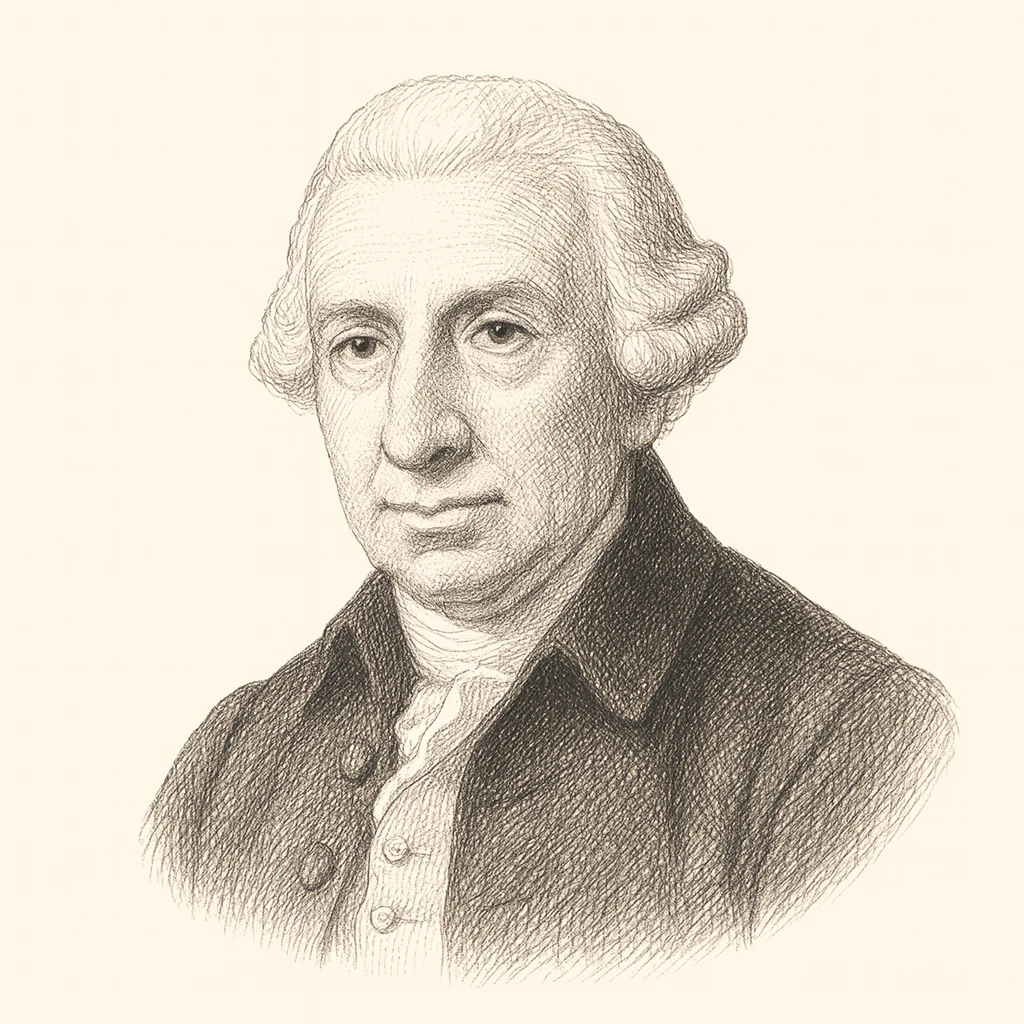
Adam Ferguson was a Gaelic speaker from Perthshire who took a divinity degree, became chaplain to the Black Watch, and by his own account was present at Fontenoy. He left the ministry in 1754, succeeded Hume as Keeper of the Advocates Library, and in 1759 took a chair at Edinburgh, moving to Moral Philosophy in 1764. The military years matter to the work: no other figure of the period writes about martial virtue, corruption and the costs of commercial refinement with the same first-hand unease.
The Essay on the History of Civil Society of 1767 is the book that carries his reputation, and it contains the sentence for which he is now most often cited: that nations stumble upon establishments which are indeed the result of human action, but not the execution of any human design. The formulation is the clearest eighteenth-century statement of unintended order, and Hayek took it as the founding text of the idea, running his account of spontaneous order back through Ferguson rather than through Smith. Ferguson's own use of it is less complacent than the later tradition allowed. He is describing something that happens to societies, not something to be trusted.
For his argument is that commercial society is corrosive of the very qualities that produced it. The division of labor, which he analyzes at length and with more disquiet than Smith, raises productivity by narrowing the individual: a man confined to one operation may become expert and ignorant at once, and a society of such men has more wealth and less capacity for public life. Ferguson's civil society is not a sphere of voluntary association standing safely apart from the state, as the phrase later came to mean; it is a condition of political life that requires citizens capable of defending it, and can be lost through prosperity as surely as through conquest. Hence his insistence on militias against standing armies, and his interest in Rome, whose republic he wrote a history of in 1783, as the case study in how a free people can be undone by its own success.
Because he framed the problem this way, Ferguson has been claimed by traditions that have little else in common. Hayek read him as the theorist of unplanned coordination. Marx read the Essay closely and quoted his account of the division of labor in the first volume of Capital, taking it as evidence that the mutilation of the worker was noticed by the classical economists themselves. Hegel absorbed the German translation, and the concept of civil society as a distinct sphere entered German philosophy substantially through it.
Wondering where you land? Take the 4-minute assessment