
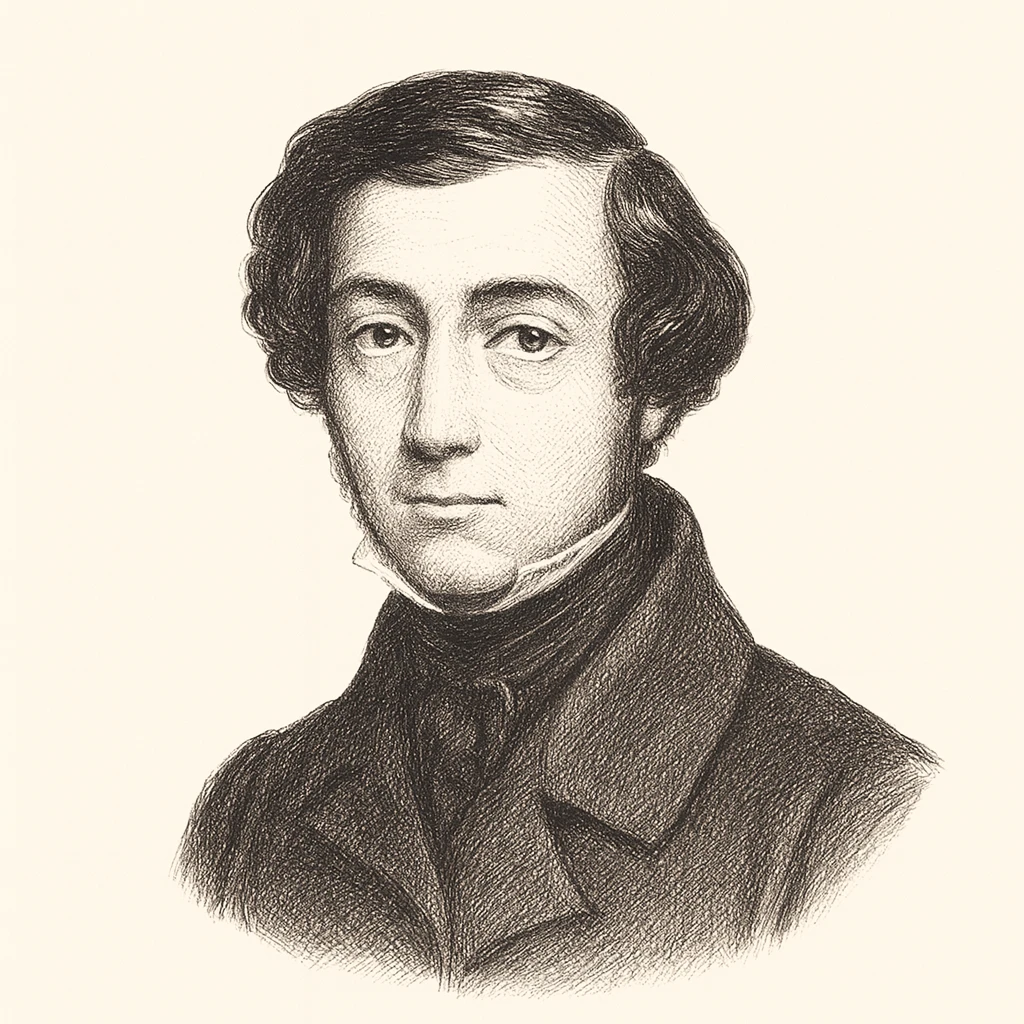
Alexis de Tocqueville was born into a French aristocratic family that had survived the Revolution by the narrowest of margins. His great-grandfather was guillotined in 1794. His parents were imprisoned during the Terror and would have been killed had Robespierre's regime lasted a few weeks longer. Tocqueville grew up under the shadow of those events, in a family that had seen the world they were born into swept away by the democratic revolution and that was learning, slowly and painfully, to live in the new world that had replaced it. This biographical fact is the key to understanding everything Tocqueville wrote. He was an aristocrat by birth and instinct, a liberal by conviction, and a student of democracy by necessity — convinced that democracy was the future, suspicious of many of its tendencies, and determined to understand it well enough to make it work as well as possible.
In 1831, at twenty-five, Tocqueville and his friend Gustave de Beaumont obtained a government commission to study the American prison system. The official mission was a pretext. Both men were really interested in the United States as a laboratory for democratic society — the first major nation in the world to attempt democracy on a large scale, and the obvious place to study what democratic life actually looked like in practice. They spent nine months traveling across the country, from New England to the frontier, interviewing politicians, judges, priests, ordinary citizens, slaves, and Native Americans. Tocqueville took voluminous notes throughout. When he returned to France, he spent the next four years writing the book that became Democracy in America — published in two volumes (1835 and 1840), translated immediately, and recognized almost from the moment of publication as one of the most important political books of the century.
What made Democracy in America extraordinary was Tocqueville's combination of sympathy and skepticism. He came away impressed by much of what he saw in the United States. He admired the political vitality of small-town American democracy, the strength of voluntary associations, the genuine equality of social conditions among white men, the way Americans took it for granted that political power belonged to ordinary citizens. He thought Europe had a great deal to learn from American democracy. But he also worried about it. He saw that democratic equality, taken to its logical conclusion, could produce a society in which everyone became so similar, so absorbed in private life, so disconnected from any sense of higher purpose that they would willingly surrender their political freedom to a centralized state that promised to take care of everything for them. He called this "soft despotism" — a tyranny that didn't crush its subjects but reduced them, gradually, to comfortable, well-managed children. It was one of the most prescient warnings ever written about what democratic societies could become if they weren't careful.
Tocqueville also analyzed slavery and the position of African Americans with a clarity that almost no other contemporary observer matched. He predicted, decades before the Civil War, that the question of slavery would eventually destroy the American republic unless it was resolved, and that even if slavery were abolished, the racial hatreds it had created would outlast emancipation by generations. He analyzed the dispossession of Native Americans with similar clarity, recognizing it as a moral catastrophe that the democratic principles Americans claimed to cherish should have made impossible. He was not a moralist, exactly — he tried to describe what he saw without preaching — but his moral judgments were sharp and they have aged well.
Tocqueville returned to French politics, served briefly in the Chamber of Deputies and then the Constituent Assembly that wrote the constitution of the Second Republic, and was foreign minister for a few months in 1849 before Louis-Napoléon Bonaparte's coup ended the republic and pushed Tocqueville out of politics. He spent his last decade writing The Old Regime and the Revolution (1856), a study of pre-revolutionary France that argued — controversially — that the centralization the Revolution carried out had actually begun under the monarchy, and that the Revolution had completed a process the old regime had started. He died in 1859 at fifty-three, leaving the second half of the book unfinished. Democracy in America and The Old Regime together established him as one of the founding figures of modern political sociology and one of the most insightful liberal critics of his own liberal tradition.
Alexis de Tocqueville is associated with Classical Liberal. See the archetype