
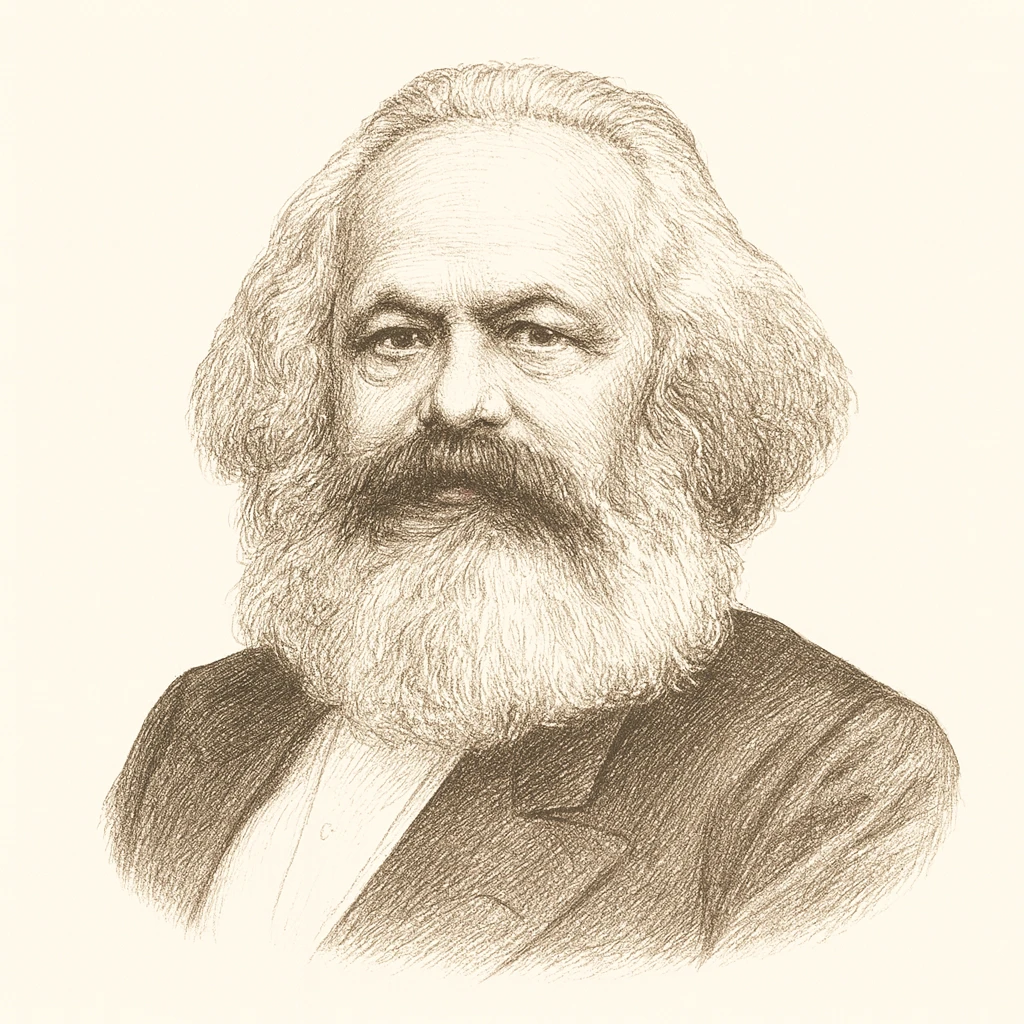
Karl Marx is the most consequential political thinker of the 19th century, and the most contested. To understand him requires holding two things in mind at once: that his ideas inspired more political movements, scholarship, and revolutions than perhaps any thinker since Christ — and that the regimes that claimed his name went on to commit some of the worst crimes of the 20th century. Both things are true. Neither cancels the other. Reading Marx well means taking both seriously.
Marx was born in 1818 in Trier, in what is now western Germany, to a Jewish family that had converted to Lutheran Christianity to escape professional restrictions. He studied law and then philosophy, finishing a doctorate at Jena in 1841 with a dissertation on ancient Greek atomism. He had hoped to become a university professor but his radical political views made that impossible — he turned instead to journalism, editing a newspaper in Cologne until Prussian censors shut it down. From there he moved to Paris, then Brussels, and finally to London, where he spent the last thirty-four years of his life, mostly in poverty, writing in the British Museum reading room.
Marx's central insight — and the one that almost everyone, friend or foe, eventually has to grapple with — was that economic structures shape political and ideological life more deeply than most people recognize. Earlier thinkers had treated politics, philosophy, and culture as primarily a matter of ideas, with economics as a backdrop. Marx flipped this. He argued that the way a society organizes its production — who owns the means of producing goods, who works for whom, who benefits from the labor of others — is the foundation on which everything else is built, including the laws, the religion, the philosophy, and the political institutions of that society. This was a radical claim and it changed how people thought about social analysis. Even thinkers who completely reject Marx's political conclusions often work with categories he invented: class, ideology, alienation, the structural critique of how power reproduces itself.
Capital, Volume 1 (1867) is Marx's most ambitious work — a thousand-page analysis of how capitalism functions, what makes it dynamic, and what makes it unstable. The book is famously hard to read in full, but its core argument is direct: capitalism generates immense productive power, but it does so by extracting surplus value from workers, treating human labor as just another commodity, and concentrating wealth in fewer and fewer hands over time. Marx predicted that these contradictions would eventually destroy capitalism from within and that the working class would replace it with something more rational and humane. The historical record on this prediction is mixed at best — capitalism proved more adaptive than Marx expected, and the revolutions that did happen produced regimes that bore little resemblance to anything Marx had envisioned.
Marx wrote relatively little about what a post-capitalist society would actually look like, and almost nothing about the political mechanisms by which it would be governed. This was a deliberate choice — he distrusted utopian socialism and thought it was idle speculation to design an ideal society in advance — but it left an enormous gap that 20th century communist regimes filled with their own answers, often horrifically. The Marx of the historical record and the Marx invoked by Stalin or Mao are not the same person, but they are not unrelated either. Reading Marx today requires taking his critique seriously without accepting that everything done in his name was an authentic application of his ideas.
Marx died in London in 1883, largely forgotten, mourned by perhaps a dozen people at his graveside. His longtime collaborator Friedrich Engels gave the eulogy, calling him "the man whom the bourgeoisie, both reactionary and democratic, vied with one another in calumniating." Within fifty years of his death, governments claiming his ideas would rule a substantial fraction of the world's population. Within a century, those governments would mostly be gone or transformed beyond recognition. What remains is the analytical tradition Marx founded — and a set of questions about capitalism, class, and human flourishing that no honest political thinker can entirely avoid.
Karl Marx is associated with Democratic Socialist. See the archetype