
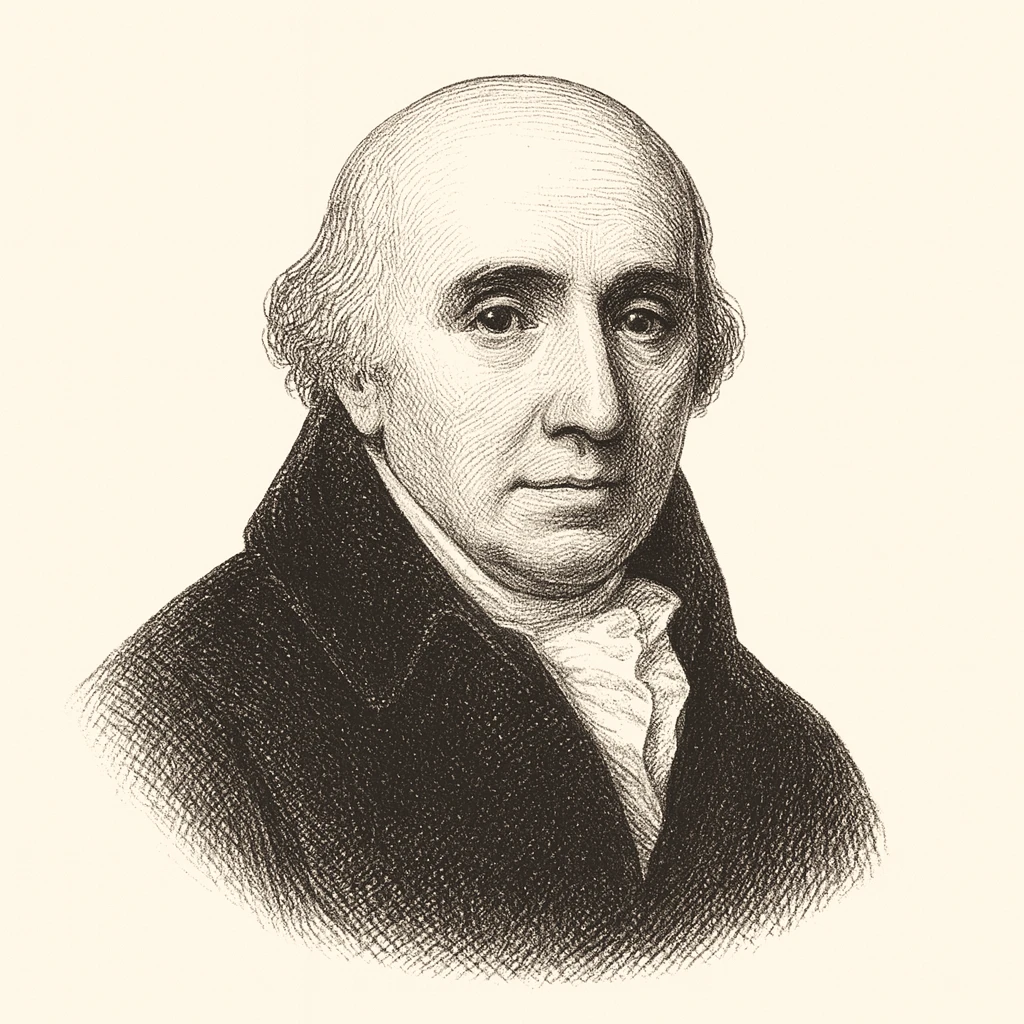
Dugald Stewart occupied the chair of Moral Philosophy at Edinburgh from 1785 to 1820 and was, in the judgment of most of his contemporaries, the finest lecturer in Britain. He had studied under Adam Ferguson at Edinburgh and under Thomas Reid at Glasgow, stood in for his father in the mathematics chair at nineteen, and spent the rest of his life consolidating and transmitting the tradition those two men represented rather than departing from it.
That description undersells his importance. The Scottish Enlightenment's first generation wrote for a European republic of letters; Stewart taught it to the people who would run nineteenth-century Britain. His lecture room held Palmerston and Lord John Russell, Henry Brougham, Francis Jeffrey and Sydney Smith of the Edinburgh Review, Walter Scott, and James Mill — who carried the Scottish inheritance to London, into the circle around Bentham, and to his son. Much of what nineteenth-century British liberalism assumed about mind, method and political economy it assumed because Stewart had taught it. He also did more than anyone to establish Smith's reputation as a philosopher rather than merely an economist: his Account of the Life and Writings of Adam Smith, read to the Royal Society of Edinburgh in 1793, is the source of much of what is known about Smith's life and the first serious attempt to present the Wealth of Nations and the Theory of Moral Sentiments as a single project.
Philosophically he refined Reid rather than extending him. The Elements of the Philosophy of the Human Mind, published across three volumes over thirty-five years, restates the case against the theory of ideas with more care about the psychology of attention, association and imagination, and with a persistent interest in the methods of inquiry — he was the first to give sustained attention to what he called conjectural or theoretical history, the reconstruction of how an institution must have arisen when no record survives, which was the characteristic method of Smith, Ferguson and Millar and had never been named.
His caution was political as well as intellectual. He wrote in the years when the French Revolution had made all speculation about the origins of authority suspect, was attacked for teaching Condorcet, and trimmed accordingly. The tradition he handed on was therefore narrower than the one he had received: the epistemology and the method survived, the more unsettling political conclusions of Ferguson and Millar largely did not.
Wondering where you land? Take the 4-minute assessment