
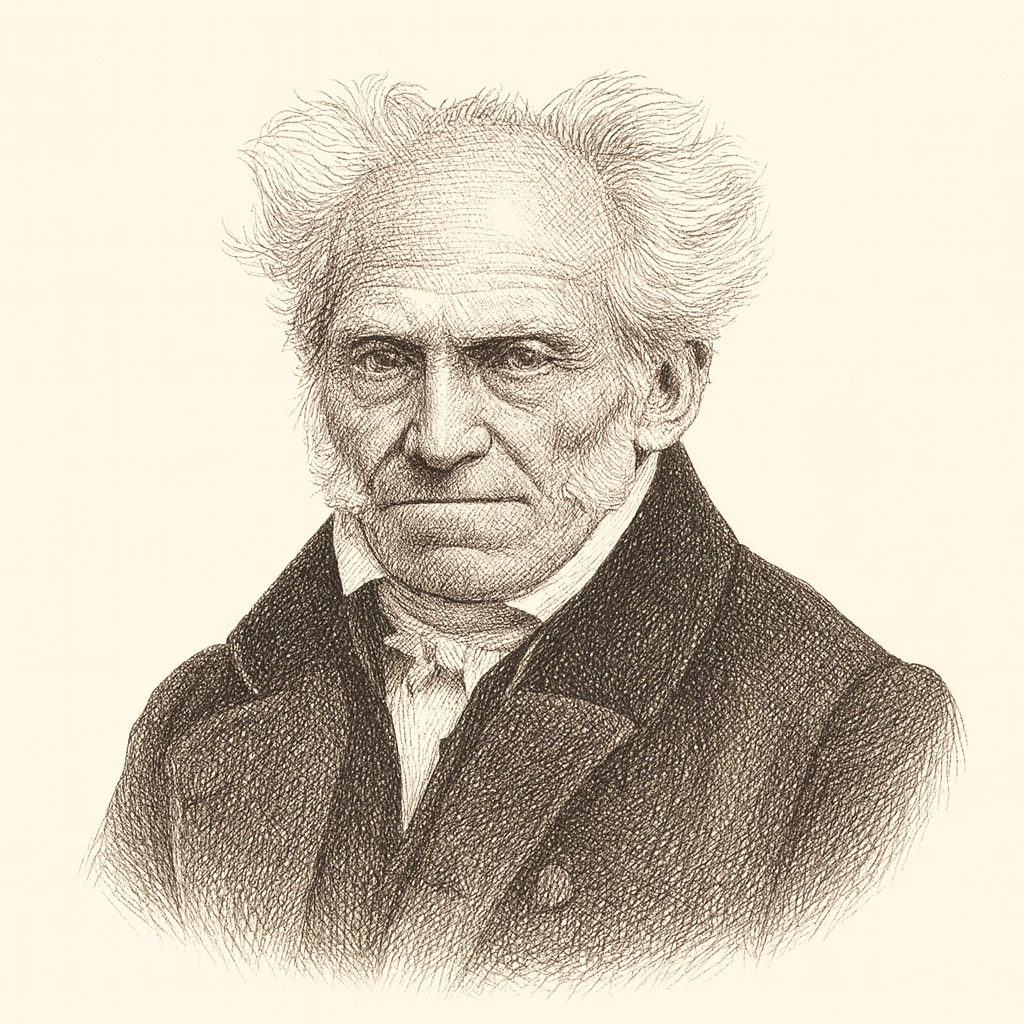
Arthur Schopenhauer was born in 1788 in Danzig — then a free city, now Gdańsk — into a wealthy merchant family whose cosmopolitan culture and financial independence shaped his intellectual development in ways that more bourgeois or more academic circumstances would not have permitted. His father Heinrich Floris Schopenhauer was a committed Anglophile who took the family to England for young Arthur's schooling and who made clear that he expected his son to enter the family trading business. His mother Johanna Schopenhauer, a novelist of some reputation in her day, later established a celebrated literary salon in Weimar where Goethe was a regular presence. The parents' marriage was miserable, and his father's death — possibly a suicide, probably not accidental — when Arthur was seventeen released the boy from the commercial destiny that had been prepared for him and allowed him to pursue the philosophical education he had wanted all along.
He studied in Göttingen and then Berlin, where he attended Fichte's lectures and found them empty — the inflation of German Idealism into mystical sublimity with nothing to show for it — and then in Jena, where he submitted the doctoral dissertation On the Fourfold Root of the Principle of Sufficient Reason (1813) that first stated the epistemological framework he would develop in his major work. He moved to Dresden, where he spent four years in intense work, and completed The World as Will and Representation in 1818. He was twenty-nine. The book was, and is, one of the most systematic and most readable philosophical works in the German tradition — a complete account of reality, knowledge, aesthetics, ethics, and the possibility of human liberation, organized around a single central insight that he stated with unusual directness: the world as we know it is representation, a construction of the knowing mind; the thing-in-itself behind representation is will — not a rational Hegelian will moving toward self-realization through history, but a blind, purposeless, insatiable striving that knows no rest and has no goal.
This was an attack on Hegel, on Enlightenment rationalism, and on all political philosophies that rested on the assumption that human reason could achieve systematic improvement in the human condition. If the fundamental reality behind human life was not reason but will — if desires were endless, satisfaction temporary, and the structure of human psychology guaranteed that the achievement of any goal immediately produced new dissatisfaction — then the progressive philosophies of history that organized liberal, socialist, and nationalist politics alike were fantasies. There was no arc of history bending toward justice. There was will, and suffering, and the question of what to do about them.
He spent his adult life in Frankfurt, having made the most consequential bad bet in the history of academic philosophy: he scheduled his Berlin lectures at the same time as Hegel's in the early 1820s and was humiliated by the attendance differential. He never recovered academically from this competition and never held a university position. He lived on his inheritance, walked his poodles through Frankfurt's streets, ate at the same restaurant at the same table for decades, and wrote. The second edition of The World as Will and Representation appeared in 1844 with substantial additions, and Parerga and Paralipomena in 1851 — a collection of essays in a more accessible style that finally won him a wide readership in the last decade of his life. He became famous at sixty-five, dying in 1860 secure in the recognition that had taken thirty years to arrive.
His political thought was not systematic in the manner of his metaphysics, but its implications were consistent. He held democracy in low regard — majority opinion was merely the pooled ignorance of unreflective people driven by will rather than reason, and democratic politics was therefore the triumph of the mediocre. Nationalism he found absurd — the pride in being born in a particular place was a substitute for genuine individual distinction that people who lacked genuine qualities could nonetheless feel. He was a political quietist: given that suffering was inherent in existence and that political arrangements could not fundamentally alter the human condition, the wisest response to political life was disengagement rather than reform. He supported the Prussian soldiers who put down the Frankfurt uprising of 1848 from his window, offering them his opera glasses.
What gave his pessimism political resonance was the way it undermined the confident rationalism on which liberal and socialist politics depended. Max Weber's diagnosis of modernity as "disenchantment" — the stripping away of religious meaning from a world governed by mechanism and bureaucratic rationality, leaving human beings in the "iron cage" of purposeless efficiency — was deeply Schopenhauerian in its emotional register even where it departed from Schopenhauer's specific framework. Freud's account of the unconscious as a seething reservoir of irrational drives that reason controlled only partially and with constant effort was Schopenhauerian in structure. The whole tradition of depth psychology — the claim that beneath the rational surface of human behavior lay darker forces that philosophy had been too polite to acknowledge — owed Schopenhauer a debt it often failed to acknowledge directly.
Nietzsche's relationship to him was the most dramatic. He described Schopenhauer as his "educator" and read The World as Will and Representation at twenty-one as the book that explained the world to him. He eventually turned against Schopenhauer's conclusion — the recommendation of aesthetic contemplation and ascetic withdrawal as responses to the will — but the Schopenhauerian diagnosis of the problem, the recognition that the will rather than reason was the fundamental reality, remained the foundation from which Nietzsche departed rather than the framework he rejected entirely.
Arthur Schopenhauer is associated with Independent Localist. See the archetype