
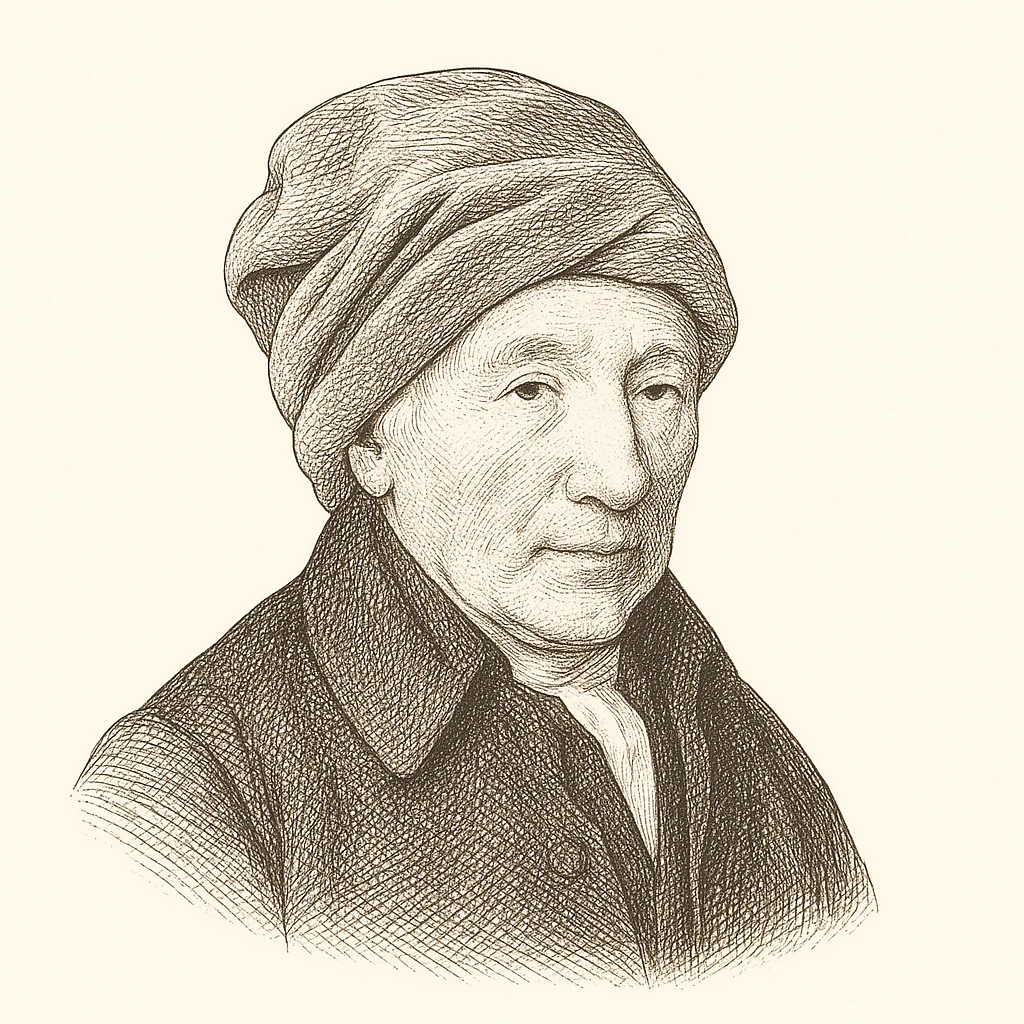
Thomas Reid was a parish minister at New Machar for fifteen years, then a regent at King's College, Aberdeen, and in 1764 succeeded Adam Smith in the chair of Moral Philosophy at Glasgow, which he held for eighteen years. He published almost nothing until he was fifty-four and then produced, across three books over twenty-four years, the most sustained alternative to the epistemology that had dominated European philosophy since Descartes.
Reid's route into philosophy was reading Hume. He said the Treatise dislodged him from opinions he had held without examination, and that he could find no fault in the reasoning — which left the conclusion, that we have no rational warrant for believing in bodies, in causes, or in a continuing self, and that only habit saves us from paralysis. Reid took the argument to be valid and therefore concluded that a premise must be false. The premise he identified was the one nobody had thought to question: the theory of ideas, according to which the immediate object of perception is not the tree but a representation of the tree in the mind. Grant that, he argued, and skepticism follows inexorably, because no comparison between the representation and the thing is ever possible. Descartes, Locke, Berkeley and Hume differ only in how far down the road they were willing to walk.
His alternative is direct realism. In perception the mind is acquainted with the object itself; sensation is a sign that suggests the quality rather than a picture that resembles it. Alongside this he set an account of first principles — that our faculties are not fallacious, that there is a real world, that other minds exist, that the past occurred — which are not conclusions from evidence but the conditions of any evidence counting for anything. To demand a proof of them is to misunderstand what proof is. Reid called these the principles of common sense, and the label has done him damage ever since, suggesting an appeal to the opinions of the plain man rather than what it was: an argument that every philosophical system rests on commitments it cannot itself establish.
He extended the same approach to action in the Essays on the Active Powers, defending an agent-causal account of freedom against the necessitarians. His influence was enormous and largely indirect. Dugald Stewart, his student, made the position the standard teaching of the Scottish universities for a generation; through Stewart it reached the French spiritualists and, through the colleges of Princeton and beyond, became the working philosophy of American academic life well into the nineteenth century.
Wondering where you land? Take the 4-minute assessment