
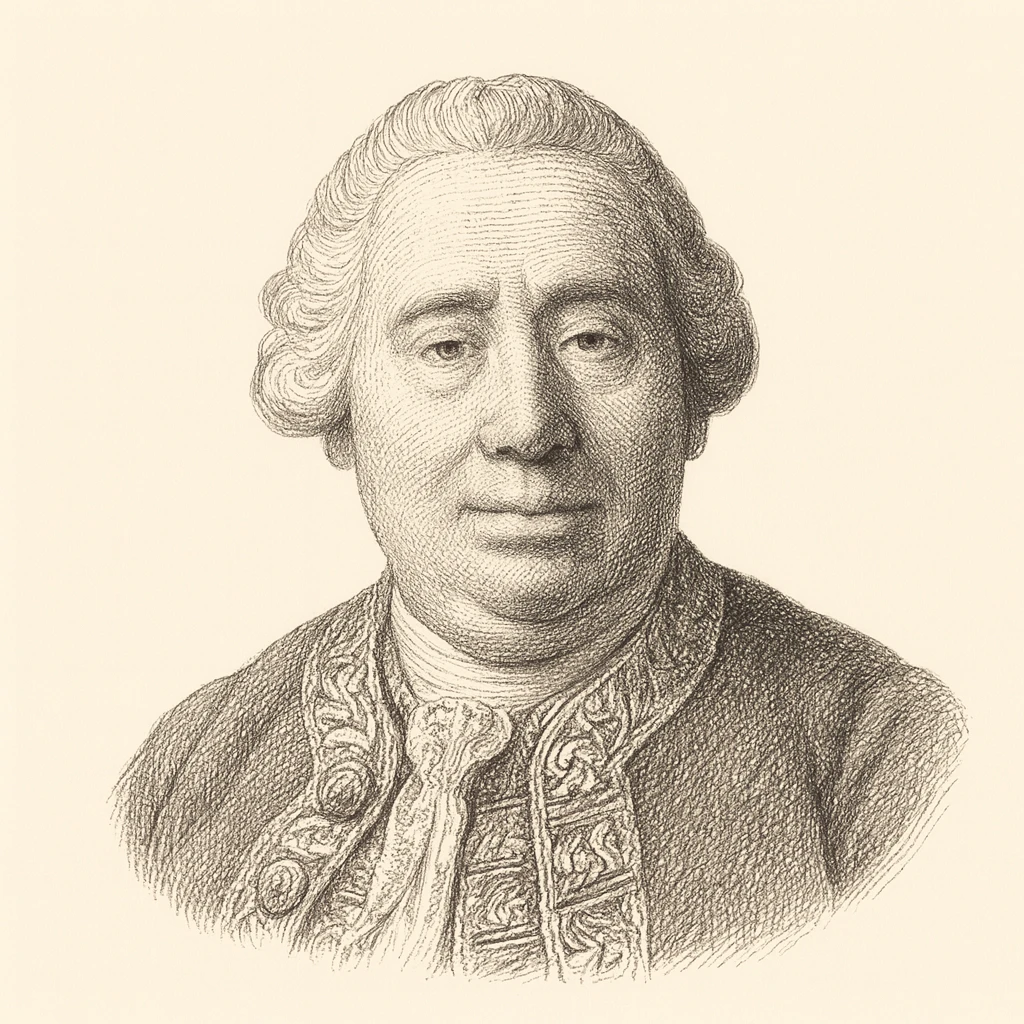
David Hume was, by all accounts, the most cheerful philosopher in the history of philosophy. He was famously generous, witty, beloved by his friends, comfortable at parties, indifferent to honors, and unbothered by the religious orthodoxies he spent his career quietly demolishing. Adam Smith called him "as nearly approaching to the idea of a perfectly wise and virtuous man as perhaps the nature of human frailty will permit." When Hume was on his deathbed, James Boswell visited him hoping to witness a frightened recantation of his religious skepticism, and was disappointed to find Hume calm, cheerful, and looking forward to non-existence with the same equanimity with which he had lived.
Hume was born in Edinburgh in 1711 to a minor Scottish gentry family. He showed early intellectual promise, was sent to the University of Edinburgh at ten, and decided sometime in his teenage years that he wanted to devote his life to philosophy. He made his major intellectual breakthrough between the ages of twenty-three and twenty-six, in a small French town called La Flèche, where he wrote A Treatise of Human Nature, the book that contained almost all the philosophical positions for which he is now famous. He published it anonymously in 1739, expected it to make him famous, and was crushed when it sank without making any impression. He spent the next thirty years recovering from that disappointment, eventually finding success not as a philosopher but as a historian — his multi-volume History of England was a bestseller for decades after his death.
The philosophical work Hume thought was a failure turned out to be one of the most important books in the history of Western thought. The Treatise is best known for two arguments. The first is Hume's analysis of causation: when we say that one event causes another, what we actually observe is just one event followed by another. The "necessary connection" we imagine between cause and effect is not something we perceive in the world, it's something our minds add through habit, after experiencing similar sequences many times. This was a devastating result for the rationalist tradition that had been trying to ground science in self-evident causal principles. The second is Hume's distinction between facts and values, sometimes called "Hume's guillotine": you cannot derive an "ought" from an "is." No accumulation of factual claims about the world can produce a moral conclusion without smuggling in some additional moral premise. This argument has shaped almost all subsequent moral philosophy.
Hume's political philosophy is less famous than his metaphysics and epistemology, but it's deeply consequential. He rejected the social contract framework that Hobbes and Locke had developed, on the grounds that no actual society had ever been founded by an explicit contract among free individuals — the framework was a myth, and a myth that obscured how political authority actually develops. Real political legitimacy, Hume argued, comes from custom, habit, and the gradual accumulation of practices that have proven workable over time. We obey governments not because we have rationally consented to them but because we have grown up under them, because they generally work, and because the alternatives are usually worse. This was a deeply conservative claim in some ways, giving existing institutions a presumption of legitimacy that the social contract tradition had withheld, but it was also liberal in its commitment to gradual reform and its skepticism of grand revolutionary projects.
Hume also developed an account of moral judgment grounded in sentiment rather than reason. We don't reason our way to moral conclusions, Hume thought; we feel them. When we see an act of cruelty, our disapproval is an immediate emotional response, not the conclusion of a syllogism. Adam Smith, Hume's closest friend, would later build his own moral philosophy directly on this Humean foundation.
Hume died in Edinburgh in 1776 at sixty-five. His friend Smith published a moving account of his final days, emphasizing his courage and serenity in the face of death — a deliberate provocation to the Christian readers who had expected someone with Hume's beliefs to die in terror. Hume's influence on subsequent philosophy is hard to overstate. Kant credited Hume with awakening him from his "dogmatic slumber." The entire tradition of analytical philosophy in the 20th century works in Hume's shadow. And anyone who has ever wondered how to ground morality and politics without appealing to God, eternal Forms, or self-evident reason is grappling with the questions Hume put on the table.
David Hume is associated with Classical Liberal. See the archetype