
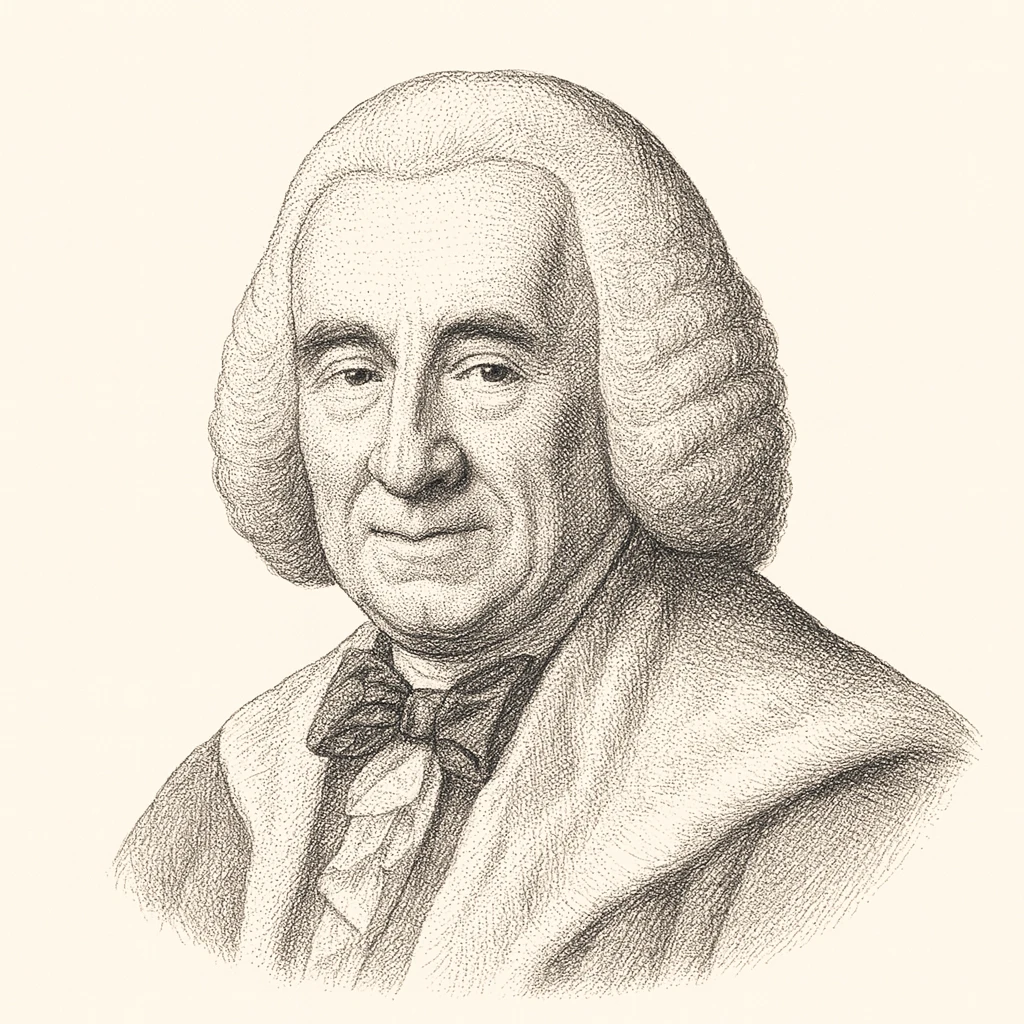
Henry Home took his judicial title, Lord Kames, on his elevation to the Court of Session in 1752, and it is the name he wrote under for thirty years. He came to the bar late and without money, made himself one of the most heavily employed advocates in Scotland, and then used the security of the bench to publish across law, morals, criticism, agriculture and the history of society — a range that looks scattered until one notices that the same question runs through all of it.
The question is where institutions come from. Kames's answer, developed across the Historical Law-Tracts of 1758 and the Sketches of the History of Man of 1774, is that they are not the deductions of reason from first principles but the deposits of a long process, and that the process has a recognizable shape. Societies pass through stages defined by how they get their living — hunting, herding, farming, commerce — and property, law, government and manners take a different form at each. A rule that looks arbitrary in the abstract becomes intelligible once one knows which stage produced it, and legal reform is therefore a matter of asking whether the conditions that generated a rule still obtain.
This is the stadial theory, and it became the organizing device of Scottish social thought. Smith used it in the Glasgow lectures on jurisprudence, Millar built the Distinction of Ranks on it, Robertson structured his history of Europe around it, and Ferguson worked with a version of it in the Essay on the History of Civil Society. Kames was not its sole author — the idea was in the air, and Montesquieu had supplied much of the impulse — but he pressed it earliest and hardest into the specific material of law.
He was also, by any accounting, the great patron of the period. He was a distant kinsman of Hume and his early mentor, pushing his work and defending him even while disagreeing with his conclusions. He supported Smith's first public lectures in Edinburgh in the late 1740s, which secured Smith's reputation before he held any post. He encouraged Millar, whom he recommended to the Glasgow chair, and he corresponded with almost everyone else. His own philosophical positions were unstable and sometimes eccentric — he defended a version of necessity while insisting on the practical necessity of believing in free will, and his Elements of Criticism tried to ground aesthetic judgment in the constitution of the mind — but his effect on the period was less through his doctrines than through his insistence that human arrangements have histories that can be reconstructed.
Wondering where you land? Take the 4-minute assessment