
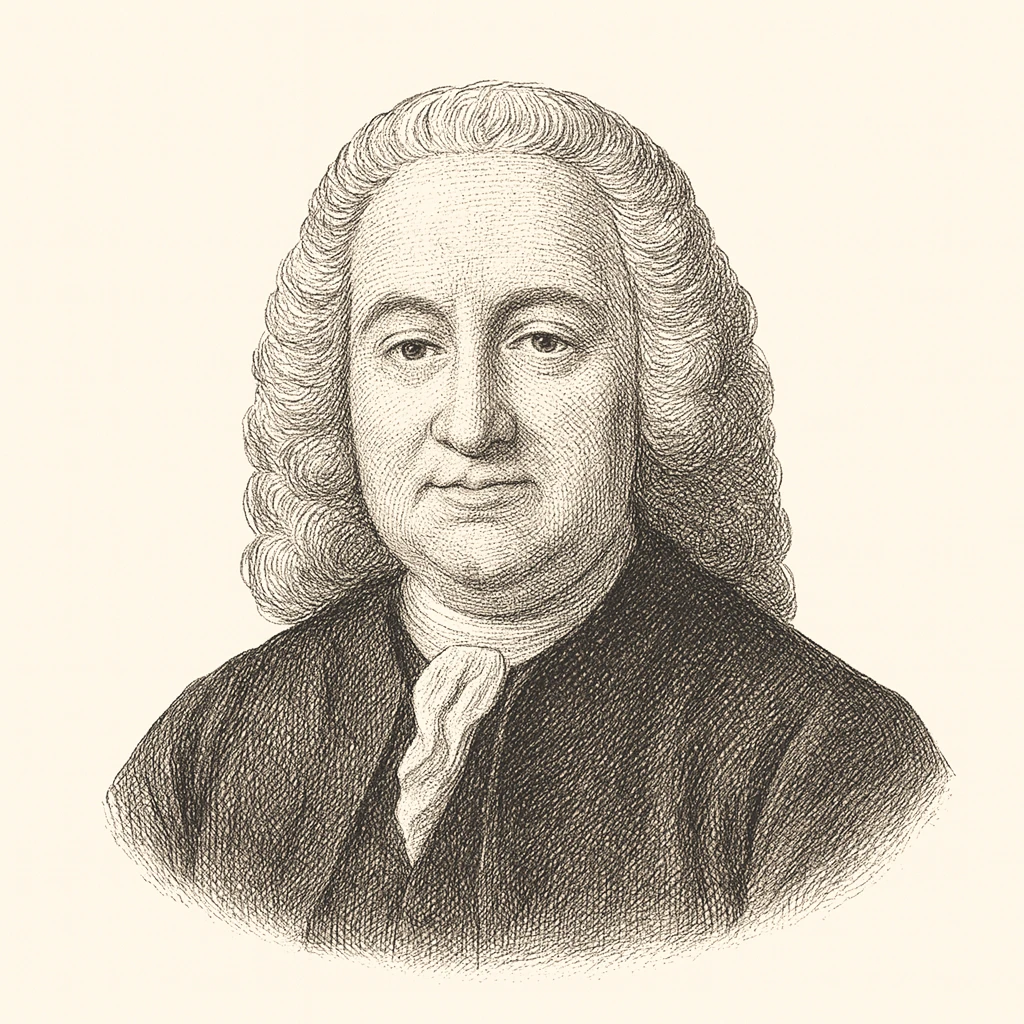
Francis Hutcheson was born in Ulster to a family of Scottish Presbyterian ministers, trained at Glasgow, and ran a dissenting academy in Dublin before returning to Glasgow in 1730 as Professor of Moral Philosophy. He held the chair until his death, and what he did with it shaped everything that followed. He lectured in English rather than Latin, which was still unusual, and he lectured on a syllabus that treated moral philosophy as a subject with its own evidence rather than as a branch of theology.
His central claim is that human beings possess a moral sense — a faculty that responds to benevolence with approval as immediately and involuntarily as the eye responds to color. The argument was directed against two opponents at once. Against Hobbes and Mandeville, who reduced apparent virtue to disguised self-interest, Hutcheson held that we approve of generous action even when we have no stake in it whatever, including in strangers, in history, and in fiction. Against the rationalists, who made morality a matter of demonstration, he held that no chain of reasoning ever moved anyone to act; something must already be attractive before reason can find means to it. Both arguments turn on the same observation, that moral response precedes moral argument and cannot be derived from it.
From that premise he drew a political conclusion sharper than his temperament suggests. If benevolence is the criterion, then the measure of an institution is how much good it produces and for how many, and in the Inquiry of 1725 he wrote that the best action is the one procuring the greatest happiness for the greatest numbers. The formula would become the slogan of a movement he would have disliked; Bentham built a calculus on it, stripped of the moral sense that had generated it. Hutcheson also held that political authority is a trust rather than a possession, that a people retains the right to resist a ruler who breaks it, and — unusually for his moment — that slavery cannot be made legitimate by any contract, because no one can alienate what is not property to begin with.
His influence ran through his students more than his books. Adam Smith attended his lectures at fourteen and later called him the never-to-be-forgotten Hutcheson, one of very few people Smith praised without qualification; the impartial spectator of the Theory of Moral Sentiments is recognizably a disciplined version of the moral sense. Hume, though he disagreed with him and was blocked from a chair partly by Hutcheson's opposition, took the anti-rationalist half of the argument and pressed it much further. Through the Irish and American dissenting academies his System of Moral Philosophy reached the colonies, where his account of resistance to broken trust was read closely in the 1760s and 1770s.
Wondering where you land? Take the 4-minute assessment