
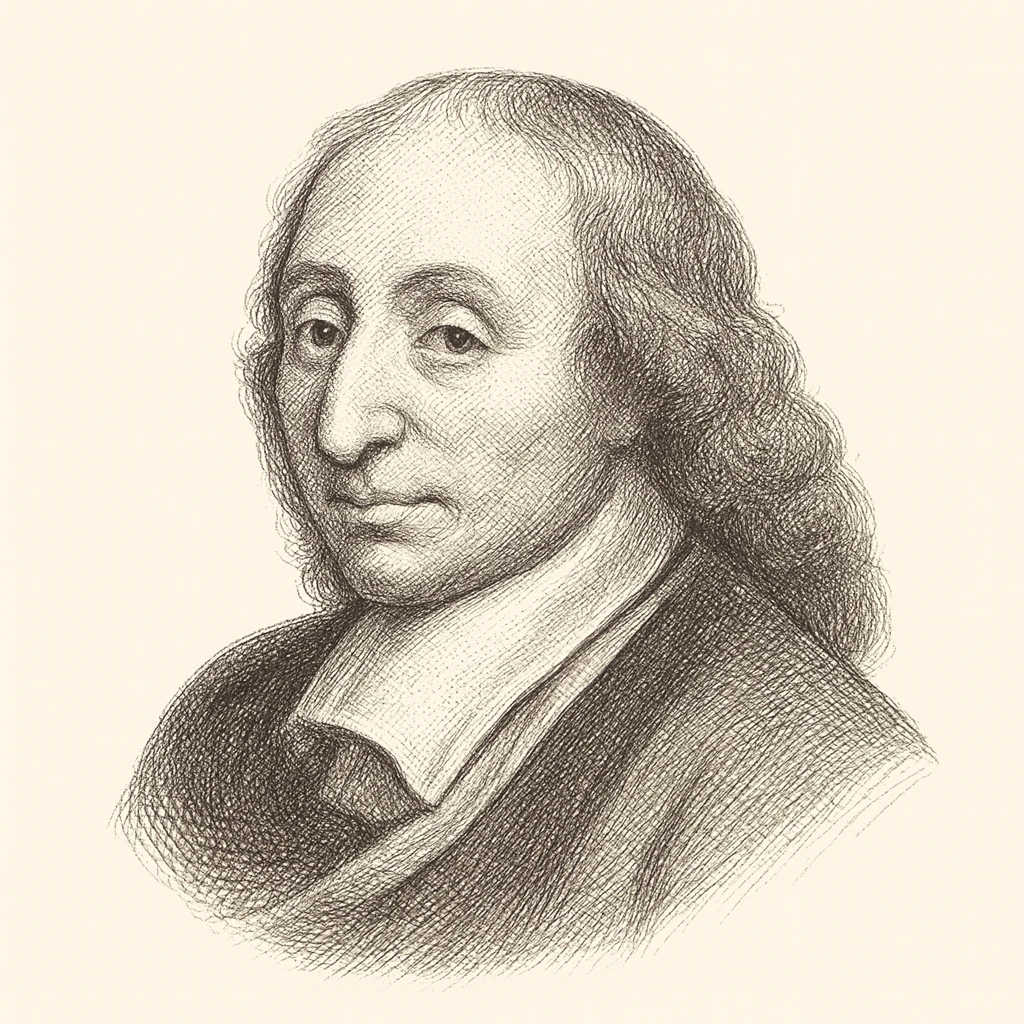
Blaise Pascal invented a calculating machine at nineteen, established the existence of the vacuum against Aristotelian physics, and with Fermat founded the mathematical theory of probability. In 1654 he had a religious experience he recorded on a scrap of parchment sewn into his coat and worn for the rest of his life, and thereafter wrote almost nothing that was not in some sense about God. He died at thirty-nine.
The Provincial Letters, published pseudonymously in 1656-57 during the campaign against Port-Royal, are eighteen letters attacking Jesuit moral casuistry — the doctrines of probabilism and mental reservation by which, Pascal argued, almost any act could be excused. They are devastating because they are funny: he quotes his opponents at length and lets them convict themselves. Voltaire, who agreed with none of his conclusions, said the letters were the first work of genius in French prose, and the word Jesuitical still carries the charge Pascal put on it.
The Pensées are fragments for an unfinished apology for the Christian religion, and their strategy is not to prove anything. Pascal thought the metaphysical proofs of God worthless — remote from human reasoning and forgotten an hour later. Instead he anatomizes the human condition: the wretchedness of a creature who cannot sit quietly in a room, who pursues diversion to avoid thinking about death, who is a thinking reed, feeble but aware of it, and whose reason is perpetually undermined by imagination, custom and self-love. The heart has its reasons which reason does not know. Only after establishing that the human situation is genuinely desperate does he offer Christianity as the only account that explains both our greatness and our misery.
The wager belongs to this strategy: addressed to someone who accepts that reason cannot decide the question, it argues that the stakes make belief the rational bet, and that one should proceed as if believing until belief follows. It is the first serious use of decision under uncertainty in philosophy.
On politics he is unillusioned to the point of bleakness: justice is unenforceable and force is unjust, so men have made what is strong just, and custom is obeyed only because it is custom. Being unable to make what is just strong, we made what is strong just.
Wondering where you land? Take the 4-minute assessment