
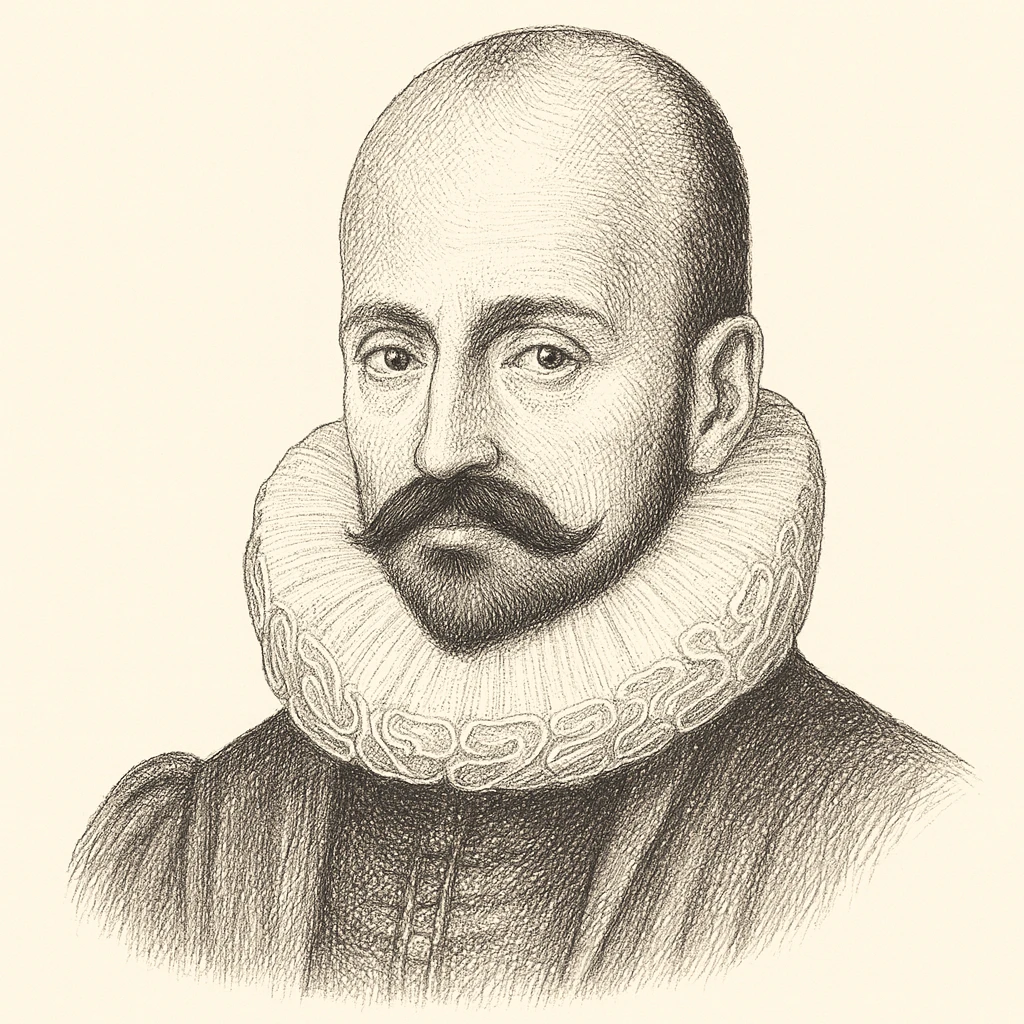
Michel de Montaigne retired from the Bordeaux parlement at thirty-eight to a tower on his estate, intending solitude, and produced a book that has no precedent: essais, attempts, in which a man of no special distinction examines his own opinions, tastes, fears, digestion and inconsistency at length, on the premise that each man bears the entire form of the human condition.
The method is inseparable from the skepticism. The longest chapter, the Apology for Raymond Sebond, is a sustained demolition of the pretensions of human reason, drawing on Sextus Empiricus, whose newly translated Outlines Montaigne had read: the senses deceive, the beasts may reason as well as we do, philosophers contradict each other on everything, custom governs what we take for nature, and our certainties are accidents of where we were born. His motto was a question — what do I know — and his emblem a balance. But the conclusion is not despair. It is that one should hold opinions loosely, follow custom in practice because it is where one is, and attend to what is actually in front of one.
Writing through the same religious wars as Bodin, he drew a different lesson. It is putting a very high value on one's conjectures, he wrote, to roast a man alive on account of them. The essay on cannibals compares the Brazilian practice of eating dead enemies with the French practice of torturing living ones and finds the French worse, then observes that everyone calls barbarism whatever is not his own custom. This is the first sustained European argument that difference is not deficiency, and it runs directly into the Enlightenment case for toleration.
His influence is unusually wide because he does not argue systematically enough to be refuted. Shakespeare read him in Florio's translation; Descartes wrote the Meditations to answer the skepticism he had helped revive; Pascal wrestled with him for years; Rousseau took from him the confessional voice; Nietzsche said that such a man had increased the joy of living on earth. The genre he invented remains the standard vehicle for thinking in public.
Wondering where you land? Take the 4-minute assessment