
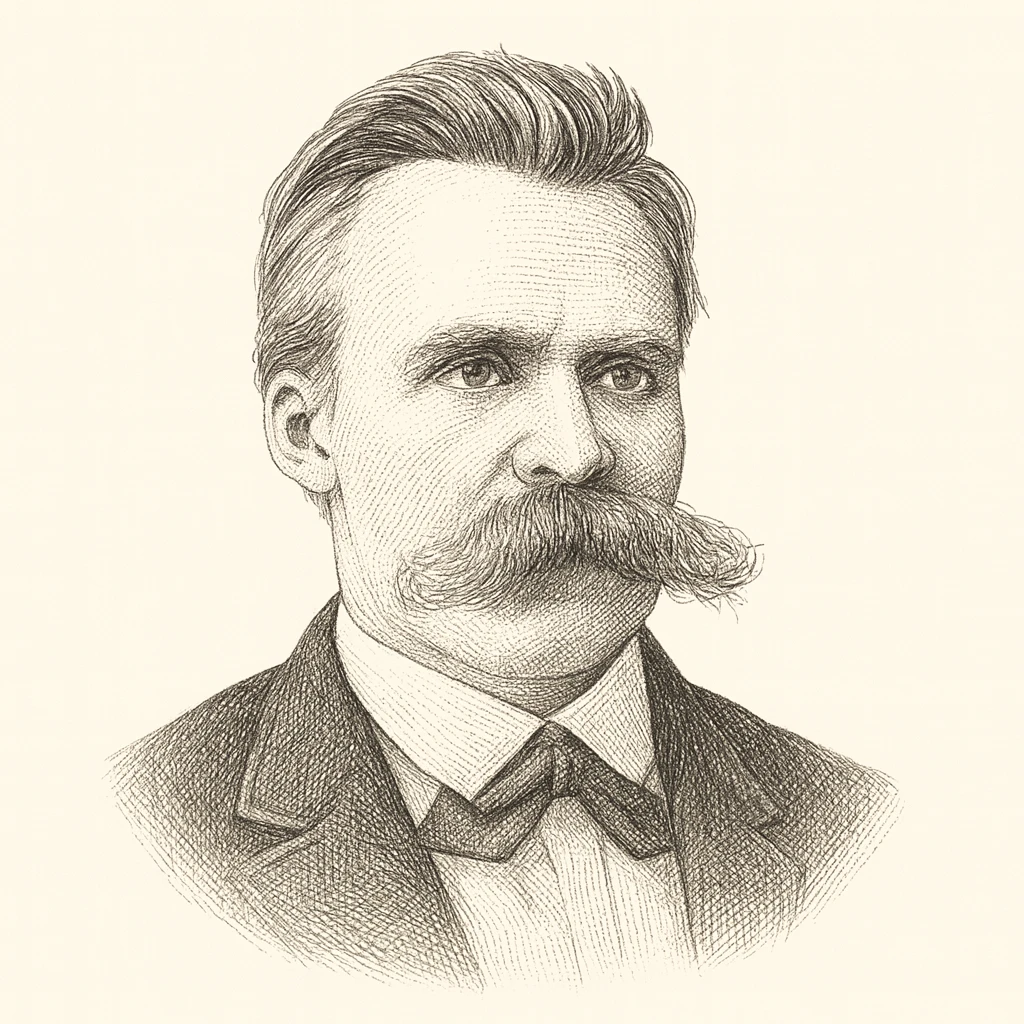
Friedrich Nietzsche is one of the most contested figures in the history of Western philosophy, and the contestation is fundamentally interpretive rather than political. Almost every major intellectual movement of the 20th century has claimed him: existentialists, postmodernists, Nazis, individualists, anarchists, conservatives, transhumanists, libertarians, leftists. He has been read as a proto-fascist and as the philosopher who would have despised fascism above all things. He has been read as the prophet of nihilism and as the philosopher who tried hardest to overcome it. The only thing all these readings have in common is that the reader keeps reaching for Nietzsche when they want to think about what's wrong with modernity and what might replace it.
Nietzsche was born in 1844 in a small Prussian village to a Lutheran pastor who died when Nietzsche was four. He was raised by his mother, sister, and grandmother in a household of pious women. He showed extraordinary intellectual promise, became a professor of classical philology at the University of Basel at twenty-four, the youngest person ever appointed to such a position, and seemed set for a conventional academic career. Then he discovered the music of Richard Wagner, befriended the composer, and wrote his first book, The Birth of Tragedy (1872), which was so unusual and so philosophically ambitious that his classical philology colleagues mostly disowned it. His academic career started to unravel. By 1879, plagued by chronic illness and increasingly out of step with his discipline, Nietzsche resigned his professorship and spent the next decade as a wandering intellectual, living in cheap boarding houses across Switzerland, Italy, and France, writing the books that would make him famous after he had lost the ability to know it.
Nietzsche's central project was the attempt to understand and overcome what he called the "death of God." He didn't mean this as a celebration of atheism. He meant it as a diagnosis: the European cultural framework that had been built on Christian foundations was collapsing, and almost no one had grasped how dangerous the collapse was going to be. Christianity had given European civilization its moral vocabulary, its sense of meaning, its hierarchy of values, its account of what made human life worth living. As Christianity lost its grip on educated Europeans in the 19th century, Nietzsche thought, the entire edifice of Western values was being hollowed out — but the values themselves were so deeply ingrained that people kept living by them without any of the foundations that had supported them. The result, Nietzsche predicted, would be either nihilism (the recognition that nothing matters) or a desperate attempt to find new foundations to replace the old ones. The 20th century's catastrophes were, in Nietzsche's view, exactly the kind of thing the death of God was going to produce.
The response Nietzsche developed across his major works — Thus Spoke Zarathustra (1883-1885), Beyond Good and Evil (1886), On the Genealogy of Morality (1887) — was a sustained attack on Christian morality and an attempt to imagine what could replace it. He thought Christian morality was a "slave morality" that had inverted the older "master morality" of pre-Christian aristocratic societies, valorizing weakness, meekness, and submission as virtues precisely because the people developing the morality were weak. He called for a transvaluation of values — a deliberate creative project of building new value systems that would affirm life, strength, creativity, and self-overcoming. The figure he proposed as the goal of this project was the Übermensch (usually translated as "overman" or "superman"), a being who would create new values for a post-Christian world rather than passively accepting inherited ones.
The interpretive disputes about Nietzsche center on what to make of all this. He hated democracy, hated socialism, hated mass politics, hated nationalism (especially German nationalism), hated antisemitism, hated his sister's antisemitic husband, hated almost everything that the 20th century would do in his name. After Nietzsche's mental collapse in 1889 — he never recovered, spent his last decade in his sister's care, and died in 1900 — his sister Elisabeth edited his unpublished notes into a book called The Will to Power, distorted his ideas to align with her own German nationalist and antisemitic views, and successfully marketed the result to the rising fascist movements of the early 20th century. The Nietzsche the Nazis claimed was substantially Elisabeth's invention. The actual Nietzsche, by every reliable account, would have been horrified.
But Nietzsche is ambiguous in ways that make these distortions possible. He really did despise democracy and equality. He really did call for a hierarchy of values. He really did write things about violence, struggle, and the cruelty of nature that can be read as endorsements rather than diagnoses. He was a brilliant and provocative writer who frequently said outrageous things to provoke his readers, and many of those things have been quoted out of context for over a century to support political projects he would have rejected. Reading Nietzsche carefully means accepting the ambiguity rather than resolving it in either direction. He is one of the great philosophical critics of modernity. He is also a thinker whose actual political conclusions, if you take them seriously, lead nowhere good. Both things are true at once.
Friedrich Nietzsche is associated with Independent Localist. See the archetype