
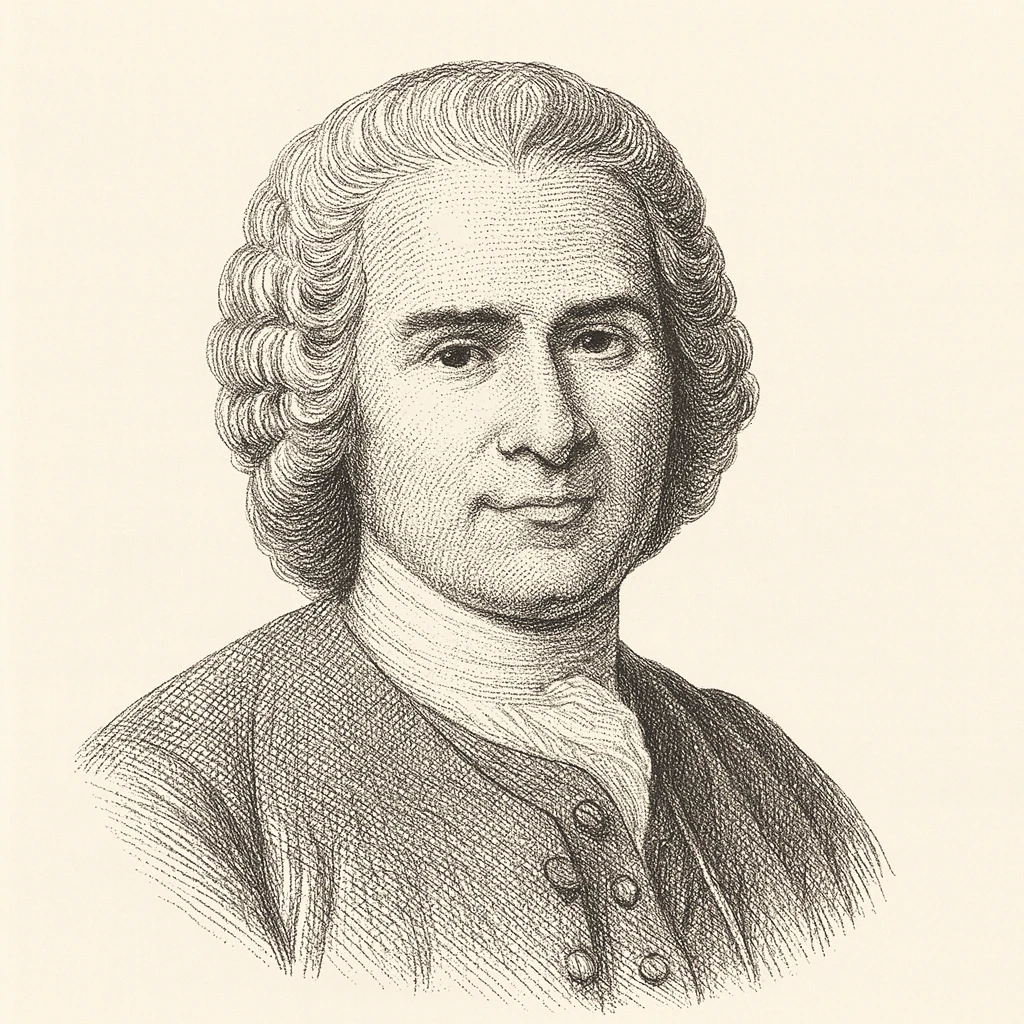
Jean-Jacques Rousseau was the strangest, most original, and most personally chaotic of the major Enlightenment philosophers. He was born in Geneva in 1712, lost his mother in childbirth, was abandoned by his father at ten, ran away from his apprenticeship at sixteen, and spent the next decade wandering Europe as a tutor, secretary, music copyist, and intermittent vagabond. He had no formal philosophical training. He taught himself by reading voraciously and arguing with himself in the margins of books. When he finally broke into the Paris intellectual scene in his late thirties, he did it by winning a prize essay competition on the question of whether the progress of arts and sciences had improved human morals. His answer — emphatically no, and the supposed progress of civilization was actually making human beings worse — launched a career and a movement.
Rousseau's central insight, the one that runs through everything he wrote, is that human beings are born good and are made bad by society. In the state of nature, Rousseau imagined, primitive humans lived solitary lives in the forests, eating what they could find, mating without complication, fearing nothing in particular, and feeling neither pride nor shame because there was no one to compare themselves to. They were neither virtuous nor vicious, just naturally good in the way animals are naturally good — content with what they had because they had no concept of what they didn't have. The corruption began when human beings started forming communities, comparing themselves to one another, developing private property, accumulating wealth, and creating the elaborate social hierarchies that turned natural self-love into vanity, envy, and resentment.
This was a radical departure from Hobbes, who had imagined the state of nature as a war of all against all. Where Hobbes thought civilization saved us from our natural cruelty, Rousseau thought civilization created the cruelty in the first place. The implications were enormous. If society itself was the source of human misery, then no amount of reform within existing institutions would fix the problem. What was needed was a much more radical reimagining of how human beings could live together — one that recovered, as far as possible, the freedom and equality of the natural state while gaining the benefits of cooperation and culture.
Rousseau's Social Contract (1762) was his answer to that challenge. Like Hobbes and Locke, he framed the question in terms of the contract by which free individuals form political society. Unlike them, he argued that the only legitimate sovereign was the people themselves, acting collectively through what he called the "general will" — a kind of common purpose that transcended individual interests and represented what the community as a whole actually needed. Citizens who participated in forming the general will were not surrendering their freedom; they were exercising it more fully, because they were obeying laws they themselves had made. The famous and controversial line from the book — "Man is born free, and everywhere he is in chains" — captures the gap between what Rousseau thought human beings could be and what they had been made into by the existing social order.
Rousseau's influence on the French Revolution was immense. Robespierre and his Jacobin allies invoked Rousseau constantly, treating The Social Contract as something close to a sacred text. The general will, in their hands, became the justification for the Terror — the argument that the revolutionary government was carrying out the people's true will even when most actual people were trying to escape the guillotine. Whether this was a fair reading of Rousseau is one of the most contested questions in the history of political thought. Rousseau himself died in 1778, eleven years before the Revolution began, and there's no way to know what he would have thought of it. But the connection between his ideas and the Revolution's worst excesses has shaped how every subsequent reader has approached him.
Rousseau also wrote on education (Emile), on autobiography (Confessions, one of the founding works of the modern memoir), and on music. He spent his last years increasingly isolated, paranoid, and bitter, convinced that his former friends in the Paris intellectual establishment were conspiring against him. He died in 1778 at sixty-six, in obscurity and misery. Within a generation, his ideas would help reshape Europe.
Jean-Jacques Rousseau is associated with Democratic Socialist. See the archetype