
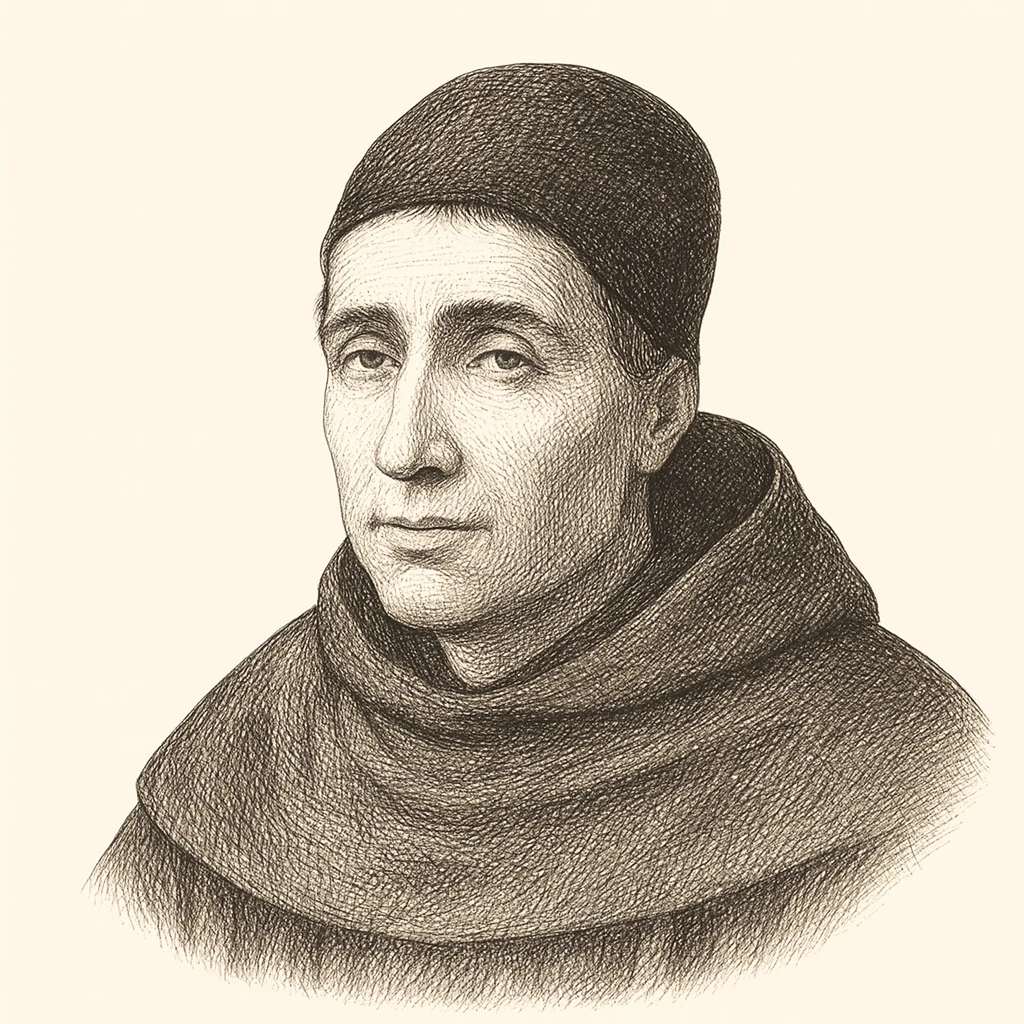
John Duns Scotus was a Franciscan from the Scottish borders who taught at Oxford, Paris and Cologne and died at forty-two, leaving work in a state his students spent decades sorting out. He was called the Subtle Doctor for the fineness of his distinctions; the sixteenth century, out of patience with them, made his name into the word dunce.
Three of his positions changed the shape of later thought. The first is the univocity of being: against Aquinas, who held that being is said of God and creatures only by analogy, Scotus argued that the concept must be univocal — the same in sense — or no argument from creatures could reach God at all, since the middle term would shift meaning. This is a technical point with enormous consequences, and much of the later story of metaphysics, including the complaint that Western thought reduced God to an item within being, traces to it.
The second is haecceity, thisness: the principle by which an individual is this individual and not merely an instance of a kind. Scotus insisted that individuality is a positive perfection, not a limitation imposed by matter. The result is a metaphysics in which the particular is more real, not less, than the universal.
The third is the priority of will. For Scotus the will is not determined by the intellect's judgment of what is best; it is self-determining, and a rational appetite is precisely one that can choose otherwise in the same circumstances. He extends this to God: the moral law, apart from the precepts of the first table that follow from the divine nature itself, is what God wills rather than something God recognizes. Obligation depends on a command, not merely on the structure of things.
That last move is where his political importance lies. If law is at bottom an act of will by a competent authority, then legal positivism has a theological ancestor, and the natural-law tradition acquires a rival within itself that it has never fully absorbed. Ockham pushed the voluntarist line further; through the Franciscan poverty controversy Scotus's account of rights as claims belonging to persons fed into the subjective language of rights that Grotius and Locke inherited.
Wondering where you land? Take the 4-minute assessment