
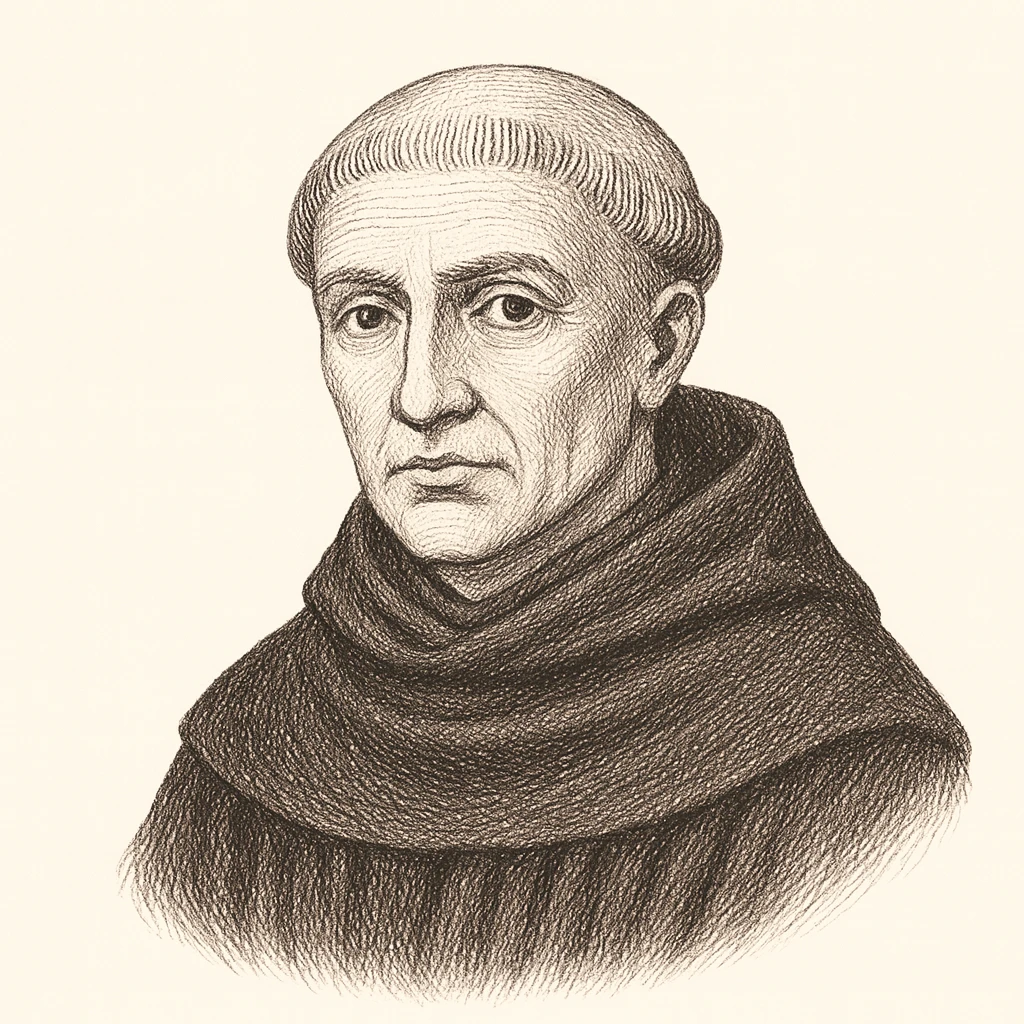
William of Ockham was a Franciscan who studied at Oxford, was summoned to Avignon in 1324 to answer for his opinions, was asked while there to examine the papal pronouncements on Franciscan poverty, concluded that the pope was a heretic, and fled to the protection of the Holy Roman Emperor. He spent the last twenty years of his life writing against the papacy from Munich. Defend me with the sword, he is said to have told the emperor, and I will defend you with the pen.
His philosophical position is nominalism, and the razor named after him is one expression of it: plurality is not to be posited without necessity. What exists is individuals; universals are not things, nor common natures shared out among particulars, but concepts — natural signs in the mind that stand for many individuals at once because of their resemblance. There is no need to postulate an extra entity to explain why several things are called by one name. The effect on the philosophy of language and knowledge was profound: Ockham developed a theory of mental language and of supposition that made logic a matter of how terms function rather than of what forms they mirror, and the epistemology that follows is one in which knowledge begins with intuitive cognition of particular things. The path from here to Locke's rejection of innate ideas is not straight, but it is real, and later empiricism inherited a world already emptied of common natures.
The political writings came out of the poverty dispute and went far beyond it. If Christ and the apostles held nothing as property, and if the pope has declared this doctrine heretical, then a pope can err — and if a pope can err, the fullness of power claimed for the office is not what it says it is. Ockham argues that the pope's authority is ministerial and limited, given for the good of the faithful and forfeit if used to their harm; that a general council, or even a single faithful person holding the truth, may stand against him; and that secular government derives its legitimacy from the community it governs, not from the church, which has no title to depose princes.
The combination — individuals rather than universals, consent rather than hierarchy, office as trust rather than possession — made him one of the most quarried authors of the late Middle Ages, by conciliarists, by Luther, and by every later argument that authority is answerable to those it exists for.
Wondering where you land? Take the 4-minute assessment