
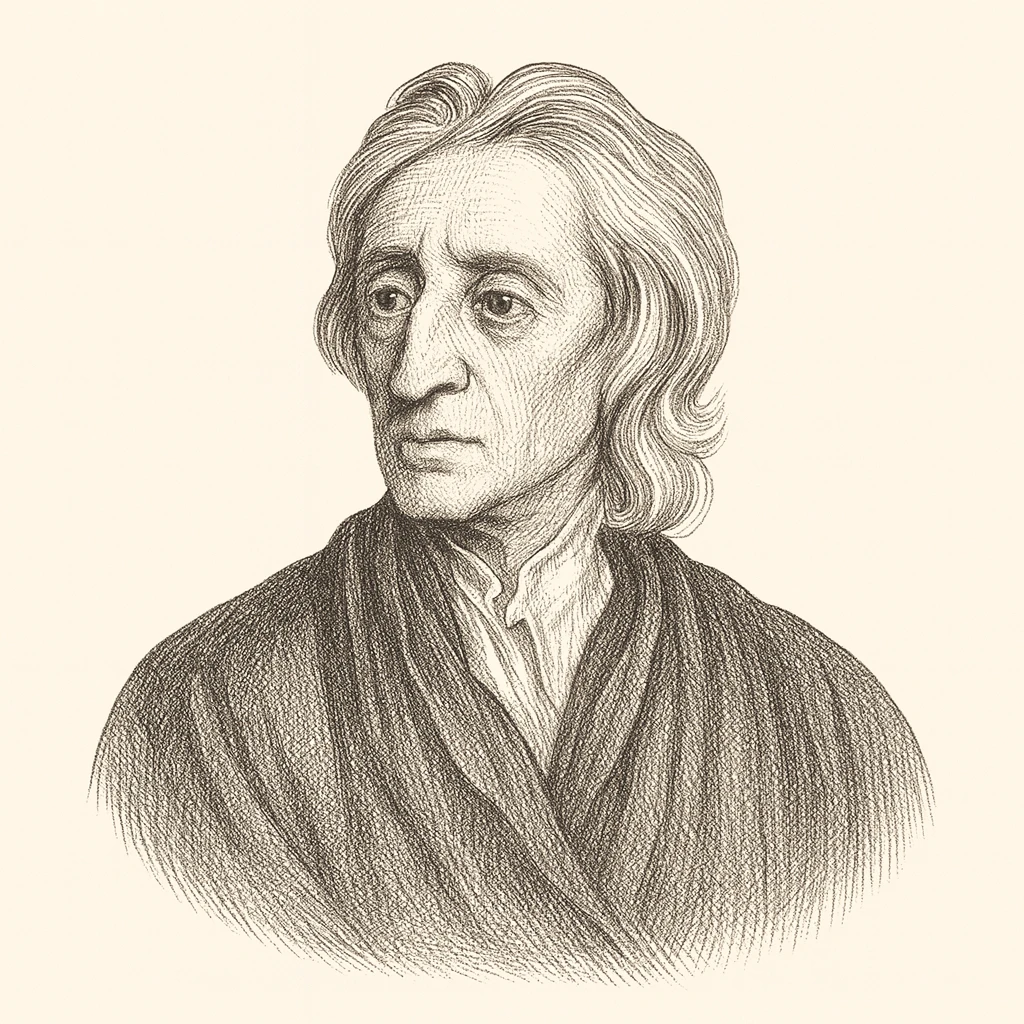
John Locke wrote the philosophical script that the American Founders later acted out. When Thomas Jefferson sat down in 1776 to draft the Declaration of Independence, the phrases that came to him — "life, liberty, and the pursuit of happiness," "consent of the governed," "the right of the people to alter or abolish" — were paraphrases of Locke, written nearly a century earlier in his Second Treatise of Government. Locke is the philosopher whose ideas became the operating system of liberal political institutions.
Locke spent the first half of his career as a physician, secretary, and political adviser, navigating the chaos of 17th century English politics from inside the household of the Earl of Shaftesbury, one of the country's leading Whig politicians. When Shaftesbury fell from power and was tried for treason, Locke fled to the Netherlands and spent six years in exile, writing the books that would make him famous. He returned to England after the Glorious Revolution of 1688 deposed James II — the political event that vindicated everything Locke had been arguing about consent, resistance, and legitimate government.
Locke's Two Treatises of Government (1689) made an argument that seems obvious today only because Locke made it so successfully: governments derive their authority from the consent of the people they govern, not from divine right or hereditary entitlement. Human beings, Locke argued, have natural rights to "life, liberty, and property" that exist independently of any government — rights that any legitimate government must protect rather than violate. When a government persistently violates those rights, the people retain the right to overthrow it. This was a radical position in 1689 and a foundational one by 1789.
What gets forgotten about Locke is how much of his energy went into defending property rights specifically. The famous "life, liberty, and property" formulation is Locke's; Jefferson's substitution of "pursuit of happiness" was a softening. For Locke, the right to property wasn't a secondary concern but a central pillar of his political philosophy, grounded in his theory that human beings own their own labor and therefore own whatever they "mix" their labor with. This argument made Locke enormously useful to later defenders of capitalism and enormously contested by later critics of it.
Locke was also one of the founders of modern empiricist philosophy. His Essay Concerning Human Understanding (1689) argued that the human mind at birth is a tabula rasa — a blank slate — and that all knowledge comes from experience. This was a direct challenge to the rationalist tradition that held some ideas were innate, and it shaped centuries of subsequent epistemology. The Locke who wrote about politics and the Locke who wrote about knowledge were the same person making the same fundamental move: trusting human experience and human reason over received authority.
Locke died in 1704 at the home of friends in Essex, having lived to see the early outlines of the political order his ideas would come to dominate. He never married, never held high office, and spent most of his life in poor health. His influence on the next three centuries of liberal political thought is rivaled only by a handful of figures — and arguably, on the specific question of what makes a government legitimate, no one has ever exceeded him.
John Locke is associated with Classical Liberal. See the archetype