
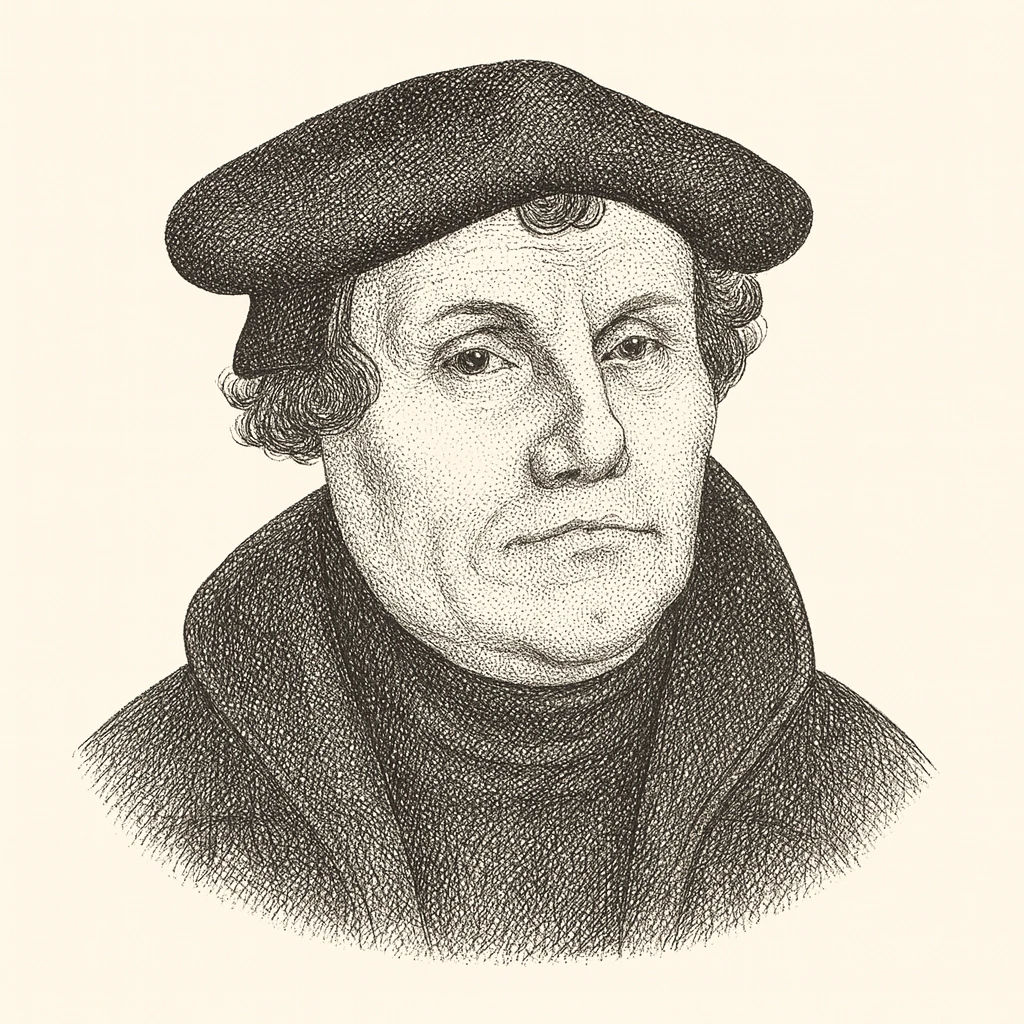
Martin Luther was born in 1483 in Eisleben, in the county of Mansfeld in Saxony, the son of Hans Luder, a copper miner who had risen to become a smelter and small investor in mining operations, and Margarethe Lindemann. His father had modest but genuine social ambitions for his son: Luther was educated at the Latin schools of Mansfeld and Eisenach and then enrolled at the University of Erfurt in 1501, where he studied the trivium and quadrivium of the medieval curriculum and then began legal studies — the path to the administrative and juridical career that his father had in mind. The father's plans were ended in July 1505, when Luther, returning to Erfurt from a visit home, was caught in a violent thunderstorm near Stotternheim. He threw himself to the ground and cried out to Saint Anne — the miners' patron — "Help me, Saint Anne! I will become a monk." He entered the Augustinian Hermits' monastery in Erfurt fifteen days later.
The monastery gave him the theological education and the spiritual crisis that produced the Reformation. He was ordained in 1507, completed his doctorate in theology in 1512, and took the chair in biblical theology at the newly founded University of Wittenberg, which he would hold for the rest of his life. His spiritual crisis — the inability to achieve the certainty of God's grace that the medieval penitential system was supposed to provide, the conviction of his own unworthiness that no amount of confession and penance could resolve — produced the breakthrough he later described as his "tower experience": the sudden recognition, while preparing lectures on Paul's letter to the Romans, that "the righteousness of God" was not the attribute by which God punished sinners but the attribute by which God, through faith, made sinners righteous. Justification was by faith alone, not by works — not by the merit-earning activities that the Church's system of indulgences, penances, and masses presupposed. The recognition transformed his theology and eventually the political landscape of Europe.
The Ninety-Five Theses, posted on the door of the Castle Church in Wittenberg in October 1517 — or so the tradition holds, though the actual method of their original circulation remains debated — were not an announcement of a new theology but a formal invitation to academic disputation about indulgences. Indulgences were the Church's mechanism for reducing the temporal punishment due to sins already forgiven, sold by authorized agents and increasingly used to finance Church building projects, including the rebuilding of St. Peter's Basilica in Rome. Luther's theses argued that repentance was an inner disposition rather than an external performance, and that the pope had no power over purgatory. What he could not have anticipated was that the printing press would turn an invitation to academic debate into a mass publication that would circulate across Germany within weeks and generate a controversy that neither he nor the Church could control.
The years between 1517 and 1521 were the years of clarification. Under pressure from the Church's demand that he recant, Luther worked out the implications of his initial insight — and they were radical. In three great treatises of 1520, he articulated positions from which he would not retreat: that all Christians were priests by virtue of their baptism (the priesthood of all believers); that the Church's authority was not superior to Scripture but derived from and subject to it; and that a Christian's conscience was bound by Scripture alone, not by popes or councils. At the Diet of Worms in April 1521, before the Holy Roman Emperor Charles V, he was given one last opportunity to recant. He asked for a day to deliberate, was granted it, and returned with the answer that has been attributed to him ever since: "Here I stand. I can do no other."
He was placed under the imperial ban — declared an outlaw — and whisked away by the Elector Frederick the Wise of Saxony to the Wartburg Castle, where he spent a year translating the New Testament into German. The translation was the most consequential single contribution to the German language ever made: Luther's German was not the German of any particular dialect but a synthetic German derived from the Saxon chancery language, accessible to readers from different regions, and it shaped both the language and the reading practices of a people who were suddenly confronted with a sacred text they could read themselves.
His political theology was worked out in the difficult years that followed. On Secular Authority (1523) developed the doctrine of the two kingdoms: the spiritual kingdom, governed by the Word and the Holy Spirit, in which Christians were free; and the temporal kingdom, governed by law and the sword, in which Christians were subject to rulers. The separation was not absolute — Luther believed that Christian princes had obligations as Christians as well as as princes — but it established a framework for distinguishing the church's authority from the state's that would be negotiated and contested for centuries. When the German Peasants' War erupted in 1524-25, Luther's response showed the limits of his radicalism: he initially tried to mediate, then sided decisively with the princes, publishing Against the Murderous, Thieving Hordes of Peasants, which urged the princes to kill the rebels without mercy. The massacre that followed — over 100,000 peasants killed — darkened the Reformation's legacy permanently.
His later years were marked by bitterness, illness, and the fracturing of the reform movement he had begun. His dispute with Zwingli over the Eucharist prevented the unification of the Protestant movements. His increasing hostility to the Jews, culminating in the vicious polemical treatise On the Jews and Their Lies (1543), is the most damning element of his legacy — a text of such virulence that it was cited by Nazi propagandists and has remained a source of anguish for Lutherans ever since. He died in 1546 in Eisleben, the city of his birth, having transformed the religious and political landscape of Europe more thoroughly than any individual since Paul of Tarsus.
Martin Luther is associated with Religious Conservative. See the archetype