
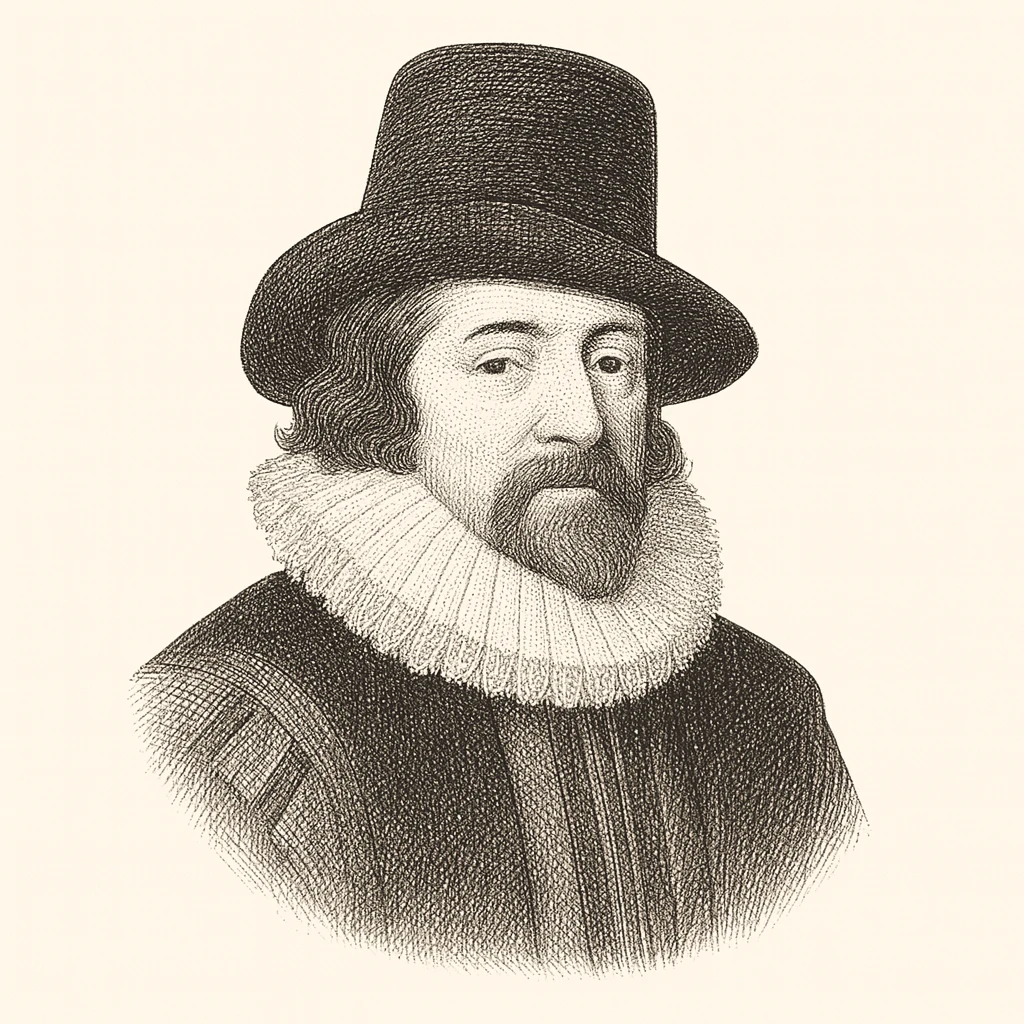
Francis Bacon rose to be Lord Chancellor of England and fell in 1621 when he confessed to taking gifts from litigants. The disgrace gave him five years to finish the program that made him one of the most consequential writers in the history of science, though he was not himself a scientist of any distinction.
His diagnosis is that learning has stalled because it has been pursued wrongly. The syllogism, he says, is useless for discovery: it operates on notions already formed, and if the notions are confused no amount of valid inference will repair them. Scholastic philosophy is a spider spinning webs from itself; mere empirics are ants heaping up material; the true philosopher is the bee, gathering and then transforming. What is needed is a new instrument — the Novum Organum, set against Aristotle's Organon — proceeding by systematic collection of instances, including negative instances, and by a graduated ascent from particulars to axioms rather than a leap to the most general principles.
He is at his sharpest on why minds go wrong. The four idols are one of the enduring pieces of analysis in philosophy: idols of the tribe, the distortions built into human nature itself, which supposes more order than it finds and is moved more by affirmatives than negatives; idols of the cave, the private prejudices of individual temperament and education; idols of the marketplace, the confusions imposed by loose language, which he thought the worst; and idols of the theater, the received systems that people accept as stage-plays of their own making.
The program is collaborative and institutional rather than heroic, and this is his lasting political contribution to science. Knowledge accumulates only if the work is divided, recorded and continued by others, and New Atlantis describes a research institution — Salomon's House — with specialized roles, systematic experiment and publication. The Royal Society was founded a generation later by men who explicitly named him as its inspiration.
His moral position, that knowledge is to be sought for the relief of man's estate rather than for contemplation or display, set the terms in which European thought would understand the point of inquiry, and the objection that this makes nature an object of domination has been made against him from Blake to the Frankfurt School.
Wondering where you land? Take the 4-minute assessment