
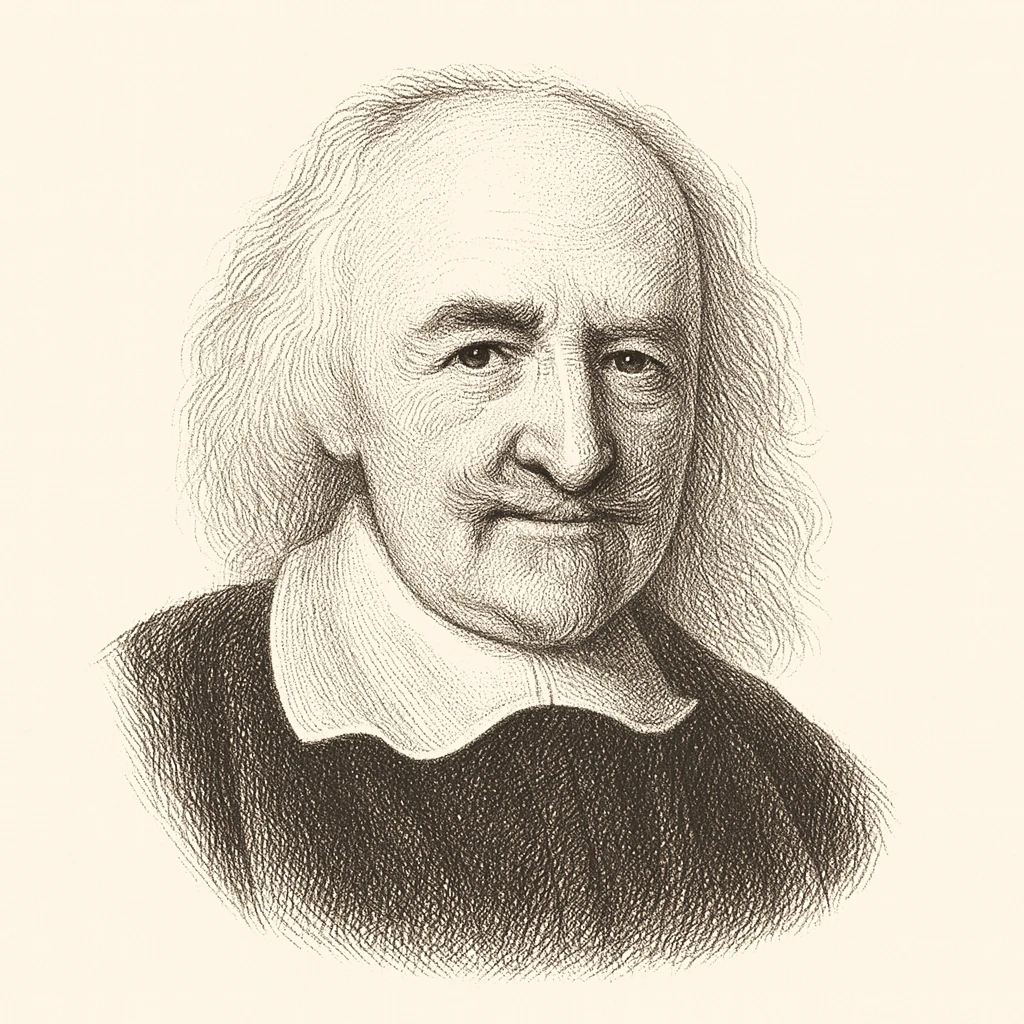
Thomas Hobbes was born prematurely on April 5, 1588, the day his mother went into labor after hearing rumors that the Spanish Armada was approaching England. Hobbes later said he and fear were born twins. The line is a joke but also a clue — Hobbes spent his ninety-one-year life thinking about what fear does to human beings, and what kinds of political institutions can save us from the consequences of being the kind of creatures that fear so much.
Hobbes lived through a period of almost continuous political violence. The English Civil War broke out in 1642 and ran for nearly a decade, ending with the execution of King Charles I in 1649 and the establishment of a short-lived republic under Oliver Cromwell. Hobbes, who had royalist sympathies, fled to Paris in 1640 and stayed there for eleven years, long enough to write Leviathan, the book that would make him famous and infamous in roughly equal measure. He returned to England after Cromwell took power, made his peace with the new regime (which earned him accusations of betrayal from his former royalist allies), and then survived the Restoration of 1660, when many of his enemies hoped he would be prosecuted for atheism.
Leviathan (1651) is one of the most important works of political philosophy ever written, and one of the most chilling. Hobbes begins with a thought experiment: imagine human beings outside of any political authority, in what he calls "the state of nature." What would life be like? Hobbes's answer became one of the most famous passages in Western philosophy. In the state of nature, he wrote, life would be "solitary, poor, nasty, brutish, and short." There would be no industry, no agriculture, no science, no arts, only a war of all against all, in which each person would have to fear violent death at every moment. Why? Because human beings are roughly equal in their ability to harm one another, they want similar things, and resources are scarce. Without an authority above them powerful enough to enforce peace, they would always fall back into conflict.
The escape from this nightmare, Hobbes argued, requires a social contract. Rational human beings, terrified of the state of nature, would agree to give up their natural freedom and submit to a sovereign authority — the Leviathan — strong enough to keep them all at peace. Crucially, Hobbes thought this sovereign authority had to be absolute. Any divided sovereignty, any check on the sovereign's power, would create the conditions for civil war. Once the sovereign was established, subjects had only one remaining right: the right to defend their own lives if the sovereign tried to kill them. Everything else was at the sovereign's discretion. The only thing worse than absolute sovereignty, Hobbes believed, was the chaos of having no sovereign at all.
The argument was scandalous in its time and remains uncomfortable today. Hobbes was attacked from every direction: by royalists who thought he gave too rationalistic a foundation for monarchy, by republicans who thought his conclusions were tyrannical, by religious authorities who thought his materialist philosophy left no room for God or the soul. But the framework he invented — the social contract — proved more durable than the conclusions he drew from it. John Locke, half a century later, would use Hobbes's own framework to argue for limited government and the right of resistance. Rousseau would use it to argue for popular sovereignty. Rawls would revive it in the 20th century to ground a theory of distributive justice. Almost every subsequent attempt to ground political legitimacy in the rational consent of free individuals descends from Hobbes, even when, especially when, the conclusions go in the opposite direction from his.
Hobbes died in 1679 at ninety-one, having outlived almost all his contemporaries and most of his enemies. His final words, reportedly, were "I am about to take my last voyage, a great leap in the dark." It was a fitting line for a man who had spent his life trying to think his way through fear, and who had concluded that the only thing standing between human beings and catastrophe was their willingness to obey.
Thomas Hobbes is associated with Reactionary Strongman. See the archetype