
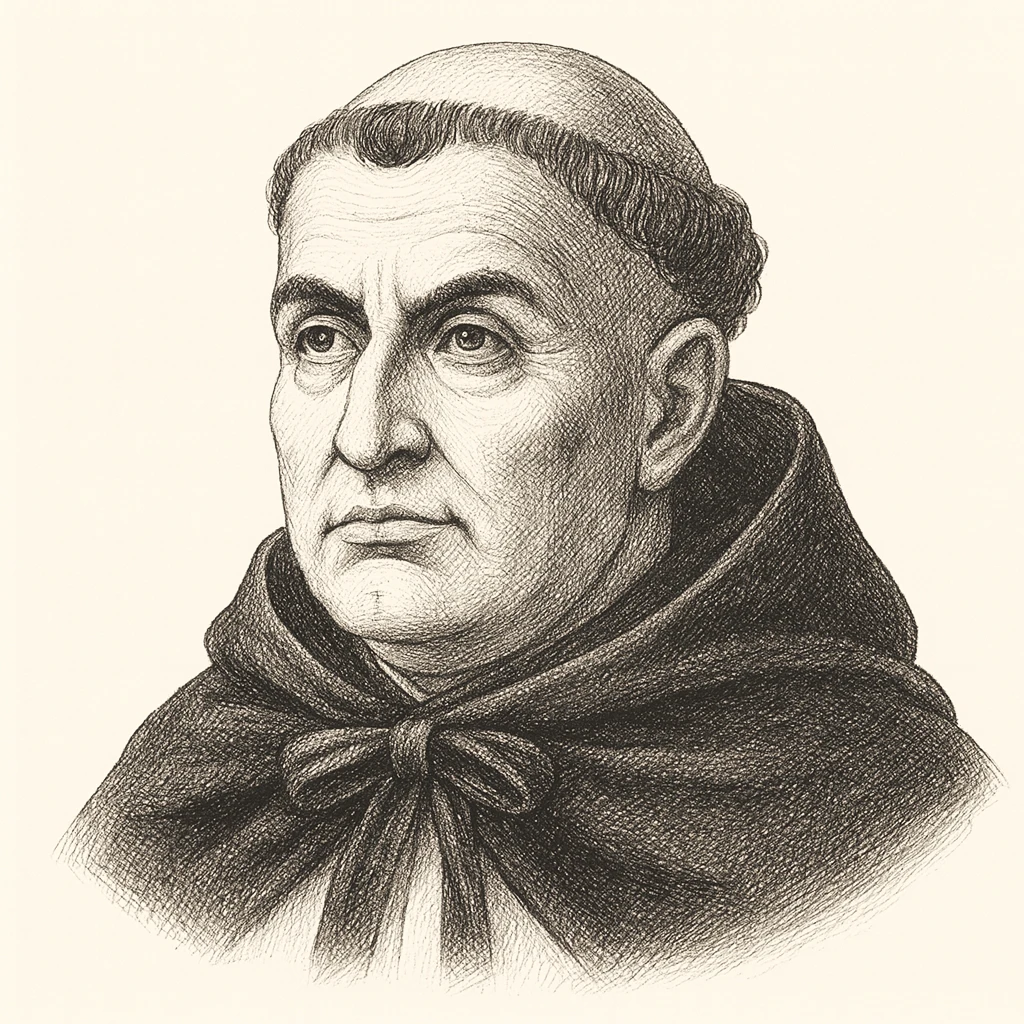
Thomas Aquinas was born around 1225 in the family castle of Roccasecca, in what is now southern Italy, the youngest son of a noble family who had planned for him to become an abbot of the prestigious Benedictine monastery at Monte Cassino — a respectable, lucrative, politically connected career. Thomas had other ideas. While studying at the University of Naples, he encountered the Dominicans, a new and controversial mendicant order that took vows of poverty and devoted itself to teaching and preaching. He decided to join them. His family was so opposed that his brothers literally kidnapped him and held him prisoner in the family castle for over a year. Eventually his family relented and he became a Dominican friar. He spent the rest of his short life as a teacher, writer, and theologian.
The challenge that defined Aquinas's intellectual career was the rediscovery of Aristotle. In the 12th and 13th centuries, the works of Aristotle were reintroduced to Western Europe through Arabic translations and commentaries, particularly those of the Islamic philosopher Averroes. This was theologically explosive, because Aristotle's philosophy seemed in many ways to conflict with Christian doctrine. Aristotle thought the world was eternal, that the soul might not be immortal in the personal sense Christians required, and that human reason could discover most of what was worth knowing without revelation. Some Christian theologians wanted to ban Aristotle entirely. Others tried to absorb him uncritically. Aquinas did something more ambitious: he tried to show that Aristotelian philosophy and Christian theology could be synthesized into a single coherent system, with reason and revelation as complementary paths to the same truth.
The result was the Summa Theologica, Aquinas's massive, unfinished masterwork, structured as a series of questions, objections, and replies that systematically work through almost every theological and philosophical problem of his era. It runs to roughly two million words across five volumes. The structure is rigorously argumentative: every question begins with the strongest objections to the position Aquinas will eventually defend, gives those objections their fairest possible form, and then works through them carefully. Reading Aquinas is like watching someone build a vast cathedral one stone at a time, with every stone placed where the weight will fall. The philosophical and political implications run throughout, but the book's overall purpose is theological — to give Christian doctrine the most rigorous intellectual foundation possible.
Aquinas's contribution to political thought lies primarily in his development of the natural law tradition. Drawing on Aristotle, Cicero, and Christian theology, Aquinas argued that there is a natural moral order built into the structure of reality, an order that human beings can discover through reason, that reflects the divine wisdom that created the universe, and that any legitimate human law must conform to. Unjust laws, Aquinas wrote, are not really laws at all but corruptions of law. Political authority is legitimate when it serves the common good and enacts the natural law; it loses its legitimacy when it works against them. This framework gave Western political thought one of its most enduring and powerful tools for evaluating political authority.
Aquinas died in 1274, at forty-nine, while traveling to a church council. The story goes that a few months before his death he had a mystical experience while celebrating Mass, after which he refused to write anything more, telling his secretary that compared to what he had seen, all his writing seemed "like straw." He left the Summa Theologica unfinished. He was canonized in 1323 and eventually declared a Doctor of the Church. The natural law framework he developed remains the foundation of Catholic political thought, and his arguments still shape contemporary debates about the relationship between religion and law, reason and faith, and the legitimacy of political authority.
Thomas Aquinas is associated with Religious Conservative. See the archetype