
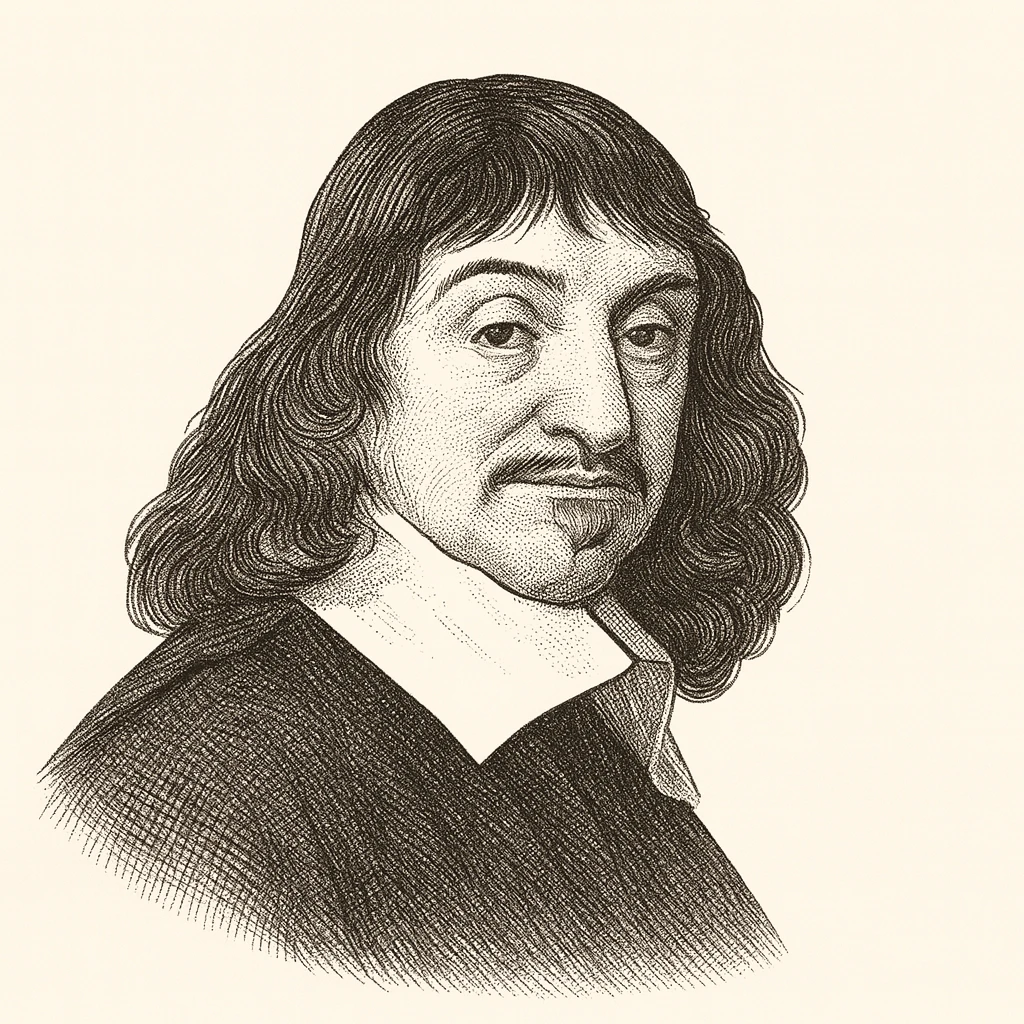
René Descartes is the father of modern philosophy, a distinction he earned by insisting that philosophical inquiry had to start over from the ground up rather than continuing to build on medieval foundations that he believed had become rotten. His method of systematic doubt, his famous conclusion "I think, therefore I am," and his sharp separation of mind from body became the starting points for almost every major philosophical tradition that followed him. His direct political writings are minimal — he deliberately avoided political controversy and spent most of his adult life in the Dutch Republic partly to escape the religious and political pressures of his native France — but his influence on modern political thought is enormous and operates indirectly through his shaping of the rationalist framework within which later political philosophers like Spinoza, Locke, Hobbes, and Kant all worked.
Descartes was born in 1596 in La Haye en Touraine, France (now called Descartes in his honor), into a family of minor nobility. He was educated at the Jesuit college of La Flèche, one of the best schools in Europe at the time, where he received a thorough grounding in classical languages, Aristotelian philosophy, mathematics, and natural science. He later said that by the end of his formal education he had become convinced that almost everything he had been taught was uncertain, and that the only subject in which genuine certainty seemed achievable was mathematics. This experience shaped his entire subsequent philosophical project: the attempt to put all knowledge on foundations as secure as those of mathematics, by starting over with whatever could not possibly be doubted and building outward only as certainty allowed.
After completing his education, Descartes spent several years as a soldier in the Thirty Years' War, traveling across Europe, and working out his philosophical method in private. In 1628 he moved to the Dutch Republic, which combined religious toleration with the best intellectual environment in Europe, and spent most of the next two decades there, moving frequently and maintaining a correspondence network that included most of the leading philosophers and scientists of his era. His major philosophical works were all written during this Dutch period. Discourse on the Method (1637) presented his philosophical approach in accessible French rather than scholarly Latin, addressed to general readers rather than academic specialists. Meditations on First Philosophy (1641), written in Latin and addressed to theologians, developed his metaphysical system in six sustained meditations that remain required reading in every serious philosophy program. Principles of Philosophy (1644) presented his complete philosophical system in textbook form.
What made Descartes revolutionary was his method. Medieval philosophy had proceeded largely by building on authoritative sources — Aristotle, Augustine, scripture, the church fathers — and working out their implications through logical analysis. Descartes rejected this approach entirely. The right way to begin philosophy, he argued, was to doubt everything that could possibly be doubted, refusing to accept any belief as certain until it had survived the most rigorous skeptical challenge he could mount. He doubted the evidence of his senses (they had deceived him before). He doubted the existence of the external world (perhaps he was dreaming). He doubted even mathematics (perhaps a powerful deceiver was making him think false things were true). But in the midst of all this doubting, he discovered one thing that could not coherently be doubted: the fact that he was thinking. Even if everything he thought was false, there had to be a thinker doing the doubting. "I think, therefore I am" — cogito, ergo sum — became the single certain foundation on which everything else could be rebuilt.
From this starting point, Descartes worked outward systematically. He argued that the existence of God could be proven from the idea of God that he found within his own mind. He argued that God's goodness guaranteed that clear and distinct ideas were reliable, and therefore that the external world could be known with certainty by careful reasoning. He argued that the mind and the body were fundamentally different kinds of things — mental substance was thinking and unextended, physical substance was extended and mechanical — and that the relationship between them was one of the central problems philosophy had to solve. This mind-body dualism has shaped Western philosophy and science ever since, and debates about consciousness, personal identity, and the relationship between mental and physical events are still framed in terms Descartes established.
Descartes's political influence is indirect but pervasive. By grounding knowledge in individual rational reflection rather than in authoritative tradition, he provided the philosophical foundation for every subsequent political tradition that treats political legitimacy as something that must be rationally justified to free individuals rather than simply inherited from the past. Modern social contract theory, liberal constitutionalism, the Enlightenment critique of monarchical and religious authority, and contemporary debates about public reason all operate within frameworks that would not have been possible without the Cartesian revolution. His specific political views were quite conservative — he deferred to established religious and political authorities, refused to engage in public controversy, and ordered his thinking to avoid provoking the Catholic Church — but the method he developed provided tools that later thinkers used for much more radical political purposes than he would have endorsed.
Descartes died in 1650 in Stockholm, where he had reluctantly accepted an invitation from Queen Christina of Sweden to tutor her in philosophy. The Swedish winter combined with early morning lessons proved too much for his frail health, and he caught pneumonia and died at fifty-three. His influence on modern philosophy is difficult to overstate. Every subsequent major philosophical tradition — rationalism, empiricism, German idealism, phenomenology, analytical philosophy — has had to define itself in relation to Descartes, either by extending his framework or by attacking it. The political thought of the Enlightenment and the modern democratic tradition that followed it are all built on foundations Descartes laid, even when the political thinkers who built on them would have found his own politics entirely too cautious.
René Descartes is associated with Independent Localist. See the archetype