
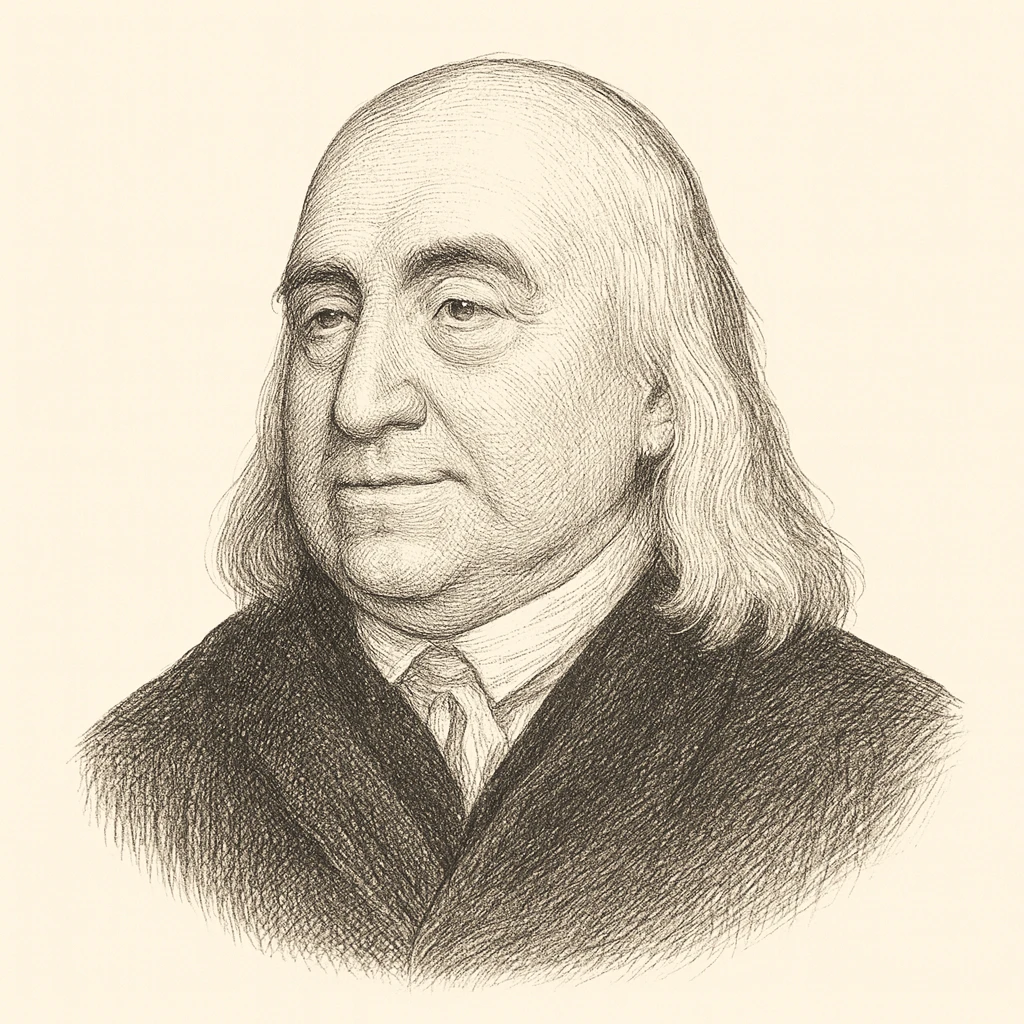
Jeremy Bentham is one of those philosophers whose influence is everywhere even though almost no one reads him for pleasure. His central idea — that actions and policies should be evaluated by whether they produce the greatest happiness for the greatest number — has shaped modern moral philosophy, public policy, economics, and law more thoroughly than almost any other single principle of the Enlightenment. He spent fifty years applying the principle to almost every aspect of British public life, with mixed results in his lifetime and enormous influence after his death.
Bentham was born in London in 1748 to a well-off family of attorneys. He was a child prodigy — reading multi-volume histories at three, learning Latin at four, attending Oxford at twelve. He trained as a lawyer but quickly became disillusioned with the chaos and corruption of the English legal system, which he came to see as a mass of irrational tradition that needed to be torn up and rebuilt on rational principles. The principle he settled on, after much wrestling, was the principle of utility: the rightness of an action depends entirely on its consequences for human happiness, calculated in terms of pleasure and pain. Everything else — natural rights, divine commands, traditional authority, religious doctrine — was, in Bentham's famous phrase, "nonsense upon stilts."
What made Bentham distinctive was not just the principle but his willingness to follow it everywhere, applying it with relentless consistency to questions most of his contemporaries hadn't thought to ask. He argued for the decriminalization of homosexuality decades before anyone else (his manuscripts on the subject weren't published in his lifetime). He argued for women's suffrage. He argued for the abolition of slavery, of corporal punishment, of the death penalty for most crimes. He argued for prison reform, animal welfare, freedom of the press, separation of church and state, and an end to imperialism. He invented the modern field of penology with his designs for the Panopticon — a prison structured so that inmates could be observed at all times by a single watchman they couldn't see, which Bentham believed would produce better behavior through internalized discipline rather than physical punishment. The Panopticon was never built in his lifetime, but the design became one of the most analyzed images in modern social theory, especially after Michel Foucault used it as the central metaphor of Discipline and Punish.
Bentham's philosophical writing is famously hard to read. He invented his own technical vocabulary for almost everything he discussed, often producing words like "deontology" and "international" that have entered general use, and many others that have not. He was also obsessively perfectionist about his manuscripts, constantly revising them rather than publishing them, leaving an enormous unpublished archive at his death which scholars are still editing nearly two centuries later. His most influential book in his lifetime, An Introduction to the Principles of Morals and Legislation (1789), laid out his utilitarian framework systematically, but most of his political and legal arguments were transmitted through his student John Stuart Mill (whose father James Mill was Bentham's close friend) and through the Philosophical Radicals — the group of younger thinkers and politicians who took up Bentham's ideas and turned them into a movement.
Bentham died in London in 1832, at eighty-four. He left detailed instructions for what should be done with his body: it should be dissected for medical research, and then his skeleton should be reassembled, dressed in his clothes, and put on display as what he called an "auto-icon" — his own argument that we should use dead bodies for the benefit of the living rather than burying them out of misplaced sentiment. The auto-icon still sits in a glass case at University College London, where Bentham helped found the institution and where his preserved body still attends ceremonial occasions. It's the kind of arrangement that captures something essential about Bentham: utterly committed to his principles, willing to follow them to their logical conclusion, and entirely unbothered by other people's discomfort with the result.
Jeremy Bentham is associated with Classical Liberal. See the archetype