
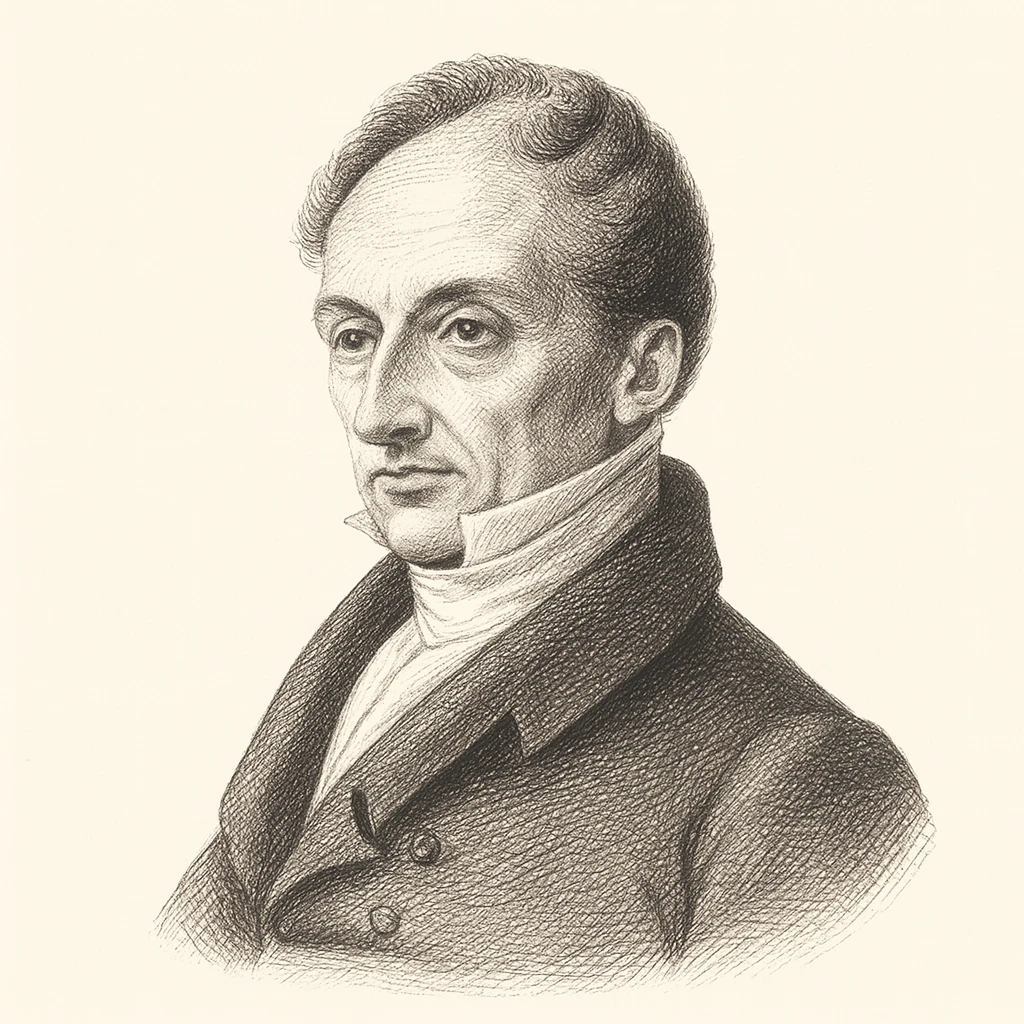
James Mill is remembered today primarily as the father of John Stuart Mill, which is unfair to him and also hard to avoid. He was his son's teacher, designer of the famously brutal homeschooling curriculum that had JSM reading Greek at three and political economy at thirteen, and the figure whose utilitarian framework the younger Mill spent his adult life humanizing. But James Mill was also a significant thinker in his own right: the organizer who took Jeremy Bentham's abstract utilitarianism and turned it into a political movement, the author of a major history of British India, and one of the founding figures of classical political economy alongside David Ricardo.
Mill was born in Scotland in 1773, the son of a shoemaker, and worked his way up through the Scottish educational system to become a writer, journalist, and eventually a senior official in the East India Company. He met Bentham around 1808 and became the older man's closest intellectual ally. While Bentham wrote voluminously but struggled to finish or publish his work, Mill took Benthamite utilitarianism and made it practical, political, and accessible. He organized a circle of younger thinkers, including his son, into what became known as the Philosophical Radicals, and turned the utilitarian framework into a platform for expanded suffrage, legal reform, free trade, and the systematic rationalization of British institutions.
His major works included the six-volume History of British India (1817), which despite being written by someone who had never visited India became the standard British account for decades, and Elements of Political Economy (1821), which codified Ricardian economics for a wider audience. He died in 1836, having lived to see his son begin to emerge from the rigid framework he had imposed, though he would not live to see JSM's mature philosophy take shape.
James Mill is associated with Classical Liberal. See the archetype