
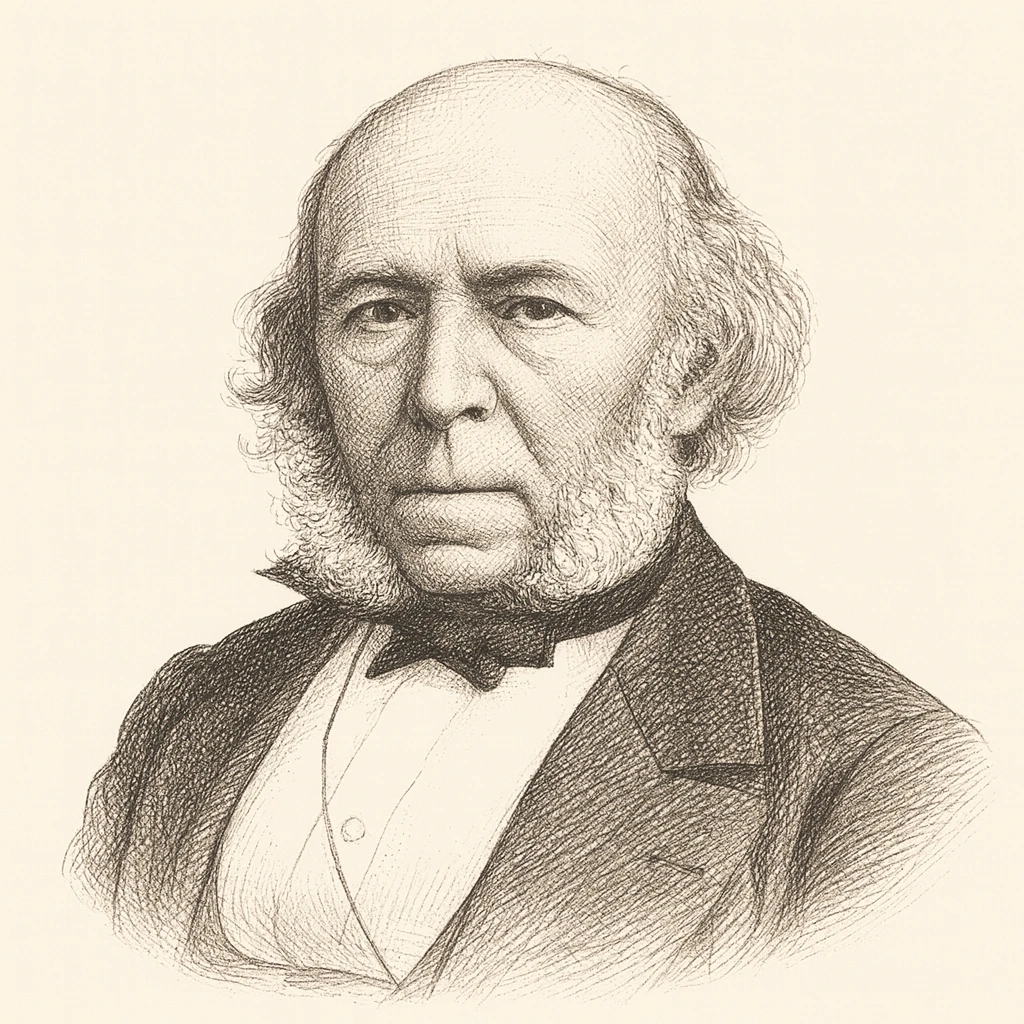
Herbert Spencer was born in 1820 in Derby, the only surviving child of eight born to William George Spencer, a schoolteacher of Dissenting Protestant background who regarded conventional education with the same skepticism he applied to conventional religion. William Spencer refused to send his son to any school, believing that genuine education required following the child's own interests rather than imposing a curriculum, and Herbert consequently grew up largely self-taught, deeply read in natural history and mechanics and mathematics, and almost entirely without the classical education that was the standard preparation for English intellectual life. When he was thirteen his Uncle Thomas, a Dissenting minister, took him for a brief period to try to teach him Latin and Greek; Spencer resisted both and returned home. The absence of a formal classical education gave him both his characteristic weaknesses — a tendency to derive everything from first principles without adequate grounding in historical particularity — and his characteristic strengths, a genuine capacity for systematic thinking unsoftened by deference to established authority.
He trained as a railway engineer during the great railway boom of the late 1830s and worked on the construction of the London-Birmingham line and other projects until 1841, when the railway boom ended and he returned to Derby. The engineering years were formative in ways that went beyond the technical: they gave him a direct acquaintance with the physical processes of industrialization, with the transformation of landscape and community that steam power and capital were producing, and with the practical question of how complex systems maintained their organization over time. These questions — of organization, development, and the relationship between structure and function — would organize his philosophical work for the next sixty years.
He moved to London in 1848 to work as a sub-editor at The Economist under James Wilson, a position that gave him both a regular income and an intellectual environment saturated with the political economy of classical liberalism. The Economist's editorial culture combined free-trade economics with a deep suspicion of state intervention in any form, and Spencer absorbed this framework even as he was developing his own more systematic justification for it. He published Social Statics in 1851, three years before leaving The Economist, and the book established his philosophical position before Darwin's Origin of Species had appeared. His argument that social progress occurred through the adaptation of individuals to their social environment — and that state interference with this process retarded adaptation and therefore progress — was derived from first principles about the nature of individual rights and the conditions of human development rather than from biological theory. When Darwin published in 1859, Spencer recognized immediately that natural selection provided a scientific grounding for conclusions he had already reached by a different route, and the phrase "survival of the fittest" that he coined was adopted by Darwin in the fifth edition of the Origin of Species.
The Synthetic Philosophy — his project to unify all human knowledge under evolutionary principles — consumed the next forty years. Volume after volume appeared: First Principles (1862), the two volumes of Principles of Biology (1864-67), the two volumes of Principles of Psychology (1855, extensively revised 1870-72), the three volumes of Principles of Sociology (1876-96), and the two volumes of Principles of Ethics (1879-93). The ambition was genuine and unprecedented: no one since Aristotle had attempted to provide a systematic account of all knowledge within a single theoretical framework. The execution was uneven — the biology was already outdated when it appeared, and the sociology depended on ethnographic sources of variable reliability — but the project itself demonstrated a systematic imagination that commanded the respect even of those who rejected his conclusions.
His American reception was extraordinary and reveals something important about both Spencer and America. He visited the United States in 1882, and was received as a celebrity philosopher — dinners in his honor, interviews with the press, audiences with figures from science, industry, and politics. Andrew Carnegie regarded him as the intellectual who had explained the moral justification for industrial capitalism and for the vast inequality it produced. John D. Rockefeller cited Spencer's framework in his Sunday school classes. William Graham Sumner carried Spencerian evolutionary individualism into American sociology and economics at Yale, shaping a generation of academics. The Supreme Court's Lochner-era jurisprudence protecting economic liberty against legislative regulation — which struck down minimum wage laws, maximum hour laws, and child labor restrictions — drew on Spencerian premises even where it did not cite them by name.
This American appropriation was something Spencer himself partly resisted. His later work became increasingly pessimistic about the direction of industrial civilization. He opposed British imperialism strenuously, arguing that militarism and imperial expansion were forms of the compulsory cooperation that genuine liberalism had to resist — he was a consistent anti-imperialist when most of his admirers were enthusiastic imperialists. He also distanced himself in his final years from some of the more extreme positions of Social Statics, including his early advocacy for the absolute right of private property in land. The man who became the philosophical justification for Gilded Age capitalism was, by the end, appalled by the uses to which his ideas were being put.
He died in Brighton in 1903, nearly blind, in considerable physical pain from chronic illness, having spent the last decade watching his reputation decline from its extraordinary heights. His work, once ubiquitous, became one of the great cautionary examples of systematic philosophy's tendency to outrun the evidence it depends on — a figure simultaneously indispensable for understanding the intellectual culture of the Victorian era and largely unreadable as a direct source.
Herbert Spencer is associated with Anarcho-Capitalist. See the archetype