
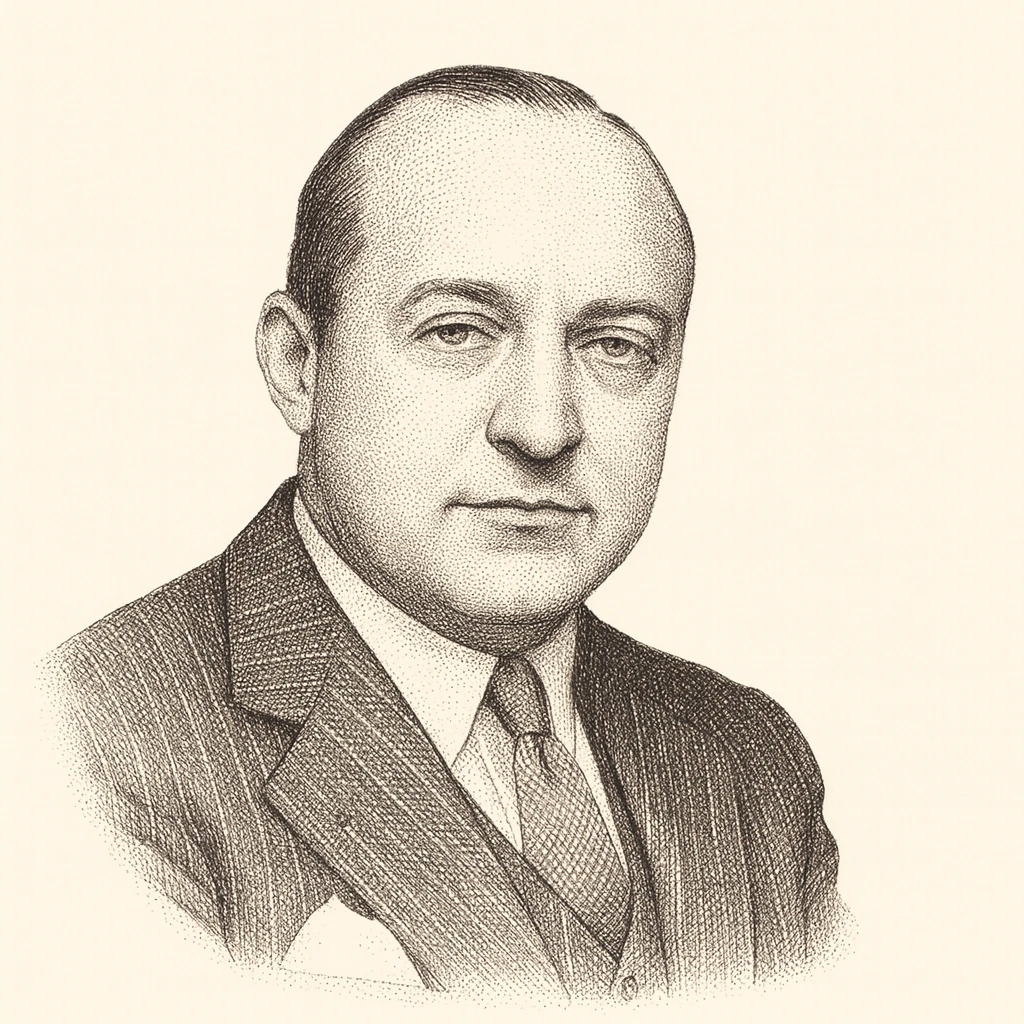
Henry Hazlitt was a largely self-taught economic journalist who became one of the twentieth century's most effective popularizers of free-market ideas. Writing across a long career for outlets including The New York Times, The Nation, and Newsweek, he brought classical-liberal and Austrian-school arguments to a general readership at a moment when Keynesian economics and expanding government were ascendant. His central conviction was that sound economics requires looking past the immediate, visible effects of a policy to its full and often hidden long-run consequences for all groups, not merely the intended beneficiaries.
Hazlitt distilled that conviction in Economics in One Lesson, which remains among the most widely read introductions to market economics ever published. Drawing on Frédéric Bastiat's parable of the broken window, he argued that public spending, tariffs, price controls, subsidies, and make-work schemes typically create concentrated visible gains while destroying diffuse and unseen value elsewhere. The book's lasting political influence lies in its habit of mind: treating the state's interventions with skepticism because their costs are frequently disguised, delayed, or borne by parties who never appear in the political calculus.
He was closely allied with the leading figures of the Austrian tradition, championing Ludwig von Mises and helping introduce Friedrich Hayek's ideas to American audiences, and he was among the founders of the Foundation for Economic Education, an early institutional home for the postwar libertarian movement. He also wrote a book-length critique of John Maynard Keynes's General Theory, attacking deficit spending and demand management as economically unsound. Through this work he helped build the intellectual infrastructure that later shaped modern libertarian and free-market conservative thought.
Hazlitt's reputation is that of a clarifier rather than an original theorist; critics note that his popular writing simplifies contested questions and treats market outcomes with a confidence many economists reject. His enduring importance is less in technical innovation than in persuasion: he gave ordinary readers a durable, accessible framework for questioning the promises of activist government, and that framework continues to inform libertarian and limited-government politics today.
Henry Hazlitt is associated with Traditional Libertarian. See the archetype