
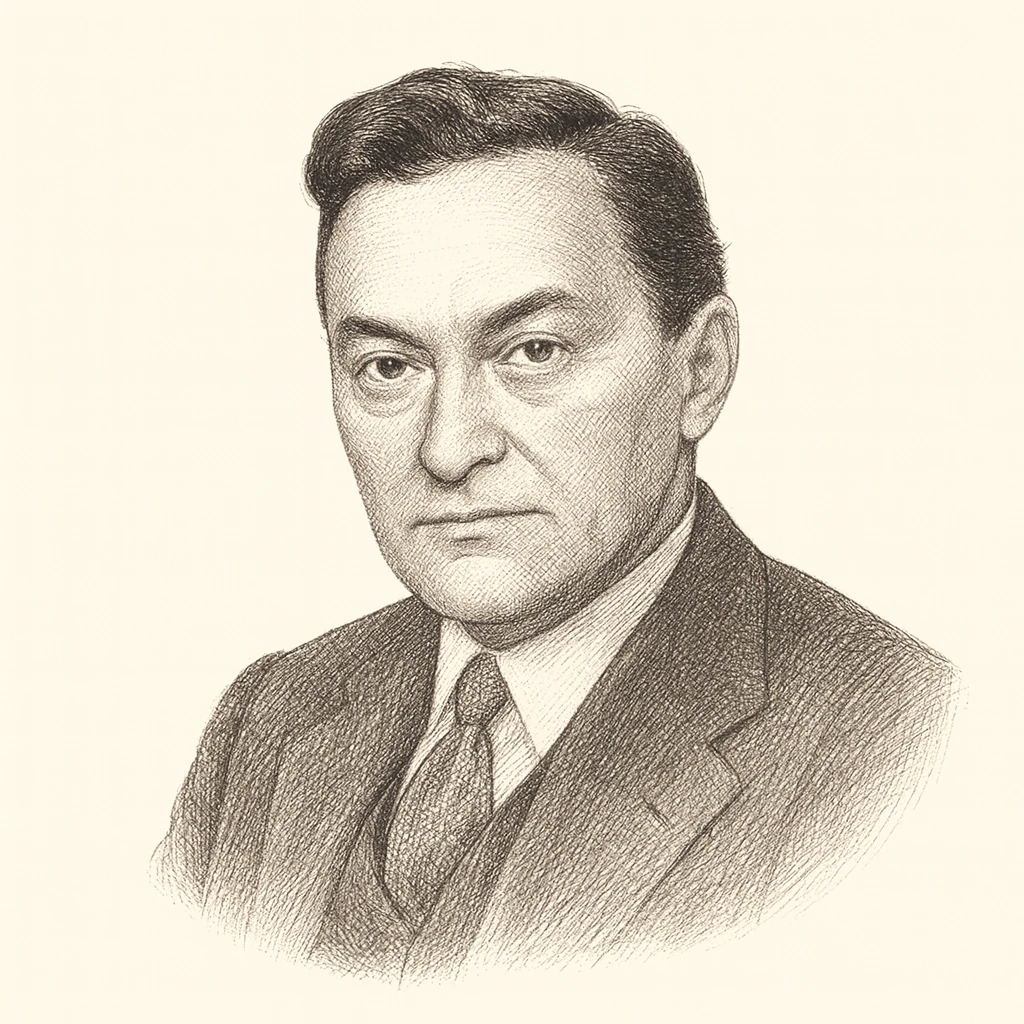
Walter Lippmann was born in 1889 in New York City, into a prosperous German Jewish family whose social world centered on the cultivated upper-middle class of the Gilded Age city — concert subscriptions, European travel, the assumption that education and culture were natural goods rather than luxuries. He attended Harvard, where he was a student of William James and George Santayana, worked for Lincoln Steffens during a brief period as a socialist journalist, and then co-founded The New Republic in 1914 at twenty-four with Herbert Croly and Walter Weyl, having published two books of political philosophy before graduating. He was a public intellectual before the term existed, with the particular combination of genuine intellectual seriousness and genuine ambition for influence that the role required and that his subsequent career demonstrated he possessed.
The New Republic years (1914-1917) established him as the most intellectually sophisticated voice of progressive liberalism — a liberalism that believed in expert governance, the scientific organization of society, and the application of intelligence to the management of industrial democracy. He was part of the circle that advised Woodrow Wilson's administration, contributed to the intellectual framework of the Fourteen Points, and accompanied the American delegation to the Paris Peace Conference in 1919. The Paris experience was one of the most formative disillusionment of his career: he watched the idealism of Wilson's Fourteen Points dismantled by European power politics, observed the manipulation of public opinion through wartime propaganda with a firsthand directness that most journalists lacked, and came away convinced that the progressive faith in democratic self-governance rested on profoundly unrealistic assumptions about what democratic citizens could know and decide.
Public Opinion (1922) was the synthesis of this disillusionment. Its central argument was about what he called the "pseudo-environment" — the simplified, stereotyped picture of the world that each person carried in their head, constructed from fragments of secondhand information, organized by existing categories and prejudices, and bearing only a rough and often distorted relationship to the actual world that political decisions affected. The citizen of a modern industrial democracy faced decisions about matters — tariffs, foreign policy, monetary policy, the management of distant territories — that were far beyond the direct experience or genuine comprehension of any but a tiny specialist minority. The gap between what democratic theory required — informed, rational citizens deciding collectively on the basis of accurate understanding — and what democratic practice produced — manipulable publics responding to symbols and stereotypes — was not a temporary deficit to be remedied by better education. It was structural.
The Phantom Public (1925) pushed the argument further. Democratic theory's model of the active citizen — the person who participated in all public decisions, formed genuine opinions about all public questions, and exercised genuine sovereign power through elections — was a fiction. The actual citizen was a "bystander" most of the time, activated by specific crises that touched their interests directly, and otherwise dependent on the guidance of those with genuine knowledge and genuine stake. This was not a comfortable conclusion for a liberal, and Lippmann spent the rest of his career trying to work out what it implied — neither abandoning democracy nor pretending that its standard justifications were adequate.
He left The New Republic in 1921, worked at the New York World until its collapse in 1931, and then began his syndicated column "Today and Tomorrow" at the New York Herald Tribune, which ran from 1931 to 1967 and was eventually syndicated to 250 papers reaching an estimated forty million readers. The column made him the most widely read serious political journalist in American history, and its longevity gave him an extraordinary platform for tracking the development of American and world politics across four decades of extraordinary change — the Depression, the New Deal, World War Two, the Cold War, Vietnam. He won two Pulitzer Prizes, was consulted by presidents and prime ministers, and became, in his own person, a demonstration of the proposition he had doubted: that a single individual with genuine knowledge and genuine judgment could exercise significant influence over a democratic public.
His theoretical positions evolved considerably over these decades. The Good Society (1937) represented his break from the progressive tradition's faith in planning and state direction, toward a defense of the liberal market order — not laissez-faire but an order of competitive markets governed by law — as the institutional framework for freedom. Essays in the Public Philosophy (1955) was his most systematic later work, arguing for a "public philosophy" grounded in natural law as the framework that democratic politics required to orient itself — a return, in old age, to the tradition of thought that progressive liberalism had been too confident to need.
He opposed American involvement in Vietnam as early as 1965, when such opposition was still lonely among establishment voices, and his columns in those years contributed to the erosion of the consensus that sustained the escalation. He died in 1974, having coined the term "Cold War" in 1947 and having watched its central conflict proceed for nearly three decades with a combination of analytical clarity and genuine moral seriousness that distinguished him from both the hawks who wanted to win it at any cost and the idealists who thought it could be wished away.
Walter Lippmann is associated with Pragmatic Centrist. See the archetype