
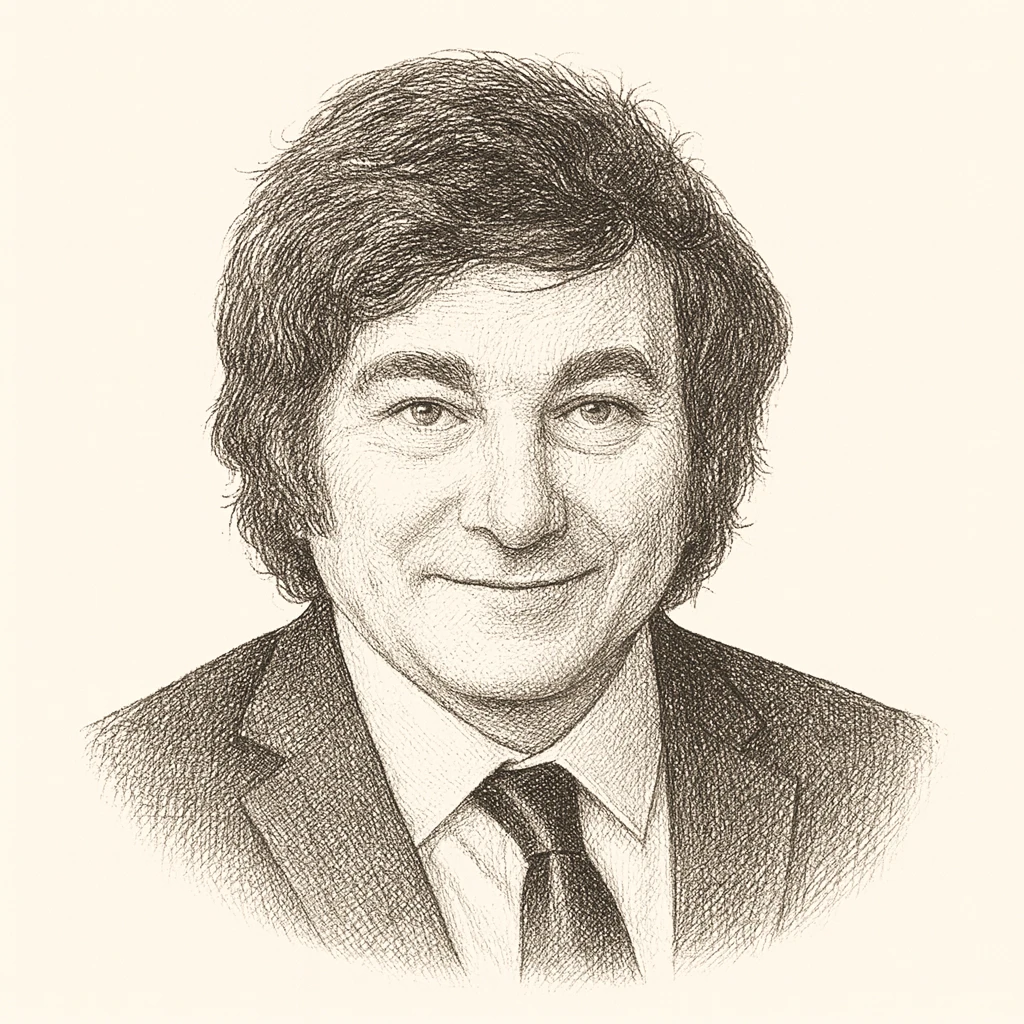
Javier Milei rose from television economist and public provocateur to the Argentine presidency, winning the 2023 election after founding the libertarian coalition La Libertad Avanza. What distinguishes him among heads of state is his open identification with anarcho-capitalism, an intellectual tradition holding that virtually all functions of the state — including money, security, and law — can and should be provided through voluntary markets rather than coercive government. Milei frequently cites the Austrian School economists, especially Ludwig von Mises and Murray Rothbard, and treats their critique of central planning and fiat money not as academic theory but as a program for governance.
His political thought centers on a radical hostility to the state, which he casts as inherently predatory and as the root of Argentina's chronic inflation and decline. He draws a distinction, common in libertarian circles, between his personal anarcho-capitalist ideal and the "minarchist" reforms achievable in office, framing his presidency as a step toward shrinking government as far as democratic politics permits. Campaigning with a chainsaw as a prop, he promised deep cuts to public spending, deregulation, and the elimination of the central bank, alongside a contested proposal to abandon the peso and dollarize the economy as a way to end monetary discretion and the inflationary financing of deficits.
Milei's significance lies in making anarcho-capitalist and Austrian ideas — long confined to think tanks and online subcultures — the governing rhetoric of a major economy. His early austerity produced sharp fiscal adjustment and falling inflation alongside rising poverty and recession, and observers debate whether these are transitional costs or lasting harm. His combative style, denunciations of what he calls the "political caste," and confrontations with opponents draw both admiration and alarm; critics warn that his rhetoric and concentration of executive ambition sit uneasily with liberal-democratic norms, while supporters see a rare politician willing to enact market-radical convictions. Whatever the ultimate verdict, Milei has become the most prominent contemporary test case of libertarian economic doctrine translated into state power.
Javier Milei is associated with Anarcho-Capitalist. See the archetype