
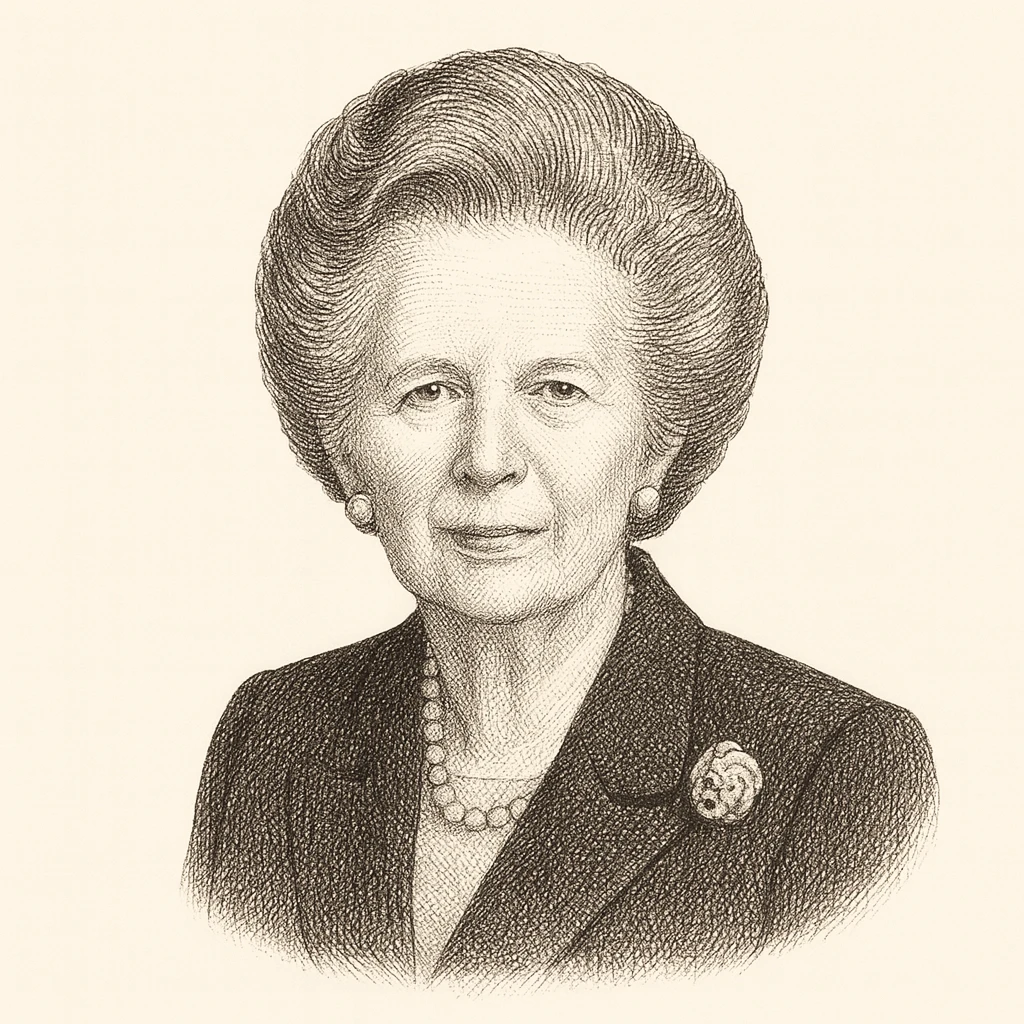
Margaret Thatcher was Britain's first female Prime Minister, serving from 1979 to 1990, and her governments reshaped the British economy and the terms of its politics. The grocer's daughter from Grantham studied chemistry at Oxford, became a barrister and tax lawyer, then entered Parliament in 1959. She won the Conservative Party leadership in 1975, defeating Edward Heath, and promised to reverse Britain's decline.
Thatcher's economic revolution, known as "Thatcherism," drew on the free-market ideas of Friedrich Hayek and on her ally Keith Joseph, with whom she had begun in the mid-1970s to question the consensus politics of the postwar decades; the two blamed that consensus for the country's decline. The economist Milton Friedman also served as an adviser to her. She called the defeat of inflation her government's "prime economic objective" and told the 1980 Conservative Party conference that "Inflation is the parent of unemployment." Earlier that year, defending pay restraint, she had said, "I believe people accept there's no real alternative." Her program combined privatization, deregulation, and confrontation with organized labor. The 1984-85 miners' strike became a defining battle; her victory broke union power. She privatized nationalized industries, sold council housing to tenants, and cut taxes while reducing inflation through monetary policy.
Unemployment rose above three million in the early 1980s. In 1981, 364 economists signed a public letter arguing that the government's economic policy should be abandoned in favor of alternatives. Income inequality rose through the decade, while the economy returned to growth soon after the 1981 budget.
Internationally, Thatcher was Reagan's partner in confronting the Soviet Union and recaptured the Falkland Islands from Argentina in 1982, a victory that revived her flagging popularity. After meeting Mikhail Gorbachev in December 1984, she told the BBC, "I like Mr. Gorbachev. We can do business together." Her deepening opposition to European integration and the unpopular poll tax led to her ouster by her own party in 1990.
The LSE economist John Van Reenen wrote in 2013 that her supply-side reforms of labor and product markets were broadly continued under the Labour governments of Tony Blair and Gordon Brown. Thatcherism became a model for free-market conservatives in other countries.
Margaret Thatcher is associated with Classical Liberal. See the archetype