
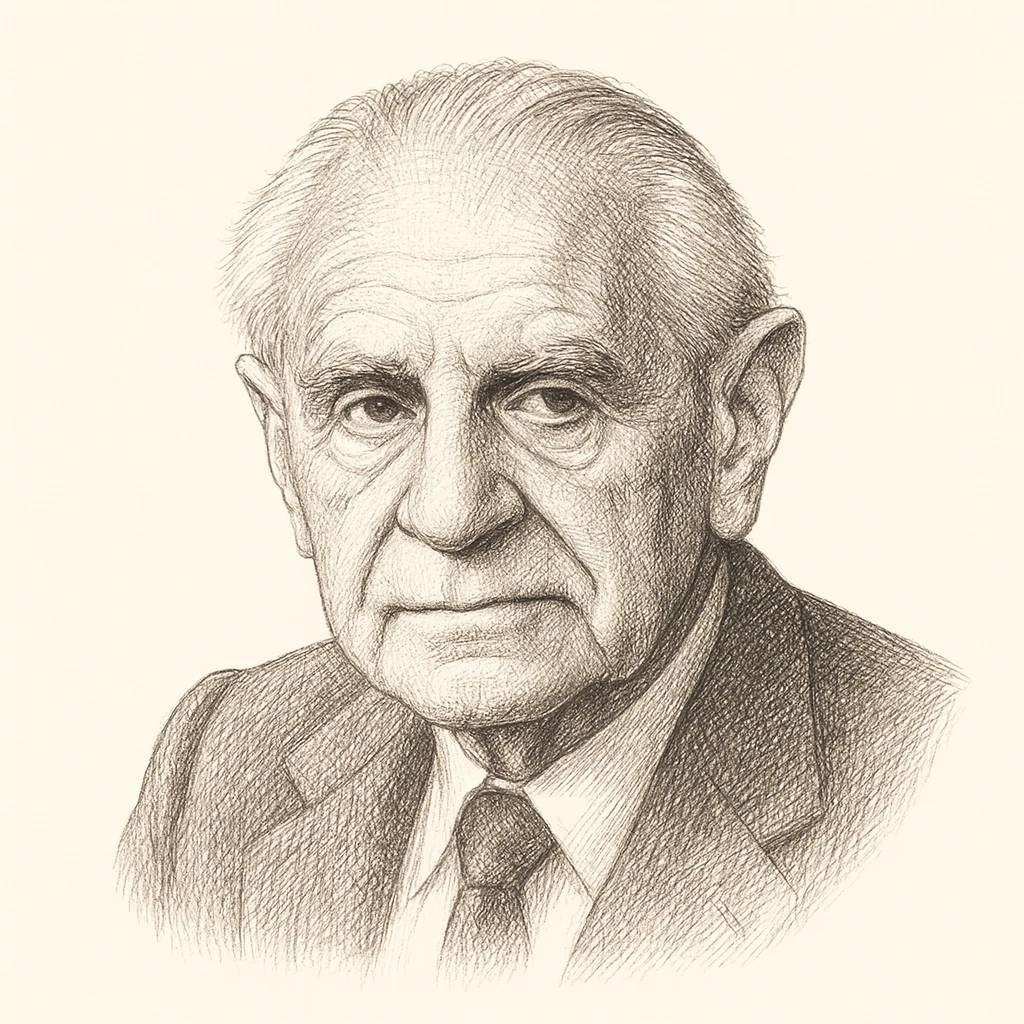
Karl Popper was born in 1902 in Vienna, the son of a lawyer of Jewish background who had converted to Lutheranism before Popper's birth, and who maintained a substantial library that his son worked through from childhood. Vienna in the years of his formation was one of the most intellectually concentrated cities in the world: psychoanalysis, logical positivism, socialist politics, and the Vienna Circle's attempt to ground all meaningful statements in empirical verification were all simultaneously in the air, and Popper encountered all of them before he had developed the positions that would define his career. He tried briefly to become a cabinetmaker after the First World War, finding the craftsmanship appealing, before returning to formal education. More consequentially, he worked for a period with delinquent children under Alfred Adler, an experience that planted the seed of his later demarcation problem: he noticed that Adlerian psychoanalysis could interpret any behavior whatsoever as confirmation of its framework, and that this seemed less like scientific power than like immunity to refutation. Around the same time, he attended a lecture by Einstein, who explained that his general theory of relativity would be refuted if certain astronomical observations were not made — a stark contrast to the unfalsifiable claims of psychoanalysis and, Popper thought, the explanation for why physics was science in a way that psychoanalysis was not.
He studied at the University of Vienna, writing his dissertation on methodology, and became aware of the Vienna Circle — the logical positivists around Moritz Schlick whose project was to establish a criterion of meaning that would distinguish scientifically significant from metaphysically meaningless statements. The positivists' verification criterion — a statement is meaningful if and only if it can be verified by experience — seemed to Popper to face a problem that Hume had already identified: no finite accumulation of observations could verify a universal generalization. You could observe a million white swans and still not be entitled to conclude that all swans were white. His response was to invert the criterion: what distinguished scientific from non-scientific theories was not verifiability but falsifiability. A theory was scientific if it specified in advance what evidence would refute it and if it survived genuine attempts at refutation. This was a positive proposal rather than a mere criticism, and The Logic of Scientific Discovery (1934) — published in German as Logik der Forschung — elaborated it into a systematic philosophy of science.
He fled Austria in 1937, as the Nazi threat became undeniable, obtaining a position at Canterbury University College in New Zealand — then an extraordinarily remote posting for a Viennese intellectual. He spent the war years in Christchurch, increasingly isolated and increasingly aware of the catastrophe developing in Europe, writing the work that would make him internationally famous. The Open Society and Its Enemies (1945) was his political masterwork and a work of genuine passion — he later described it as his war effort. Its argument was dual: a philosophical critique of what he called "historicism" — the belief that history moves according to discoverable laws toward a predetermined destination — and a political critique of the totalitarian politics that historicism enabled. Plato's Republic was the first blueprint for the closed society, organized around a fixed ideal of the Good that justified coercion of those who resisted it. Hegel's philosophy of history provided the intellectual structure for both Fascist and Communist claims that history was moving in a particular direction and that those who understood this direction were entitled to coerce those who did not. Marx's historical materialism was the most sophisticated version of this structure and therefore the most dangerous.
What he proposed instead was "piecemeal social engineering" — the reform of specific institutions in response to specific identified problems, with careful attention to consequences and genuine openness to revision. This was explicitly anti-utopian: the attempt to realize a comprehensive vision of the good society would inevitably require coercion of those who did not share it. Better to define political problems as the specific evils to be eliminated — poverty, disease, tyranny, exploitation — than as the positive goods to be achieved. The former approach was compatible with democratic institutions; the latter required bypassing them.
He joined the London School of Economics after the war, where he remained until his retirement, and where his seminar became one of the most stimulating intellectual environments in postwar British philosophy. His friendship with Friedrich Hayek — who shared his critique of central planning and his epistemological argument against comprehensive social design — placed him within the intellectual network that shaped postwar liberal thought. The two reinforced each other: Hayek's analysis of the knowledge problem in economics and Popper's analysis of the epistemological pretensions of historicism in politics were parallel arguments that together constituted one of the most powerful intellectual cases for liberal institutions produced in the twentieth century.
His influence ran not only through academic philosophy but through practical politics. George Soros studied under Popper at the LSE in the early 1950s and was so shaped by the encounter that he named his philanthropic foundation after Popper's concept — the Open Society Foundation has funded civil society organizations, independent media, and democratic institution-building across the former Communist world. Popper himself lived quietly in Kenley, Surrey, for most of his British decades, working incessantly, arguing with a combativeness that his students found both stimulating and exhausting, and watching the postwar liberal order that his ideas had helped justify be maintained, expanded, and eventually challenged. He died in 1994 at ninety-two, still intellectually active, having revised and extended his positions through Objective Knowledge (1972) and The Self and Its Brain (1977) into domains — evolutionary epistemology, the philosophy of mind — that his original logical work had not anticipated.
Karl Popper is associated with Pragmatic Centrist. See the archetype