
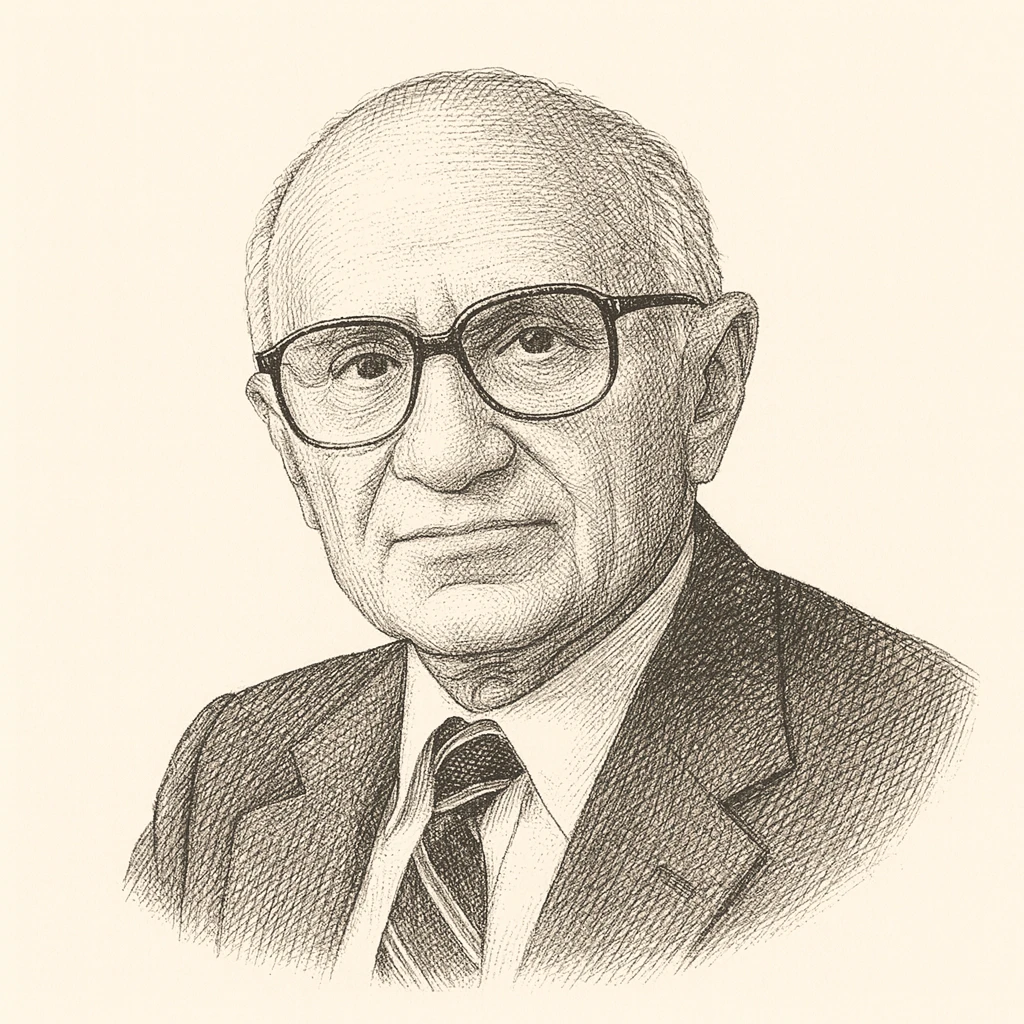
Milton Friedman was the most politically influential economist of the second half of the 20th century, a Nobel laureate whose rigorous academic work on monetary theory combined with his extraordinary talent for popular communication to shape economic policy, political discourse, and the broader public understanding of markets and government across the Western world. Where Hayek had made the philosophical case for classical liberalism and Mises had developed the Austrian theoretical framework, Friedman made the case concretely, empirically, and accessibly to audiences who had never read an economics textbook. His television series Free to Choose (1980) reached millions of viewers. His popular books, including Capitalism and Freedom (1962) and Free to Choose (written with his wife Rose, also 1980), translated classical liberal economics for general readers in ways that shaped how an entire generation of American conservatives and libertarians understood the relationship between markets and freedom. His academic work on monetary history and theory shifted the economics profession away from Keynesian orthodoxy and provided the theoretical foundations for the monetarist revolution and the broader neoliberal policy shift of the 1980s.
Friedman was born in 1912 in Brooklyn, New York, to Jewish immigrant parents from what is now Ukraine. The family moved to Rahway, New Jersey when Friedman was a baby, and his father died when he was fifteen, leaving the family in straitened circumstances. Friedman worked his way through Rutgers University and then earned his master's at Chicago and his PhD at Columbia, with the University of Chicago economics department becoming his primary intellectual home for most of his academic career. He taught at Chicago from 1946 until his retirement in 1977, during which time the Chicago School of economics emerged as one of the most distinctive and influential intellectual traditions in 20th century economic thought.
Friedman's first major academic work was A Theory of the Consumption Function (1957), which challenged the Keynesian account of how households made consumption decisions and introduced what Friedman called the "permanent income hypothesis" — the idea that people based their spending decisions on their expected lifetime income rather than on their current paycheck. This was more technical than his later popular work but it was important because it undermined one of the foundational assumptions of Keynesian macroeconomic policy: that government fiscal stimulus would reliably increase consumer spending and therefore boost aggregate demand. Friedman showed that the effect was likely to be smaller and less predictable than Keynesian models had assumed, which started the long process of shifting mainstream economics away from confident fiscal interventionism.
His most important academic contribution was A Monetary History of the United States, 1867-1960 (1963), written with Anna Schwartz. This massive work of economic history made the case that monetary policy had been the single most important factor in American economic fluctuations over nearly a century, and that the Great Depression specifically had been caused primarily by the Federal Reserve's failure to prevent the collapse of the money supply after 1929. This was a direct challenge to the Keynesian consensus that had interpreted the Depression as a failure of private sector demand that required fiscal intervention. Friedman and Schwartz argued that the Depression had been made vastly worse than it needed to be by the Fed's passive response to banking failures, and that a competent monetary policy could have prevented the worst of the collapse without any need for the New Deal's interventions. This historical argument, combined with Friedman's theoretical work on the quantity theory of money, became the foundation for monetarism — the doctrine that central banks should focus on maintaining stable growth in the money supply rather than on trying to manage aggregate demand through fiscal policy.
Friedman won the Nobel Prize in Economics in 1976, and by that point his influence on economic thinking had already begun to reshape policy discussions across the Western world. The 1970s crisis of stagflation — simultaneous high inflation and high unemployment, which Keynesian models had predicted should be impossible — discredited the postwar Keynesian consensus and created the opening that Friedman and his allies had been waiting for. Margaret Thatcher's government in the UK and Ronald Reagan's administration in the US both drew explicitly on Friedman's monetary framework in the early 1980s, and the broader shift toward market-oriented economic policy across the OECD during the 1980s and 1990s was shaped substantially by Friedman's intellectual influence.
But Friedman's political impact went far beyond monetary policy. Capitalism and Freedom (1962) was his systematic presentation of the case for limited government, free markets, and individual liberty. The book argued that economic freedom and political freedom were inseparable — that markets were a precondition for democracy rather than a threat to it, that concentrations of economic power in government hands were more dangerous than concentrations in private hands, and that a long list of government functions that most Americans took for granted (public schools, licensing requirements, minimum wage laws, Social Security, the draft) should be abolished or radically restructured to restore individual choice and market competition. The book became a foundational text of the American libertarian movement and shaped how an entire generation of conservatives and libertarians understood the relationship between economic and political liberty.
Free to Choose (1980), the book and accompanying PBS television series that Friedman made with his wife Rose, extended this argument to a mass audience. The television series was one of the most successful popular economics programs ever produced, reaching an estimated 45 million viewers worldwide in its initial broadcast and continuing to influence public debate about markets and government for decades afterward. The book became an international bestseller. Together they established Friedman as not just an academic economist but as a public intellectual whose influence on popular political consciousness rivaled that of any 20th century American thinker.
Friedman was also involved in specific policy advocacy across a remarkable range of issues. He advocated for school vouchers and education reform. He opposed the military draft and testified before Congress in support of the all-volunteer military that replaced it in 1973. He defended the decriminalization of drugs and the legalization of prostitution. He argued for a negative income tax as a replacement for the existing welfare system. He supported flexible exchange rates and opposed the Bretton Woods system. His willingness to take controversial positions and to defend them in public made him one of the most visible economists of his era, and his influence on specific policy debates extended far beyond his formal academic work.
Friedman died in 2006 at ninety-four in San Francisco, having continued to write and speak publicly well into his nineties. His influence on contemporary economic thought and policy has been both celebrated and bitterly contested. Defenders credit him with restoring classical liberal economics to intellectual respectability and with providing the theoretical foundation for policy shifts that lifted billions of people out of poverty through market liberalization. Critics blame him for the rise of neoliberalism, the dismantling of postwar social democratic protections, and the increases in economic inequality that followed the policy shifts of the 1980s and afterwards. The debate about Friedman's legacy continues to shape contemporary discussions about the proper relationship between markets and democratic government.
Milton Friedman is associated with Classical Liberal. See the archetype