
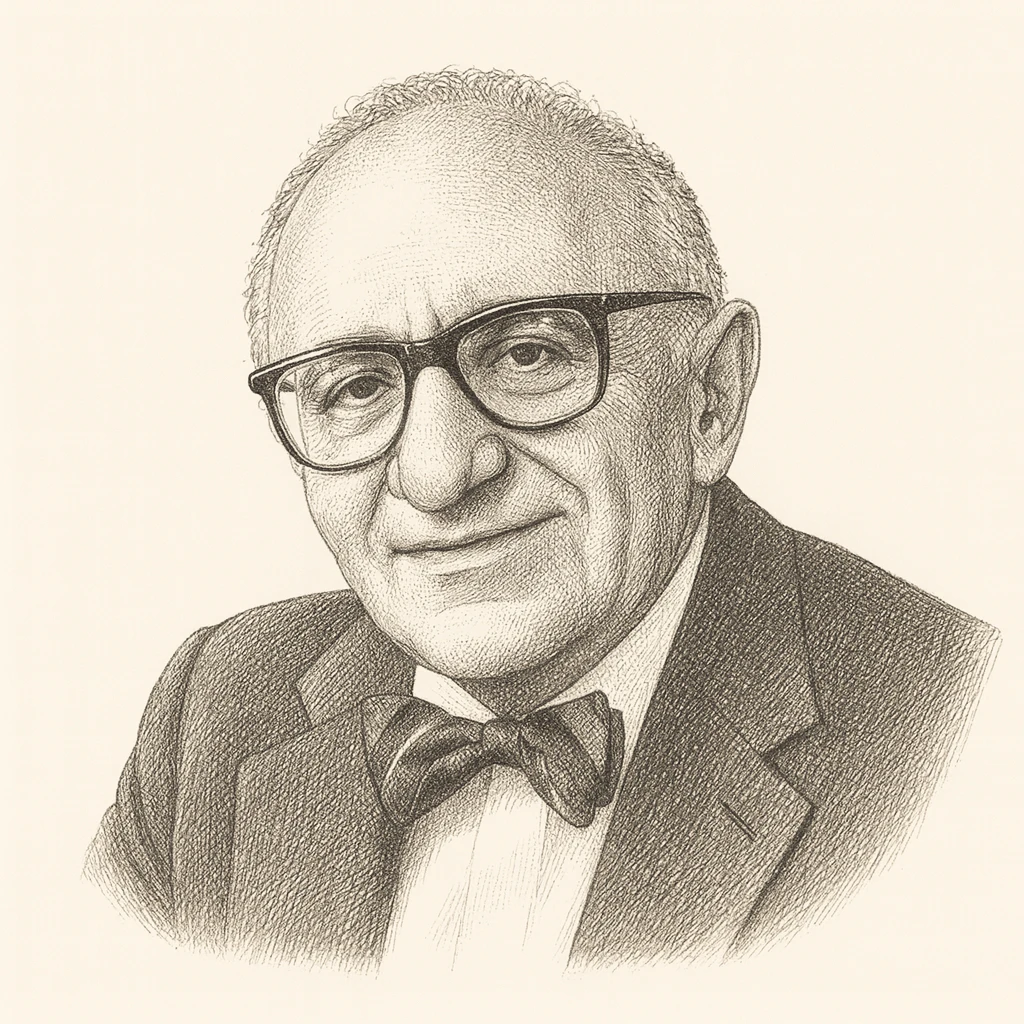
Murray Rothbard was the most prolific and systematic libertarian theorist of the 20th century, a polymath economist, historian, and philosopher who took Austrian economic theory and pushed it to its most radical logical conclusion: the complete abolition of the state in favor of voluntary market provision of all social functions, including law and security. The tradition he founded, anarcho-capitalism, remains one of the most distinctive American contributions to political philosophy, and his influence on contemporary libertarian and classical liberal thought is difficult to overstate. He was also a political activist who switched alliances repeatedly, moving from the Old Right to the New Left, then to the Libertarian Party and the Cato Institute, and finally to the paleoconservatives; his reputation within the libertarian tradition remains contested.
Rothbard was born in 1926 in the Bronx to Jewish immigrant parents from Poland. He was intellectually precocious, attended Columbia University, and there encountered Ludwig von Mises through his writings and eventually in person at Mises's famous private seminar in New York. Rothbard became one of Mises's most devoted students, absorbing the Austrian economic framework and the broader classical liberal political philosophy that Mises had brought with him from prewar Vienna. But Rothbard was always more radical than his teacher. Where Mises had defended classical liberalism and a minimal state, Rothbard came to believe that the state itself was illegitimate and that consistent libertarianism required its abolition.
Rothbard's major theoretical contribution was the systematic development of anarcho-capitalist political philosophy, most fully worked out in his 1973 book For a New Liberty and his 1982 treatise The Ethics of Liberty. His argument proceeded from a simple first principle: self-ownership. Every person owns themselves and, by extension, the product of their labor. All legitimate social relationships arise from voluntary exchange among self-owning individuals. Any relationship involving coercion — the use or threat of force against non-aggressors — is illegitimate by definition. But the state is precisely an institution that maintains its existence through coercion. It taxes people who have not consented to be taxed. It imposes laws on people who have not agreed to them. It claims a monopoly on the legitimate use of force within its territory. Every one of these activities, Rothbard argued, would be criminal if carried out by any other institution. The state, therefore, is criminal, and consistent libertarianism must be anarcho-capitalist.
What distinguished Rothbard's anarchism from other anarchist traditions was his full embrace of private property and market exchange. Where left-wing anarchists typically opposed private property as a form of coercion, Rothbard argued that private property was the necessary foundation of voluntary social order. Markets would provide all the services currently monopolized by the state, including law enforcement, courts, and defense, through private security firms, private arbitration services, and competing protection agencies. This framework raised obvious questions about whether such a system could actually function in practice, and those questions have been debated among libertarians ever since, but the theoretical framework Rothbard established became the foundation for an entire tradition of anarcho-capitalist thought.
Rothbard's influence extended beyond pure theory. He was a founder of the Libertarian Party in 1971, though he later broke with it multiple times over strategic disagreements. He was a co-founder of the Cato Institute in 1977, though he was expelled in 1981 after disagreements with its other founders. He co-founded the Ludwig von Mises Institute in 1982 with Lew Rockwell, and that institute became his primary intellectual home for the rest of his life. He wrote voluminously on economic history, producing among other works a multi-volume history of economic thought that rehabilitated thinkers who had been written out of the standard mainstream economic narrative. He also wrote on American history, foreign policy, monetary theory, and the theoretical foundations of libertarianism.
Rothbard's late-career alignments have remained one of the most controversial aspects of his legacy. In the 1990s, he and Lew Rockwell developed what they called "paleo-libertarianism," which sought to build a political alliance between libertarians and paleo-conservatives around shared opposition to the welfare state, foreign interventionism, and what they saw as the cultural excesses of the left. This strategy involved tactical alliances with figures like Pat Buchanan and led to the publication of newsletters under Ron Paul's name that contained material many libertarians later repudiated as racist and homophobic. The paleo-libertarian experiment shaped the direction of parts of the contemporary libertarian movement in ways that remain hotly debated within the tradition.
Rothbard died in 1995 in New York, aged sixty-eight, having spent his final years writing what would become his four-volume history of economic thought and continuing to guide the Mises Institute. His theoretical framework, whatever one makes of his political alliances, remains one of the most rigorous and influential statements of radical libertarian philosophy ever produced. The anarcho-capitalist tradition he founded has grown substantially since his death, particularly through the work of Hans-Hermann Hoppe and others at the Mises Institute, and his influence on contemporary libertarian thought runs through nearly every major debate in the tradition.
Murray Rothbard is associated with Anarcho-Capitalist. See the archetype