
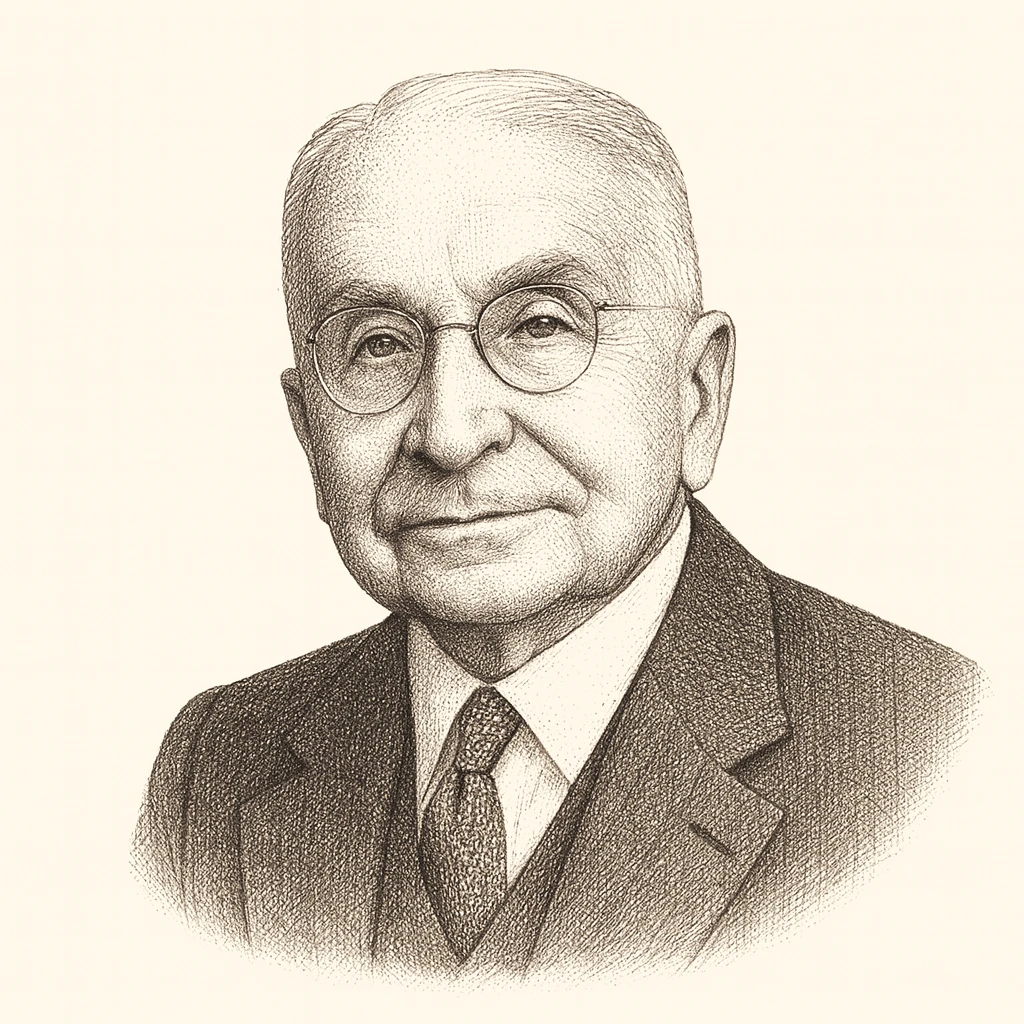
Ludwig von Mises spent his career making an argument that almost everyone in his profession thought was wrong, and then watching most of his profession come around to it half a century later. The argument, in its briefest form, was that socialism could not work — not because it was unjust or inefficient or politically dangerous, though Mises thought it was all those things, but because it was technically impossible. A socialist economy, Mises argued, would have no way to calculate the relative scarcity of resources without the price signals that free markets generate, and without those signals, central planners would be flying blind. The result would not be a more rational economy but a less rational one, lurching from shortage to shortage, unable to coordinate production with actual human needs. Mises made this argument in 1920, in an article called "Economic Calculation in the Socialist Commonwealth." Most of the economics profession dismissed it. The collapse of the Soviet bloc seventy years later vindicated him so thoroughly that even his most committed opponents had to concede the basic point.
Mises was born in 1881 in Lemberg, then part of the Austro-Hungarian Empire (now Lviv, Ukraine), into a Jewish family. He studied at the University of Vienna with Eugen von Böhm-Bawerk, the second-generation leader of what was already being called the Austrian School of economics. The Austrian School, founded by Carl Menger in the 1870s, had developed a distinctive approach to economic theory centered on individual decision-making, the role of time in economic processes, and the limits of mathematical modeling in capturing economic reality. Mises absorbed this tradition and extended it. His early book The Theory of Money and Credit (1912) was a major contribution to monetary theory and helped establish him as one of the leading economists of his generation.
The political environment in interwar Vienna was hostile to almost everything Mises believed in. Austria was experimenting with socialist policies. The Austrian School was being marginalized within the economics profession by mathematical and Keynesian approaches that Mises thought were fundamentally misguided. As a Jewish liberal, Mises was also increasingly threatened by the rising tide of antisemitism and nationalism in Central Europe. In 1934, with the Nazi threat growing, he left Vienna for Geneva, where he taught at the Graduate Institute of International Studies for six years. In 1940, with German troops approaching Switzerland, he fled to the United States, arriving in New York with almost nothing.
Mises spent the rest of his life in the United States, mostly in New York, where he held a series of unpaid or underpaid academic positions, including a "visiting professorship" at New York University that he held for nearly a quarter century without ever being given a regular faculty appointment. The American economics profession of the mid-20th century was dominated by Keynesian and mathematical approaches that had no use for Austrian methodology, and Mises was treated as a kind of intellectual relic for most of his career in America. He nevertheless produced his most important work during this period, including Human Action (1949), the massive treatise that systematized his entire economic and political philosophy and became the foundational text of postwar libertarian thought.
Human Action is one of the strangest major works of 20th century economics. It runs to over a thousand pages and treats economics as a branch of what Mises called "praxeology" — the general science of human action. Mises argued that economic laws could be derived from the basic axiom that human beings act purposefully, choosing means to achieve ends, in conditions of scarcity. From this axiom, Mises thought, all the major conclusions of economic theory could be deduced through pure reasoning, without the need for empirical testing or mathematical modeling. This methodology was rejected by mainstream economics, which was moving in the opposite direction toward econometrics and formal modeling, but it gave Mises a powerful framework for defending free markets against every form of state intervention. The book's combination of methodological purity and political conviction made it a kind of bible for the postwar libertarian movement.
Mises died in New York in 1973 at ninety-two. By the end of his life, his ideas were being rediscovered by a generation of younger economists, libertarian intellectuals, and political activists who saw the failures of central planning being borne out exactly as Mises had predicted. His student Friedrich Hayek won the Nobel Prize in Economics the year after Mises's death and gave a Nobel lecture explicitly crediting Mises as the figure who had taught him the most. The Mises Institute, founded in 1982, has spent the last four decades publishing his work, training new generations of Austrian economists, and keeping his uncompromising version of classical liberalism in continuous circulation. The triumph of his ideas, when it came, was posthumous and partial — most economists today would not call themselves Austrians — but on the question that defined his career, the question of whether socialism could work, history vindicated him as fully as any economist has ever been vindicated.
Ludwig von Mises is associated with Anarcho-Capitalist. See the archetype