
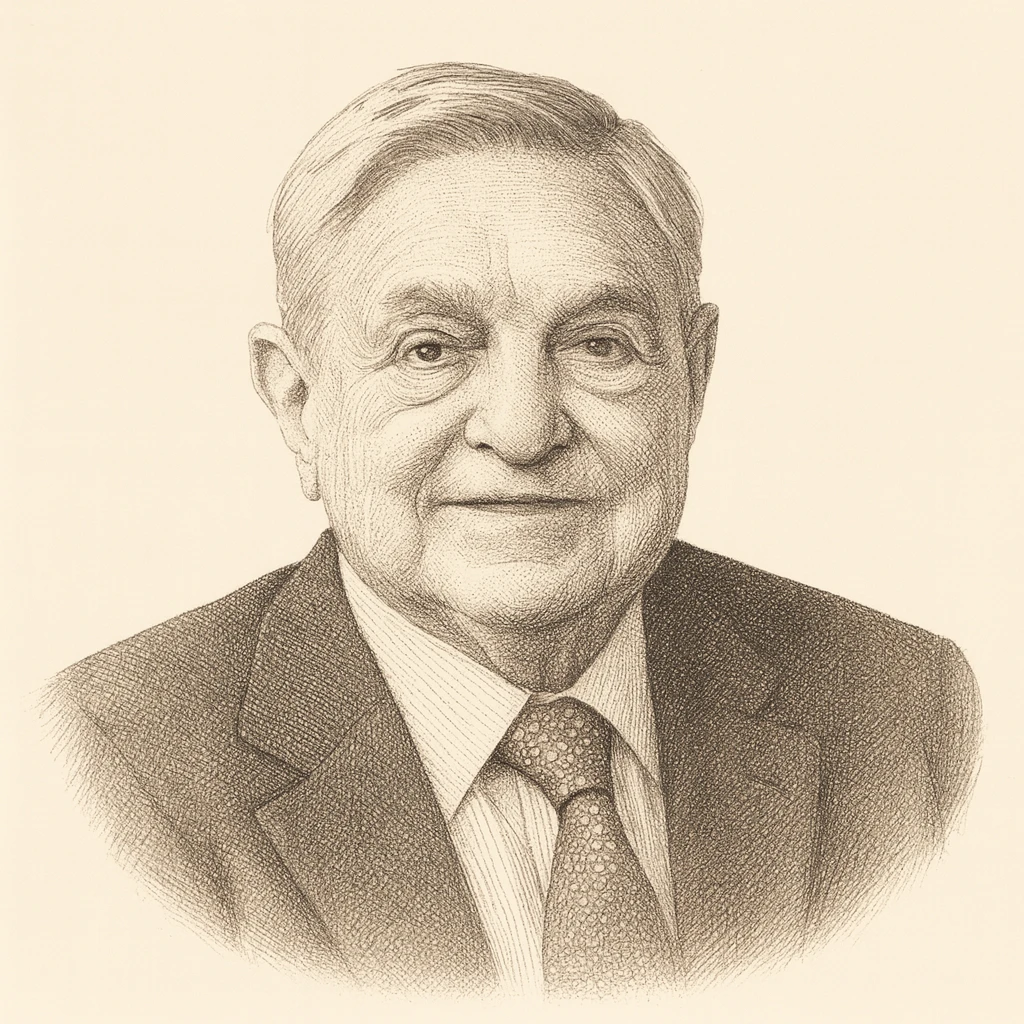
George Soros (born 1930) survived the Nazi occupation of Budapest as a Jewish teenager, emigrated to London, and studied at the London School of Economics under the philosopher Karl Popper, whose idea of the "open society" — a polity that institutionalizes fallibility through free debate, rule of law, and correctable government — became the organizing conviction of his public life. He made his fortune as a hedge-fund manager: his Quantum Fund produced one of the great investing records of the twentieth century, and his 1992 bet against sterling, which forced the pound out of the European exchange-rate mechanism, earned him the epithet "the man who broke the Bank of England."
His intellectual signature is reflexivity, developed in The Alchemy of Finance (1987): the argument that market participants' biased perceptions shape the fundamentals they are trying to perceive, so markets tend toward boom-bust distortion rather than equilibrium. He offered it as both a trading edge and a philosophical claim — a Popperian case that certainty is unavailable and institutions must be built for error-correction.
His philanthropy operationalized that philosophy at unprecedented scale. Beginning with scholarships for Black South Africans under apartheid and support for dissidents in communist Eastern Europe, the Open Society Foundations grew into a global network to which he has transferred more than thirty billion dollars, funding independent media, universities, legal-aid groups, and democracy promotion. In American politics he became a leading Democratic donor after opposing the Iraq War, and later a major funder of criminal-justice reform, including progressive district-attorney campaigns. He handed the foundations' chairmanship to his son Alexander in a succession announced in 2023.
Soros's significance now exceeds his own activity. For admirers he is the era's great institutional liberal, spending private wealth to defend open societies against authoritarianism. The case against him is that he wields unaccountable donor power to impose cosmopolitan values on unwilling publics. And for a global conspiracy culture — much of it recycling antisemitic tropes — "Soros" has become a symbol detached from the man, invoked wherever nationalist movements need a face for the liberal order they oppose.
George Soros is associated with Establishment Progressive. See the archetype