
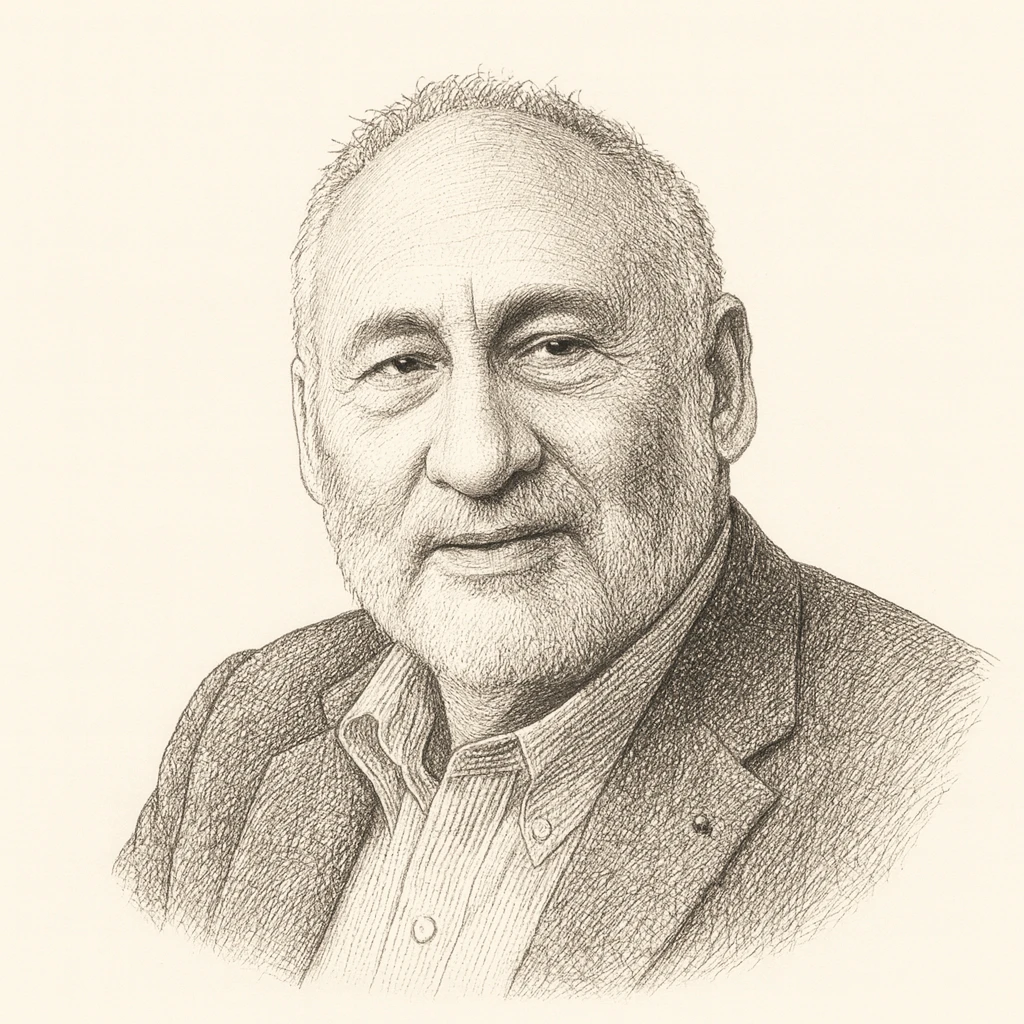
Joseph Stiglitz is an American economist whose theoretical work and public advocacy have made him one of the most influential critics of unregulated markets. His scholarly reputation rests on the economics of information—particularly the analysis of markets in which participants have unequal or imperfect knowledge, work for which he shared the Nobel Memorial Prize in Economic Sciences. By demonstrating that information asymmetries routinely prevent markets from reaching efficient outcomes, Stiglitz supplied rigorous foundations for a politics skeptical of the claim that free markets are self-correcting and welfare-maximizing. This body of work positioned him against the strand of economic liberalism that treats minimal state intervention as the default and lent intellectual support to arguments for regulation and public action.
Stiglitz became a prominent public figure through his roles in policymaking and international institutions, including service in the U.S. government as a senior economic adviser and later as chief economist of the World Bank. Drawing on these experiences, he emerged as a sharp critic of the policy prescriptions associated with the so-called Washington Consensus—rapid liberalization, deregulation, and austerity—arguing that they were often imposed on developing countries without regard to institutional realities and imposed heavy social costs. His critique of how globalization has been managed, and of the governance of institutions such as the International Monetary Fund, made him a reference point for movements seeking a more equitable international economic order.
Inequality is the central political theme of Stiglitz's later work. He has argued that rising concentrations of income and wealth are not simply the natural result of impersonal market forces but reflect political choices, rules, and the exercise of market power—what he describes in terms of rent-seeking and the capture of policy by concentrated interests. On this view, inequality is both an economic inefficiency and a threat to democratic legitimacy, because economic power translates into political power. These arguments have made him an intellectual touchstone for center-left and progressive politics, informing calls for stronger public investment, progressive taxation, and regulation of finance.
Stiglitz is thus associated with a tradition that revives Keynesian and welfare-state commitments while grounding them in contemporary economic theory. His significance lies in showing how technical economic analysis can underwrite a substantive political case: that markets require active shaping by democratic institutions, and that unchecked inequality corrodes both economies and the political systems meant to govern them.
Joseph Stiglitz is associated with Progressive Activist. See the archetype