
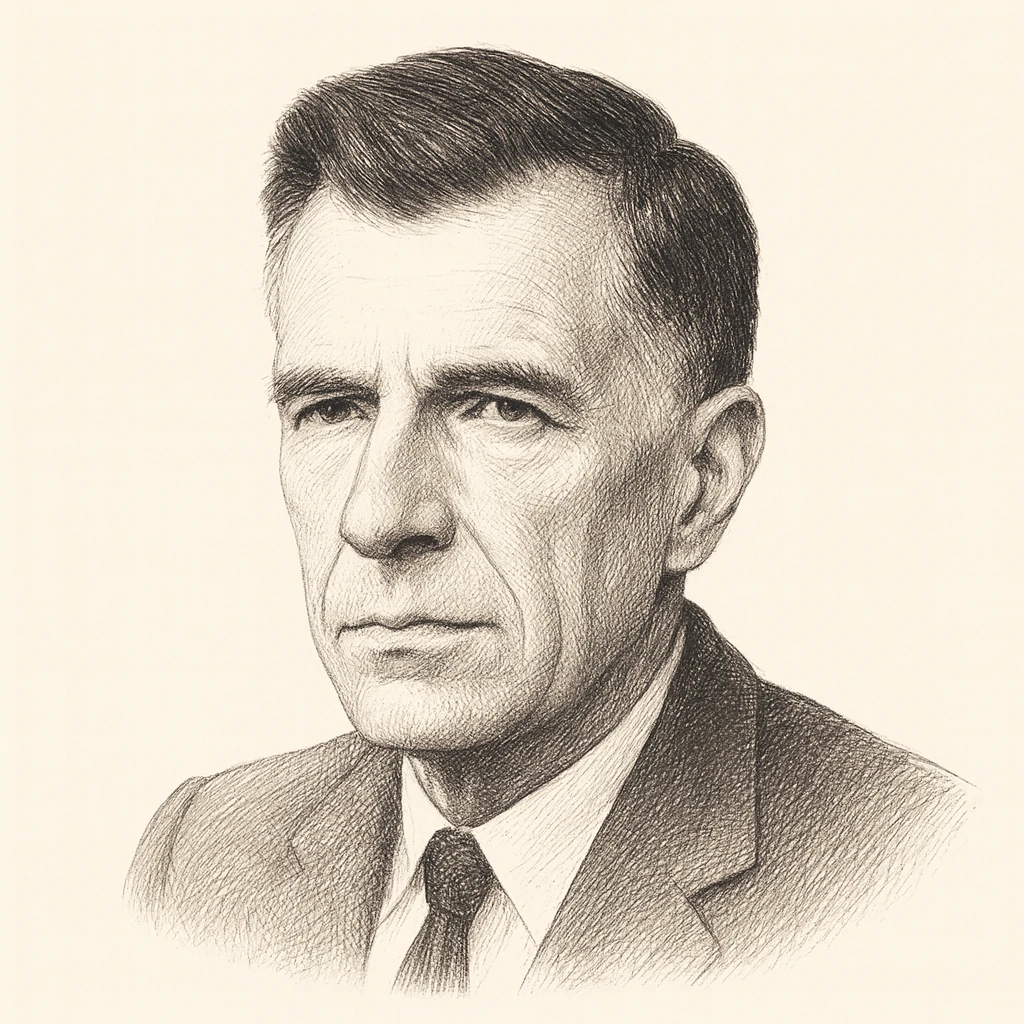
John Kenneth Galbraith was born in 1908 in Iona Station, Ontario, a farming community near Lake Erie, the son of a Scottish-Canadian schoolteacher and farmer of strong opinions and genuine intellectual ambition. He grew up in a rural community where his father was also a local political figure — an organizer for the United Farmers of Ontario, a man who took politics seriously as a practical craft rather than a spectator sport — and absorbed both the egalitarian skepticism of agrarian politics and the sense that economic arrangements were not natural facts but human choices that could be made differently. He was six feet eight inches tall by the time he stopped growing, a physical presence that compelled attention and that he used to full effect throughout a career that was as much performance as analysis.
He attended Ontario Agricultural College at Guelph, studying agricultural economics, and then went to the University of California at Berkeley for his doctorate, where he encountered the American institutional economics tradition — Thorstein Veblen and his successors who were skeptical of the neat fictions of classical economic theory. He spent a postdoctoral year in Cambridge in 1937-38, where he encountered Keynes himself and absorbed the Keynesian revolution at its source. Keynes's demonstration that market economies were not self-correcting machines that automatically reached full employment equilibrium — that they required active management through fiscal policy — transformed economic thinking, and Galbraith was among the first generation of American economists to absorb the lesson thoroughly and apply it systematically.
His wartime work proved as important to his intellectual formation as his academic training. He served from 1941 to 1943 as deputy administrator of the Office of Price Administration, responsible for price control in the American wartime economy — an experience that gave him direct, practical knowledge of how large organizations actually worked, of the gap between the economic textbook's competitive markets and the administrative reality of organized industrial capitalism. He watched large corporations navigate price controls with the ease of institutions that had become accustomed to managing their environments rather than responding to them, and this observation — that the large corporation was not a price-taker but a price-maker and market-maker — became one of the central insights of his later theoretical work. He also absorbed, from the wartime experience, the lesson that collective economic management was not only possible but effective, and that the postwar case for laissez-faire was being made in the face of evidence that large-scale government coordination of economic activity worked rather well.
He joined the Harvard faculty after the war, in the economics department whose luminaries included Alvin Hansen and Seymour Harris, and spent his career there writing books that his academic colleagues found simultaneously impressive and suspicious — impressive for their clarity and range, suspicious for their popularity and their willingness to engage in policy advocacy that the profession increasingly regarded as beneath its scientific dignity. He was aware of this tension and not especially troubled by it: he believed that economics was ultimately a moral and political subject, that its purpose was to improve human life, and that academic professionalism was a poor excuse for silence on questions that mattered.
The Affluent Society (1958) was the book that made his name. Its opening argument was about the inadequacy of what he called "conventional wisdom" — a phrase he coined and that has entered the language — the inherited concepts of classical economics that had been designed for conditions of scarcity and were now being applied mechanically to conditions of abundance. The real problem was not insufficient production but maldistribution: private affluence coexisting with public squalor. American families drove gleaming automobiles through dirty streets to inadequate schools. The reason was not resource scarcity but political ideology — the inherited conviction that private spending was inherently productive and public spending inherently wasteful. His case for better balance between private and public investment was the intellectual foundation for the Great Society programs that Lyndon Johnson would launch six years later.
The New Industrial State (1967) went further. The large modern corporation did not respond passively to market signals; it planned its environment, managing demand through advertising, lobbying governments for favorable regulation, and deploying its managerial technostructure as the real power center of economic life. This convergence between large corporations and large state enterprises — both organized around administrative planning rather than price-taking market response — challenged the ideological distinction between capitalism and socialism in ways that neither capitalists nor socialists found comfortable. His later books — Economics and the Public Purpose (1973), The Culture of Contentment (1992) — extended these themes through the stagflation crisis, the Reagan decade, and the early 1990s with consistent analytical framework and increasingly dark conclusions about whether democratic politics could maintain the attention required to address structural inequality.
He served as Kennedy's ambassador to India from 1961 to 1963 — a posting he accepted partly for the Indian connection his academic work had not supplied — and was a persistent voice against the Vietnam War from early in the escalation, when such opposition was still lonely within the Democratic establishment. He advised Democratic presidential candidates from Adlai Stevenson through Walter Mondale, and his influence on the party's economic thinking was enormous even as the party moved away from the Keynesian consensus he represented. He died in 2006 at ninety-seven, still writing, having outlived most of the intellectual framework he had helped build and watched its displacement by the neoliberal consensus he had spent his career opposing.
John Kenneth Galbraith is associated with Establishment Progressive. See the archetype