
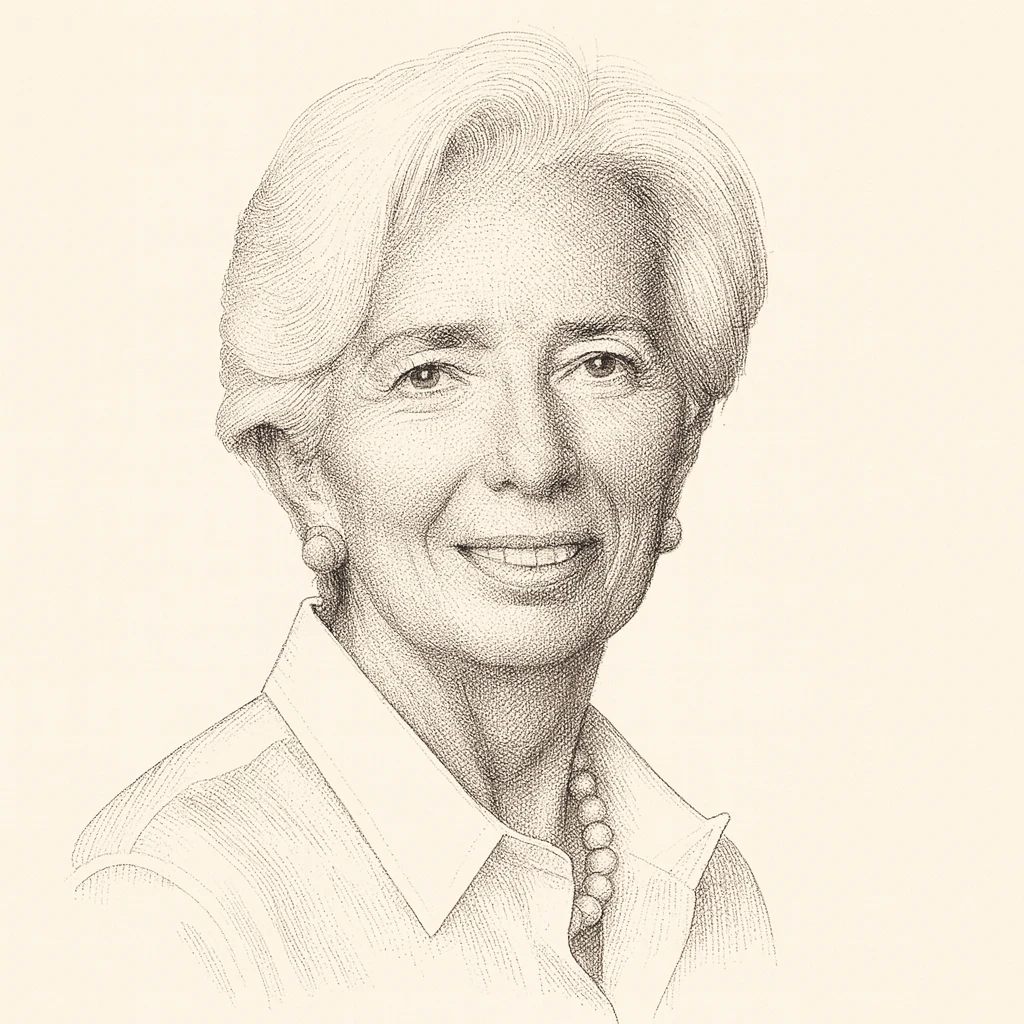
Christine Lagarde is a French politician and lawyer whose career has placed her at the center of the institutions that manage the global and European economies. Trained as a lawyer and having led the international firm Baker McKenzie before entering French government, she served as finance minister under President Nicolas Sarkozy, becoming a prominent figure in coordinating responses to the 2008 financial crisis. She went on to head the International Monetary Fund and subsequently the European Central Bank. Her career embodies a technocratic, managerial approach to political economy in which economic stability, institutional credibility, and international cooperation are treated as paramount public goods.
Lagarde's political thought is not systematic or ideological but pragmatic and centrist, rooted in the liberal internationalist tradition that sees open markets, multilateral institutions, and rules-based coordination as the framework for prosperity and stability. At the IMF she became associated with debates over austerity, sovereign debt, and the terms of crisis lending, particularly during the eurozone turmoil involving Greece and other member states. While the IMF under her leadership remained committed to fiscal discipline and structural reform, she also voiced concern about the social costs of adjustment and the risks of inequality, reflecting a recognition that economic policy carries deep political consequences for democratic legitimacy.
A recurring theme in her public arguments is the link between economic governance and broader questions of inclusion. She has repeatedly emphasized the economic case for greater participation of women in the labor force and in leadership, framing gender equality as a matter of growth and stability rather than solely of rights. She has also drawn attention to climate change and financial risk, arguing that central banks and financial institutions cannot ignore long-term structural threats to economic order.
Her influence lies less in original theory than in her role as a steward and communicator of the postwar liberal economic order at a moment when that order faces populist and nationalist challenges. As a defender of multilateralism, European integration, and institutional independence, she represents a strand of political thinking that trusts expert-led, cooperative management of complex economies. Critics from both left and right question whether such technocratic governance is sufficiently accountable or responsive, making her a focal point in ongoing debates about the relationship between democratic politics and unelected economic authority.
Christine Lagarde is associated with Cosmopolitan. See the archetype