
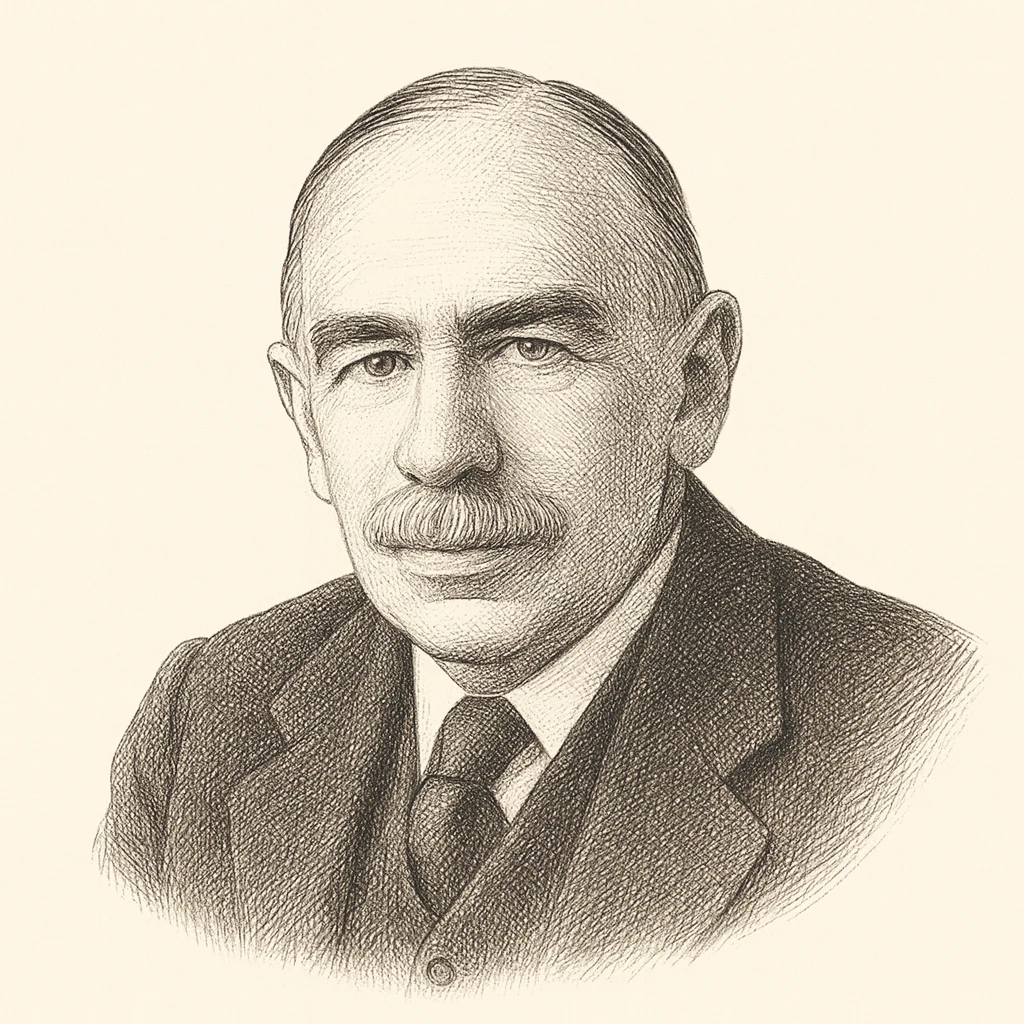
John Maynard Keynes is often remembered as a technical economist, and he was that, but reducing him to economics obscures his larger importance. He was a political philosopher whose theoretical work on how modern capitalist economies actually functioned became the intellectual foundation for the mixed-economy welfare state that defined mid-20th century Western liberal democracy. The New Deal, British postwar social democracy, the Bretton Woods international economic order, and the broader political compromise between markets and state provision that shaped the Western world from 1945 to the 1970s were all built on Keynesian foundations. His influence on 20th century political thought is comparable to that of Marx in the 19th century: a single theorist whose framework came to define a whole era of political and economic possibility, and whose decline in influence marked the end of that era.
Keynes was born in 1883 in Cambridge, England, into an academically elite family. His father was an economist at Cambridge; his mother was the first female mayor of Cambridge; the family was deeply embedded in the intellectual culture that made Cambridge one of the most productive universities in the world during his lifetime. He attended Eton, then King's College Cambridge, where he was taught by Alfred Marshall, the leading British economist of the late 19th century. He absorbed the classical economic framework that Marshall represented, became part of the Bloomsbury Group of writers and artists (Virginia Woolf, Lytton Strachey, E.M. Forster), and began a career that would combine academic economics, government service, financial speculation, and public intellectual work across six decades.
Keynes first became internationally prominent with The Economic Consequences of the Peace (1919), his devastating critique of the Treaty of Versailles that had ended World War I. Keynes had served as a British Treasury official at the Paris Peace Conference and had resigned in protest over the punitive reparations demanded of Germany. His book argued, with extraordinary clarity and moral force, that the treaty's economic provisions would make Europe's recovery impossible, would destroy the international economic order that had underpinned prewar prosperity, and would eventually produce political consequences more dangerous than anything the victors had intended. The prediction turned out to be accurate. The book made Keynes famous and established his reputation as a public intellectual whose judgment mattered.
His major theoretical contribution came seventeen years later with The General Theory of Employment, Interest and Money (1936), the single most important work of 20th century economic theory. The book was written during the Great Depression, when classical economic theory had predicted that capitalist economies would automatically return to full employment but the actual economies of the 1930s were doing nothing of the kind. Keynes's argument was that classical theory had misunderstood how modern capitalist economies actually worked. Capitalist economies, Keynes argued, could become stuck in prolonged depressions because of problems with aggregate demand — there was nothing in the structure of market capitalism that guaranteed that total spending would be enough to employ all available workers. When private demand collapsed, as it had in the 1930s, government spending could and should step in to restore it, funded by borrowing if necessary and repaid during later periods of prosperity.
This was a technical economic argument, but its political implications were enormous. If Keynes was right, then the classical liberal conclusion that government should stay out of economic management was wrong. Modern capitalist economies required active government intervention to function well. The state had to take responsibility for maintaining aggregate demand, for providing social insurance against the unemployment that capitalist economies would periodically produce, and for managing the international economic order in ways that classical liberalism had considered beyond its proper scope. Keynes's framework provided the intellectual foundation for the transformation of Western liberal democracy from the classical liberal night-watchman state of the 19th century into the mid-20th century welfare state, and it shaped policy debates across the entire political spectrum for decades.
Keynes's political philosophy was more sophisticated than "pro-government intervention." He was himself a committed liberal who believed deeply in individual freedom, private markets, and capitalist dynamism. His argument was not against capitalism but for saving it from its own destructive tendencies. He saw the 1930s as a moment when classical liberalism was collapsing and the choice facing Western civilization was between fascism, communism, and some kind of reformed capitalism. Keynesianism was his attempt to provide the intellectual foundation for the third option — a mixed economy in which markets did most of the economic work but the state managed overall demand, provided social insurance, and prevented the periodic collapses that would otherwise destroy democratic legitimacy.
Keynes's public service during and after World War II was as influential as his academic work. He was the chief British negotiator at the Bretton Woods conference in 1944, which established the postwar international economic order including the IMF and the World Bank. His proposals for international economic cooperation went further than the American position allowed, but the framework that emerged from Bretton Woods was substantially shaped by his ideas. He died in 1946 at sixty-three, exhausted by wartime and postwar work, before the full Keynesian era that his work had made possible had really begun. For the next thirty years, Keynesian economics was the dominant framework for Western economic policy. The 1970s crisis of stagflation discredited Keynesian management and opened the door for the neoliberal revival of Hayekian classical liberalism, and since then the political economy of Western democracies has been contested ground between Keynesian and post-Keynesian frameworks.
John Maynard Keynes is associated with Social Liberal. See the archetype