
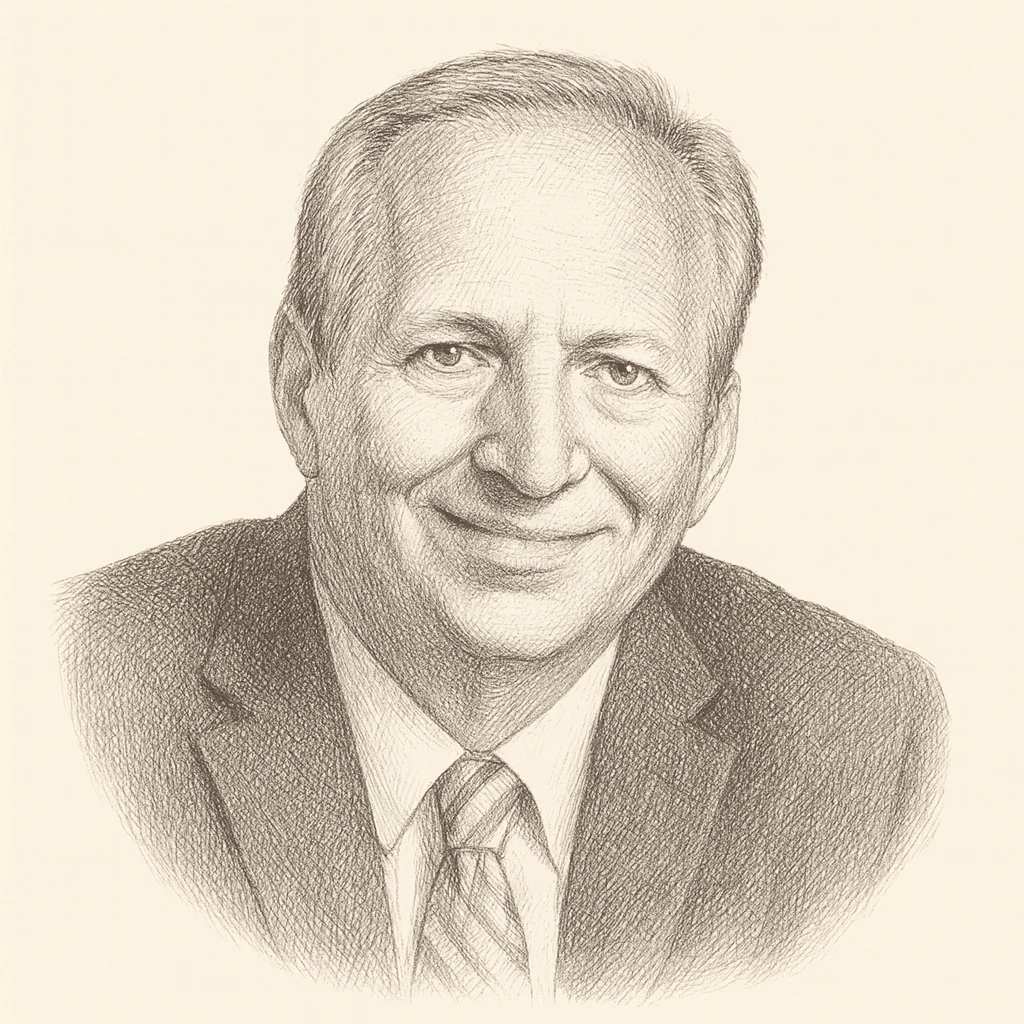
Lawrence H. Summers is an American economist whose career bridges elite academic economics and the highest levels of policymaking, making him one of the most influential voices in center-left economic thought since the 1990s. A precocious scholar who became one of the youngest tenured professors at Harvard, Summers went on to serve as Chief Economist at the World Bank, Treasury Secretary in the Clinton administration, President of Harvard University, and Director of the National Economic Council under President Obama. Across these roles he came to embody a particular strand of pragmatic, market-oriented liberalism often associated with the Clinton-era Democratic Party, combining confidence in market mechanisms and free trade with a belief in the state's capacity to stabilize and correct economies.
Summers's political thought is rooted in mainstream Keynesian-influenced macroeconomics tempered by a strong regard for market efficiency. During the 1990s he was associated with policies favoring globalization, financial liberalization, and fiscal discipline, an orientation that later drew criticism from both the populist right and the progressive left, who linked such policies to financial fragility and rising inequality. His tenure has thus become a reference point in debates over whether the technocratic, pro-globalization consensus of that era served or failed ordinary workers.
In more recent years Summers has been central to two major economic-policy debates. He revived and popularized the concept of "secular stagnation," arguing that advanced economies may suffer from chronically weak demand and low interest rates requiring sustained public investment. Later, he became a prominent early warning voice about inflation risks following large-scale pandemic-era fiscal stimulus, breaking with many fellow Democrats and arguing that overheating was a serious danger. This positioned him as an internal critic of his own party's more expansive spending ambitions and reinforced his reputation as a contrarian technocrat willing to challenge political orthodoxy.
Summers's broader influence lies less in a single doctrine than in his role as an interlocutor shaping how policymakers and commentators frame economic choices. He represents a tradition that treats economics as the central discipline of governance, favoring empirical analysis and expert judgment over ideological commitment. Admirers see him as a rigorous, independent-minded steward of sound policy; critics view him as emblematic of an insular expert class whose confidence contributed to crises it failed to foresee. Either way, his arguments continue to structure debates about growth, inequality, and the proper scope of government intervention.
Larry Summers is associated with Cosmopolitan. See the archetype