
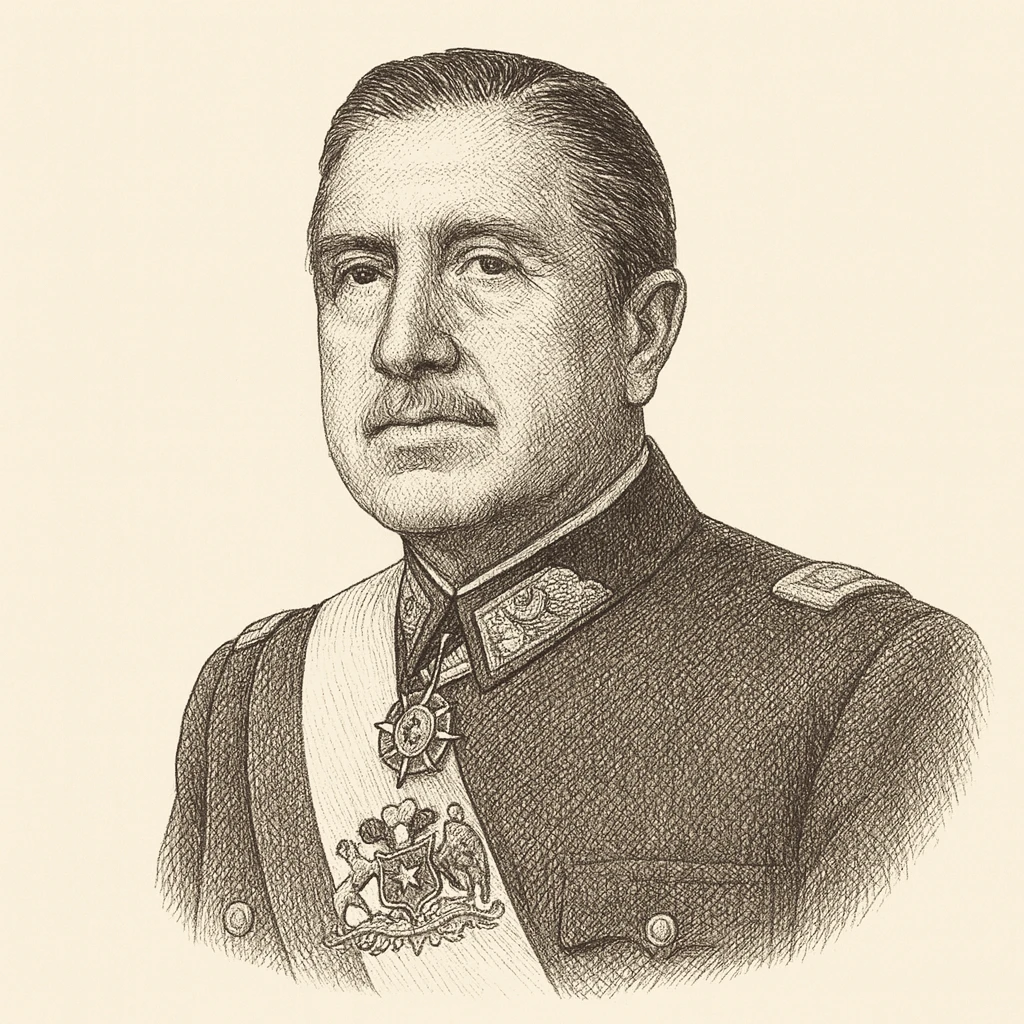
Augusto Pinochet was the Chilean general who overthrew the democratically elected socialist president Salvador Allende in 1973 and ruled Chile as military dictator until 1990. His regime combined violent political repression with radical free-market economic reforms.
The 1973 coup ended Allende's socialist experiment. The United States had covertly funded Allende's opponents since 1970; a 2000 CIA report to Congress found that the agency did not instigate the coup but knew of the plotting and actively supported the junta afterward. Thousands were killed, tortured, or disappeared by Pinochet's security forces; Chile's official truth commissions, beginning with the Rettig Report of 1991, documented more than 3,000 people killed or disappeared and tens of thousands imprisoned or tortured. Operation Condor coordinated repression across South American dictatorships. Pinochet justified this violence through the doctrine of national security, which defined the military's task as defeating a domestic Marxist enemy that had infiltrated the nation's institutions.
Simultaneously, Pinochet implemented economic policies advised by 'Chicago Boys'—Chilean economists trained under Milton Friedman at the University of Chicago. Privatization, deregulation, and free trade produced growth but also inequality and economic crises. The Chilean case became a reference point in debates over whether market liberalization requires or is compatible with political freedom. Friedman, who lectured in Chile in 1975, argued that free markets would ultimately undermine political centralization and control. Orlando Letelier, a former minister in Allende's government, argued from exile in 1976 that the economic program could only be imposed through repression; later that year he was assassinated in Washington by agents of Pinochet's secret police.
Pinochet's rule was institutionalized through the 1980 constitution, which entrenched military prerogatives and shaped Chilean politics long after his departure. He lost a 1988 plebiscite that he had expected to win and left office in 1990, though he retained influence as army commander and later as senator-for-life. In 1998 he was arrested in London on a Spanish extradition request, and the House of Lords ruled that a former head of state had no immunity from prosecution for torture; Britain released him on health grounds in 2000. He spent his final years fighting extradition and prosecution attempts, and died in 2006 without facing trial for human rights abuses.
Augusto Pinochet is associated with Reactionary Strongman. See the archetype