
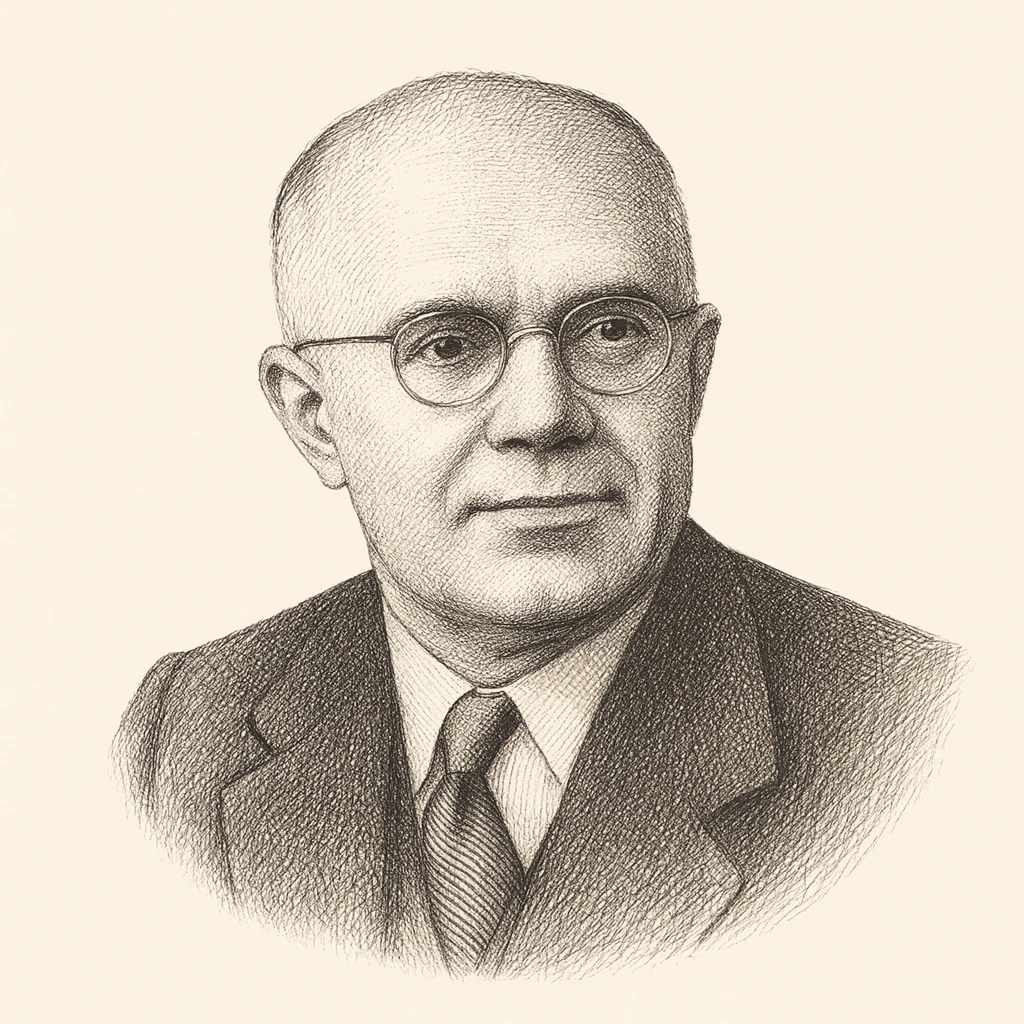
Oskar Lange (1904–1965) was a Polish economist best known for his contributions to the theory of market socialism and to the so-called "socialist calculation debate" of the 1920s and 1930s. Against Ludwig von Mises and Friedrich Hayek, who argued that a socialist economy without private ownership and market prices could not allocate resources rationally, Lange contended that a central planning board could simulate the workings of a market. Drawing on neoclassical general-equilibrium theory, he proposed that planners could set prices provisionally and adjust them iteratively in response to shortages and surpluses—a trial-and-error process analogous to the Walrasian idea of "groping" toward equilibrium. This argument, developed in his writings on the economic theory of socialism, sought to show that efficient allocation did not require capitalist ownership of the means of production.
Politically, Lange's work mattered because it reframed socialism as an economically defensible system rather than merely a moral or political aspiration. He combined a commitment to socialist goals—reducing inequality and subordinating the economy to social ends—with the analytical tools of mainstream Western economics, positioning himself between orthodox Marxism and liberal economics. His model implied that public ownership could be paired with decentralized decision-making and consumer choice, and it became a central reference point for debates about whether planning could rival markets in efficiency.
Lange's career bridged East and West. He studied and taught in Poland and spent years in the United States, where he was associated with academic economics before returning to serve postwar socialist Poland in diplomatic and public roles. This trajectory reflected the tensions of his thought: an economist trained in Western marginalism who placed his expertise in service of a state-socialist project. In his later work he engaged with cybernetics and computation, suggesting that advances in information processing might resolve the practical difficulties of planning that critics had emphasized.
Lange's legacy is contested. Critics, especially in the Austrian tradition, argued that his model underestimated problems of dispersed knowledge, incentives, and political power that no computational or price-adjustment mechanism could overcome. Yet his intervention remains a landmark in twentieth-century political economy, shaping how generations of scholars have thought about the feasibility of socialism, the limits of markets, and the relationship between economic theory and political ideals.
Oskar Lange is associated with Market Socialist. See the archetype