
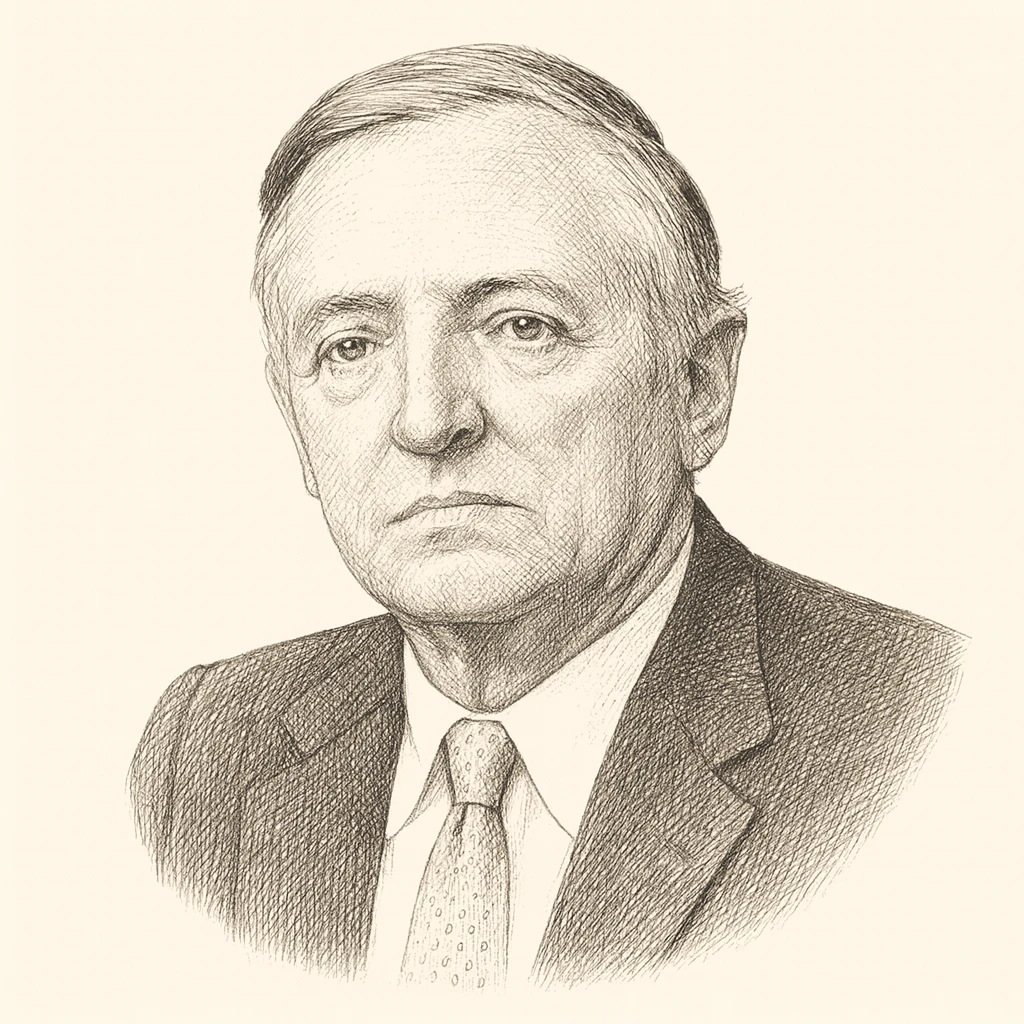
William F. Buckley Jr. was born in 1925 in New York City, the sixth of ten children of William F. Buckley Sr., a self-made Texas oilman who had made and lost and remade a fortune in Mexico, and Aloise Steiner, a New Orleans Catholic of genteel Southern stock. The elder Buckley was a man of forceful opinions and genuine political convictions — he had been expelled from Mexico for opposing the revolutionary government — and the family home, whether in Sharon, Connecticut, or the various other residences the Buckleys maintained on two continents, was saturated with argument, religion, and a confident sense that the prevailing currents of American public life were mistaken. Young Bill absorbed Spanish from Mexican servants before he fully absorbed English, studied in England for two years as a child, and arrived at Yale in 1946 already equipped with the rhetorical self-assurance and the wide reading that would characterize him for the rest of his life.
He served briefly in the army during the war and arrived at Yale in the postwar generation of veterans and younger students, studying political science and economics, writing for the Yale Daily News, and developing the conservatism that would define his public life. His senior thesis — an attack on the liberalism of the Yale faculty and the secular relativism that, in his view, pervaded the university's intellectual culture — became, with revision, God and Man at Yale (1951). Published when he was twenty-five, the book argued that Yale was teaching its students to abandon the religious faith and free-market economics that had made American civilization possible, and doing so under the guise of academic neutrality that was itself a form of liberal ideology. The academy's response was furious; the book sold well and made Buckley a recognizable figure on the right.
The founding of National Review in 1955 was his central institutional achievement. He was twenty-nine, had limited experience in journalism, and was attempting something that most observers thought impossible: a serious conservative intellectual magazine that could compete with the liberal periodicals that dominated American intellectual life. The statement of purpose he wrote announced that the magazine would "stand athwart history, yelling Stop" — a formulation that acknowledged the losing character of the position while insisting on the honor of maintaining it. What made the magazine possible was Buckley's talent for coalition-building: he brought together ex-Communists and Midwestern isolationists, libertarians and traditionalists, Catholics and Protestants, under a broad anti-Communist tent whose internal tensions he managed through a combination of personal charm and editorial authority.
The fusionism he championed — the attempt to reconcile libertarian economic freedom with traditionalist moral order and both with vigorous anti-Communism — was Frank Meyer's theoretical construction, but Buckley made it the practical operating ideology of the American conservative movement. Whether the synthesis was genuine or merely tactical was a question the magazine debated for decades without resolution. What was not tactical was Buckley's role as gatekeeper. He drew a bright line between respectable conservatism and the movements on its fringes, and he defended that line publicly and at considerable personal cost. The John Birch Society, whose conspiracy theories about Communist infiltration were making the entire right look unhinged, was expelled from the movement. The anti-Semitic and neo-fascist elements of the old right were excluded. The paleoconservatives who coalesced around Pat Buchanan in the 1990s were denounced. Each expulsion earned him permanent enemies on the right while giving the movement credibility it would not otherwise have had.
Firing Line, the television program he hosted for thirty-three years beginning in 1966, was the most visible expression of his talent. It was a program on which ideas were taken seriously, opponents were treated with genuine curiosity, and the host's vocabulary — delivered with a distinctive transatlantic drawl acquired from years in England and his mother's Southern locutions — required the occasional dictionary consultation. His guests ranged from Norman Mailer to Huey Newton to Ronald Reagan to Noam Chomsky, and Buckley engaged all of them with a combination of intellectual seriousness and effortless condescension that was entirely his own. The program demonstrated that conservatism could be entertaining as well as principled, and that a conservative intellectual could be a celebrity without becoming merely a showman.
His personal positions evolved in ways that complicated the movement's relationship with him. He opposed the Civil Rights Act of 1964 on states' rights grounds and was deeply embarrassed by this in later years; his columns from the period are among the least defensible of his career, and he acknowledged this. He shifted his views on drug policy toward decriminalization in the 1990s. He grew increasingly skeptical of the Iraq War that the neoconservatives his magazine had helped elevate were championing. By the end of his life he was ambivalent about the movement he had built — convinced that it had become something cruder and less intellectually serious than he had intended, uncertain about the legacy of the fusion he had made possible. He died in February 2008, at his desk, alone, working. He was eighty-two.
William F. Buckley Jr. is associated with Moderate Conservative. See the archetype