
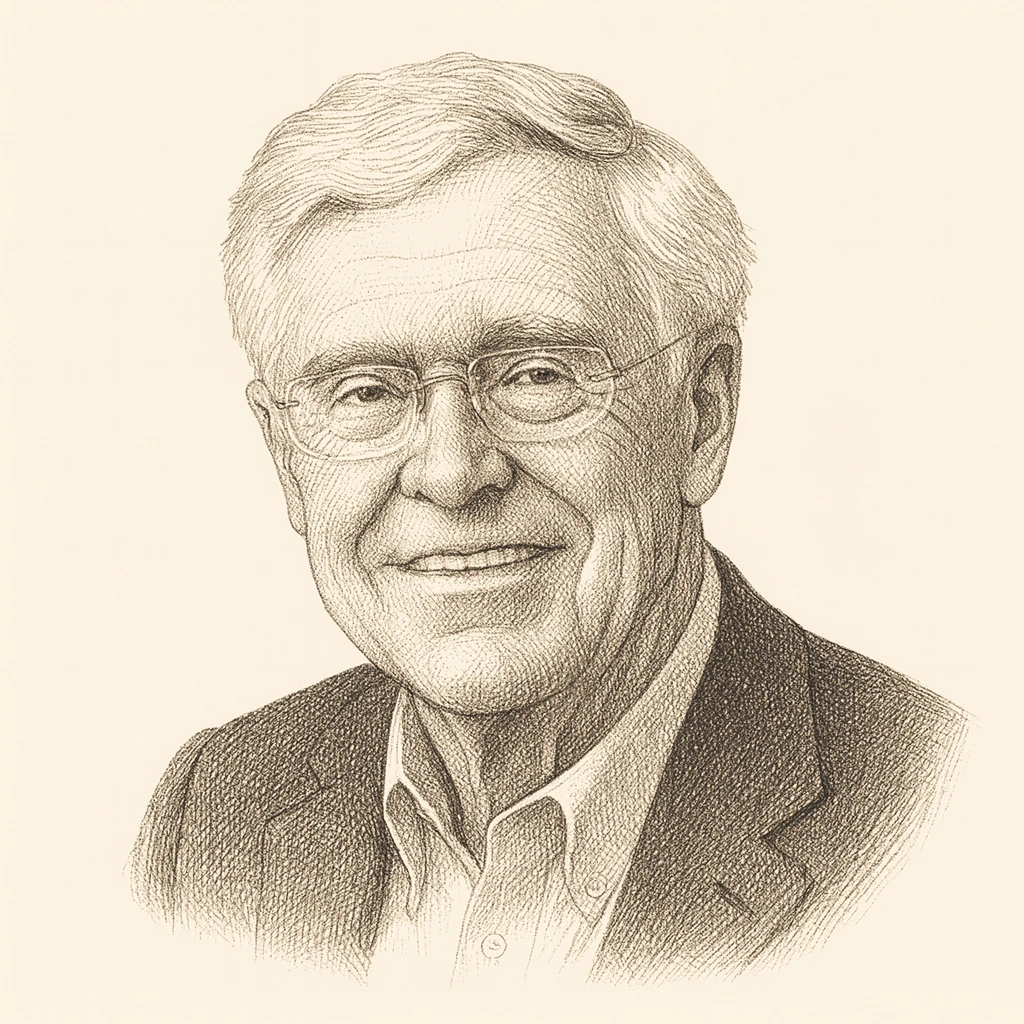
Charles Koch (born 1935) is an American industrialist who, as longtime chief executive of Koch Industries, became one of the most influential funders and organizers of libertarian and free-market politics in the United States. While his business career centered on building a private conglomerate spanning energy, chemicals, and manufacturing, his political significance lies in the decades he spent channeling his wealth into intellectual and advocacy institutions. Beginning in the 1970s, he helped finance the emergence of the modern libertarian movement, supporting think tanks, academic programs, and policy organizations aimed at promoting limited government, deregulation, free markets, and skepticism of state economic intervention.
Koch's political thought draws on the classical liberal and Austrian economic traditions, particularly the work of thinkers such as Friedrich Hayek and Ludwig von Mises, whose emphasis on spontaneous order, individual liberty, and the limits of central planning informed his worldview. He has framed his philosophy in terms of "market-based management" and a broader conviction that voluntary exchange and free enterprise produce human flourishing more reliably than coercive government. He was an early backer of the Cato Institute, a leading libertarian think tank, and over time built and funded a network of donors and organizations—most prominently Americans for Prosperity and, later, the Stand Together network—that sought to move American policy and public opinion in a free-market direction.
His influence has been felt less through original theoretical writing than through the systematic construction of institutional infrastructure: funding scholarship, mobilizing activists, and cultivating a donor community capable of sustained political engagement. Critics across the spectrum have scrutinized this model as an example of concentrated private wealth shaping democratic politics, and the "Koch network" became shorthand in the 2010s for organized conservative and libertarian donor activity. In later years, Koch signaled a partial reorientation, emphasizing bipartisan cooperation on issues such as criminal justice reform, immigration, and free trade, and expressing reservations about polarization and about the direction of populist nationalism within the American right.
Whether viewed as a champion of individual liberty or as an emblem of money's role in politics, Koch stands as a central figure in translating libertarian ideas into organized political force, illustrating how philanthropy, ideology, and institution-building can combine to influence a nation's political trajectory.
Charles Koch is associated with Classical Liberal. See the archetype