
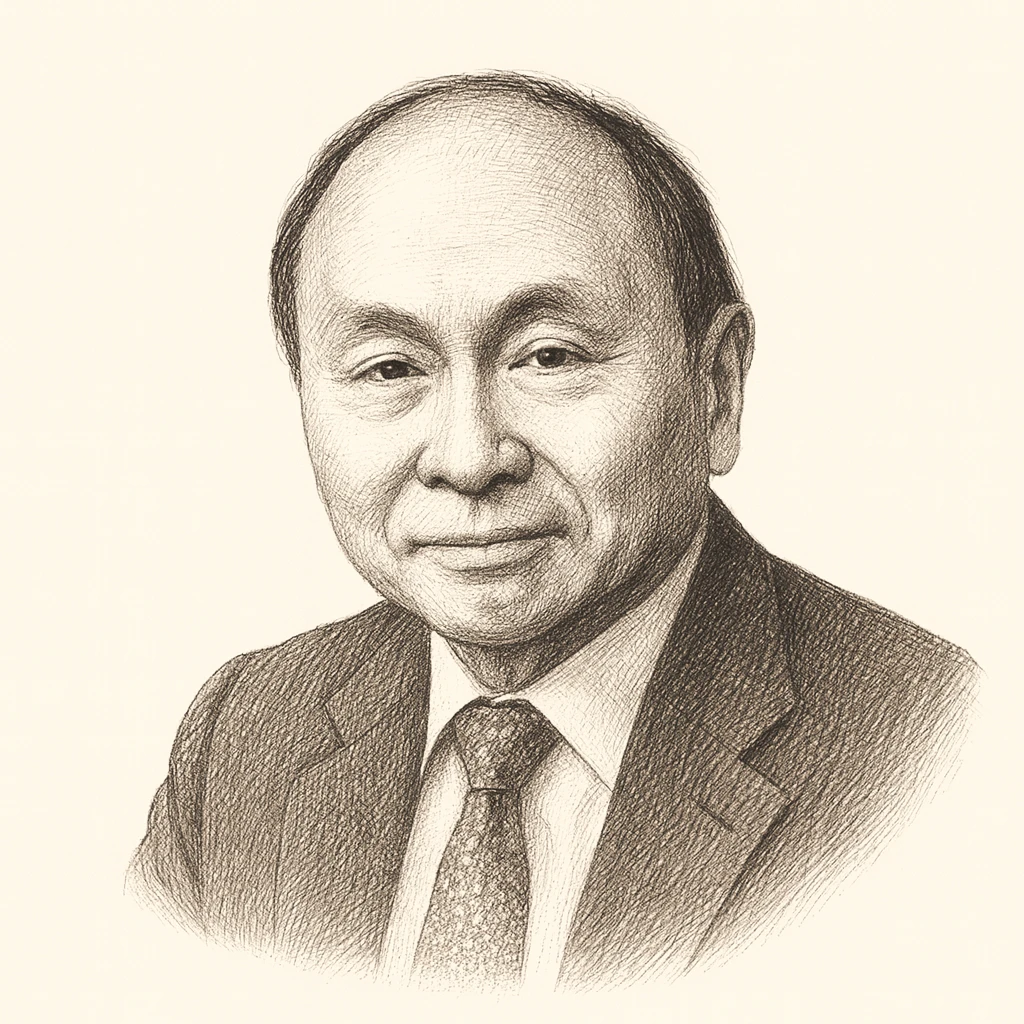
Francis Fukuyama is one of the most widely read and frequently misunderstood contemporary political theorists, a scholar whose 1989 essay "The End of History?" and the 1992 book that followed it became part of the general intellectual vocabulary of the post-Cold War period and whose later work on state capacity, political order, and identity politics has continued to shape contemporary debates about the trajectory of liberal democracy. The popular reception of his "end of history" thesis has typically been a caricature — Fukuyama never argued that history had literally ended or that no further political changes would occur — but the actual argument he made was more careful and more Hegelian than the version that became shorthand in contemporary political discourse. His subsequent career, including his break with the neoconservatism he had earlier been associated with, his development of a framework for thinking about state capacity as a central problem of political development, and his recent engagement with questions about identity and nationalism, has taken his work in several further directions.
Fukuyama was born in 1952 in Chicago, to a Japanese-American father who trained as a Protestant minister and a Kyoto-born mother whose father founded the economics department of Kyoto University. He was raised in Manhattan, attended Cornell as an undergraduate, where he encountered Allan Bloom and through Bloom was introduced to the Straussian tradition of political philosophy that would shape his subsequent intellectual development. He went on to Harvard for graduate work in political science, completing his doctorate under Samuel Huntington, another scholar who would shape his thinking about political development and the challenges facing liberal democracy. The combination of Straussian political philosophy with Huntington's empirical political science gave Fukuyama an unusual intellectual formation that would mark his work throughout his career.
After completing his doctorate, Fukuyama worked at the RAND Corporation and then at the U.S. State Department's Policy Planning Staff during the Reagan and George H.W. Bush administrations. It was during his second stint at the State Department in the late 1980s, as the Soviet Union was visibly collapsing, that he wrote the essay that made him famous. "The End of History?" was published in The National Interest in the summer of 1989, just months before the Berlin Wall fell. The essay argued that what the world was witnessing was not just the end of the Cold War but something more fundamental: the exhaustion of the major alternatives to liberal democracy and market economics as the organizing principles of advanced political communities. Communism had demonstrated its inability to deliver on its promises. Fascism had been decisively defeated in the Second World War. Various forms of traditional and religious political authority continued to exist but had lost their capacity to provide coherent alternatives to the combination of liberal democracy and market economics as the political destination toward which history had been moving.
The argument was not that history had literally ended or that nothing important would happen in the future. Fukuyama was working within a Hegelian framework (filtered through Alexandre Kojève's mid-20th century reading of Hegel, which he had absorbed through his Straussian training), in which "history" referred specifically to the dialectical development of political forms toward their adequate realization. The end of history in this sense meant the arrival of a political form — liberal democracy combined with market economics — that no longer had a coherent dialectical alternative and that therefore represented the end-point of the historical process of political development. Other things could still happen. Wars could still occur. Economic cycles could still produce crises. But no fundamentally new form of political organization was going to emerge to replace liberal democracy the way liberal democracy had replaced the absolutist monarchies of the early modern period.
The essay and the subsequent book The End of History and the Last Man (1992) provoked enormous controversy. The objections were that the argument was triumphalist, culturally imperialist, and naïvely optimistic. Fukuyama himself spent the next three decades partly defending and partly revising his original argument in response to events that seemed to challenge it: the rise of Islamic political movements, the persistence of ethnic conflict in the Balkans and Africa, the 9/11 attacks, the failure of the Iraq War, an intervention he had once called for, the rise of authoritarian capitalism in China, the financial crisis of 2008, and the rise of populist nationalism in the 2010s. In each case Fukuyama's response was that these developments complicated his original framework without fundamentally refuting it — liberal democracy still faced no coherent ideological alternative at the level of systematic political theory, even as it faced many practical challenges and local reversals.
Fukuyama's most important break came over the Iraq War. He had signed a 1998 Project for the New American Century letter calling for intervention in Iraq, but by his own account he changed his mind on intervention in the months leading up to the March 2003 invasion, and by 2006 he had publicly broken with neoconservatism in an essay in the New York Times Magazine and in the book America at the Crossroads (2006). The argument was that neoconservatism had misunderstood the conditions under which liberal democracy could be established in previously authoritarian societies. Military force alone could not produce democracy. What was required was functional state institutions, civil society, rule of law, and a long process of institutional development that could not be achieved quickly or imposed from outside. Fukuyama's break with neoconservatism was costly to him professionally and personally, but it established his independence from partisan commitments and shaped the direction of his subsequent work.
That subsequent work, focused on political order and state capacity, produced Fukuyama's most important post-1990s contribution: the two-volume study The Origins of Political Order (2011) and Political Order and Political Decay (2014). These books traced the historical development of political institutions across multiple civilizations, arguing that three essential components — a capable state, the rule of law, and democratic accountability — needed to develop in a particular sequence for liberal democracy to function effectively. Societies that achieved democracy before building state capacity tended to develop dysfunctional political systems, while societies that built state capacity without developing rule of law or democratic accountability tended toward authoritarianism. The framework drew on extensive historical and comparative analysis and provided a theoretical foundation for Fukuyama's critique of attempts to impose democracy on societies that lacked the institutional prerequisites.
His more recent work has focused on the challenges posed to liberal democracy by identity politics and populist nationalism. Identity (2018) argued that the rise of both left-wing identity politics and right-wing populist nationalism reflected the failure of liberal democracies to provide adequate recognition for the legitimate identity claims of their citizens, and that the solution required developing broader, more inclusive national identities that could integrate diverse populations into shared political communities. Liberalism and Its Discontents (2022) defended classical liberalism against its critics on both the left and the right while acknowledging that contemporary liberalism faced genuine challenges that could not be dismissed.
Fukuyama, a former director of Stanford's Center on Democracy, Development, and the Rule of Law, continues to teach at Stanford, where he is a senior fellow at the Freeman Spogli Institute for International Studies and directs the Ford Dorsey Master's in International Policy, and to write prolifically on contemporary political questions.
Francis Fukuyama is associated with Social Liberal. See the archetype