
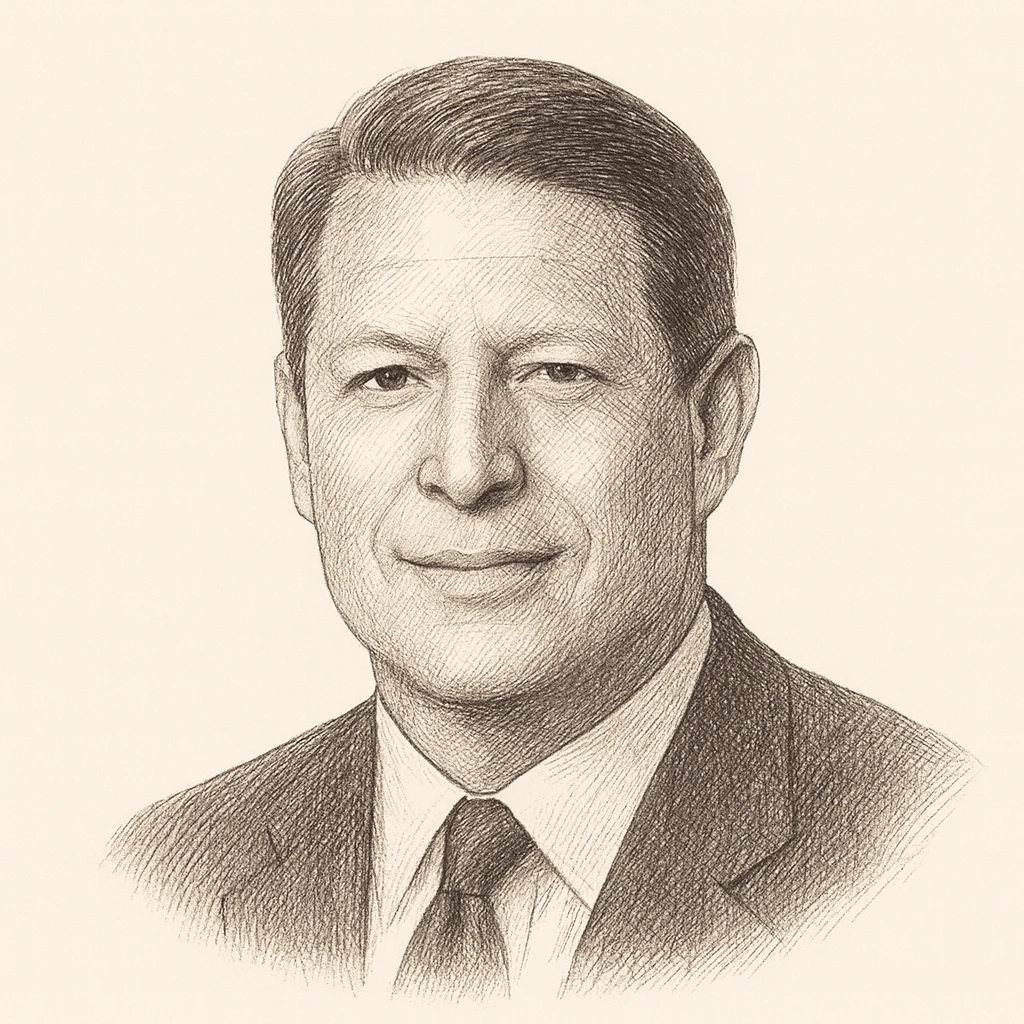
Al Gore built his political career at the intersection of establishment liberalism and technocratic reform. Elected to the House of Representatives and then the Senate from Tennessee, he cultivated an early reputation as a policy-minded legislator interested in science, technology, and the environment. As Vice President under Bill Clinton, he became a leading figure in the centrist "New Democrat" project, which sought to reconcile progressive social aims with fiscal discipline, market mechanisms, and a faith in expertise and efficient governance. His "Reinventing Government" initiative reflected this instinct: the belief that the state could be modernized and streamlined rather than simply expanded or dismantled.
Gore's most enduring contribution to political thought lies in his campaign to place environmental degradation, and climate change in particular, at the center of mainstream politics. He argued that the scientific consensus on global warming imposed a moral and civilizational obligation on democratic societies, and he framed the issue not as a fringe concern but as a defining test of responsible governance. Through the documentary An Inconvenient Truth and sustained advocacy, he helped translate complex climate science into a broadly accessible political narrative, an effort recognized with a Nobel Peace Prize shared with the Intergovernmental Panel on Climate Change.
His approach embodies a characteristically establishment-progressive conviction: that serious problems are best met through evidence, institutions, and incremental but ambitious policy, rather than through radical rupture. Critics from the left have charged that his market-oriented remedies and comfort with corporate partnership are inadequate to the scale of the crisis, while opponents on the right have contested both his politics and, at times, his framing of the science. His narrow and disputed loss in the 2000 presidential election, resolved by the Supreme Court, made him a symbol of the fragility of democratic processes and of the stakes of establishment liberalism's electoral setbacks.
Beyond electoral politics, Gore's influence endures in the way climate change is now widely understood as a governing priority rather than a specialist issue. He helped normalize the expectation that mainstream center-left politics should treat environmental stewardship as central to its identity, shaping a generation of policymakers and activists who inherited his conviction that democratic institutions must respond to scientific warning.
Al Gore is associated with Establishment Progressive. See the archetype