
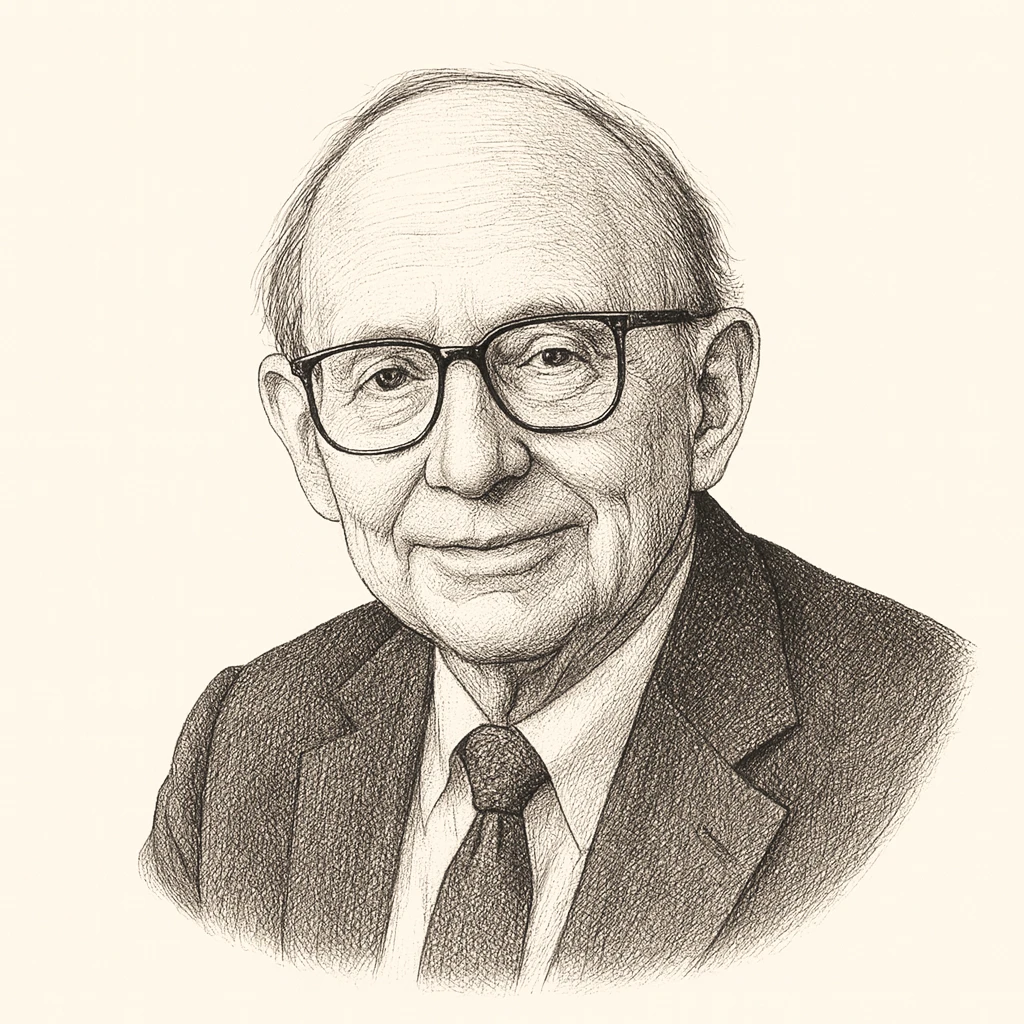
Samuel Huntington was born in 1927 in New York City, the son of a hotel trade publisher, and educated at Yale, where he graduated at eighteen after accelerating through the curriculum. He served briefly in the army, then went to the University of Chicago and then Harvard for his doctorate in political science, studying under Carl Friedrich, the German-American political theorist whose comparative approach to political institutions gave Huntington the framework for thinking about politics across cultures and historical periods rather than within the assumptions of any single tradition. He joined the Harvard faculty in 1950 and remained there, with interruptions, for the rest of his career — a span of nearly six decades in which he produced a series of books that consistently challenged the prevailing consensus of the political science profession and were consistently proved more durable than that consensus.
The early career established his credentials as a rigorous empiricist with no patience for wishful thinking. The Soldier and the State (1957) was his doctoral dissertation turned into a major work — an analysis of civil-military relations that argued, against the dominant liberal view, that a professional military with its own distinct ethos and institutional identity was more compatible with democratic civilian control than a military integrated into civilian society. It was a conservative argument in the technical sense: it defended the value of hierarchy, professionalism, and institutional autonomy against the liberal preference for civilian oversight and integration. The book was attacked by liberal academics and praised by military professionals, a pattern that would repeat throughout his career.
Political Order in Changing Societies (1968) was his most sustained theoretical work and his most consequential contribution to comparative politics. Written against the background of Third World instability and the failure of American development policy in Vietnam, it argued that the central problem of modernizing societies was not the achievement of democracy but the maintenance of order. Rapid economic and social modernization generated political demands that existing institutions could not accommodate, producing instability, civil war, and military coups — not despite economic development but partly because of it. Strong institutions mattered more than democratic procedures for maintaining the order within which development could occur. This was an uncomfortable argument in 1968, when development economists and Cold War strategists were committed to the view that economic growth would produce liberal democracy, and it was rejected by those who found its implications too convenient for American support of authoritarian allies. It became, in time, standard comparative politics.
He worked in the Carter administration's National Security Council from 1977 to 1978, which gave him direct experience of foreign policy-making and deepened his skepticism about the gap between American ideals and American interests in international politics. He returned to Harvard and in 1993 published a Foreign Affairs article that would prove to be one of the most discussed and contested pieces of political analysis of the postwar era. "The Clash of Civilizations?" argued that the post-Cold War world would be organized not by ideological or economic competition but by civilizational conflict — that the great cultural traditions, shaped by centuries of religious and historical development, would increasingly come into conflict along their fault lines, and that Western liberal universalism — the belief that everyone, given the opportunity and the institutions, would embrace Western democratic values — was wishful thinking that served as intellectual cover for Western imperialism.
The book that expanded the argument in 1996 generated a response proportional to its ambition. Edward Said, in "The Clash of Ignorance" (2001), argued that he had reified complex, internally contested traditions into monolithic blocs; other objections held that he had confused political Islam with a civilization and that his framework generated the conflicts it claimed to predict. None of this kept his conceptual vocabulary — civilizational clash, fault lines, the West and the Rest — from entering the standard language of international relations, where it remains. The September 11 attacks were experienced by many as confirmation of his thesis, generating renewed engagement with both the argument and its critics.
Who Are We? (2004) turned the civilizational analysis inward. American national identity was not a creedal proposition — not simply commitment to the universal values of freedom and equality — but a cultural inheritance rooted in what Huntington called Anglo-Protestant civilization: the specific religious, linguistic, and cultural traditions that the first settlers had brought and that had shaped American institutions and social life for three centuries. Mass immigration, particularly from Latin America, was generating a population that shared neither this cultural inheritance nor, in his analysis, the assimilationist pressures that had absorbed previous waves of immigration. The book was received as a provocation and by some as xenophobia. It was the work of a man who believed that communities had identities that deserved to be taken seriously, and that taking them seriously sometimes required saying things that the prevailing liberal consensus preferred not to hear.
He died in 2008, on Martha's Vineyard, having spent his last years watching the debates his work had generated continue without resolution. He was one of the very few political scientists whose books were read beyond the profession, by diplomats, strategists, and general readers who recognized that he was asking real questions about how the world actually worked rather than how political theorists wished it would.
Samuel Huntington is associated with National Conservative. See the archetype