
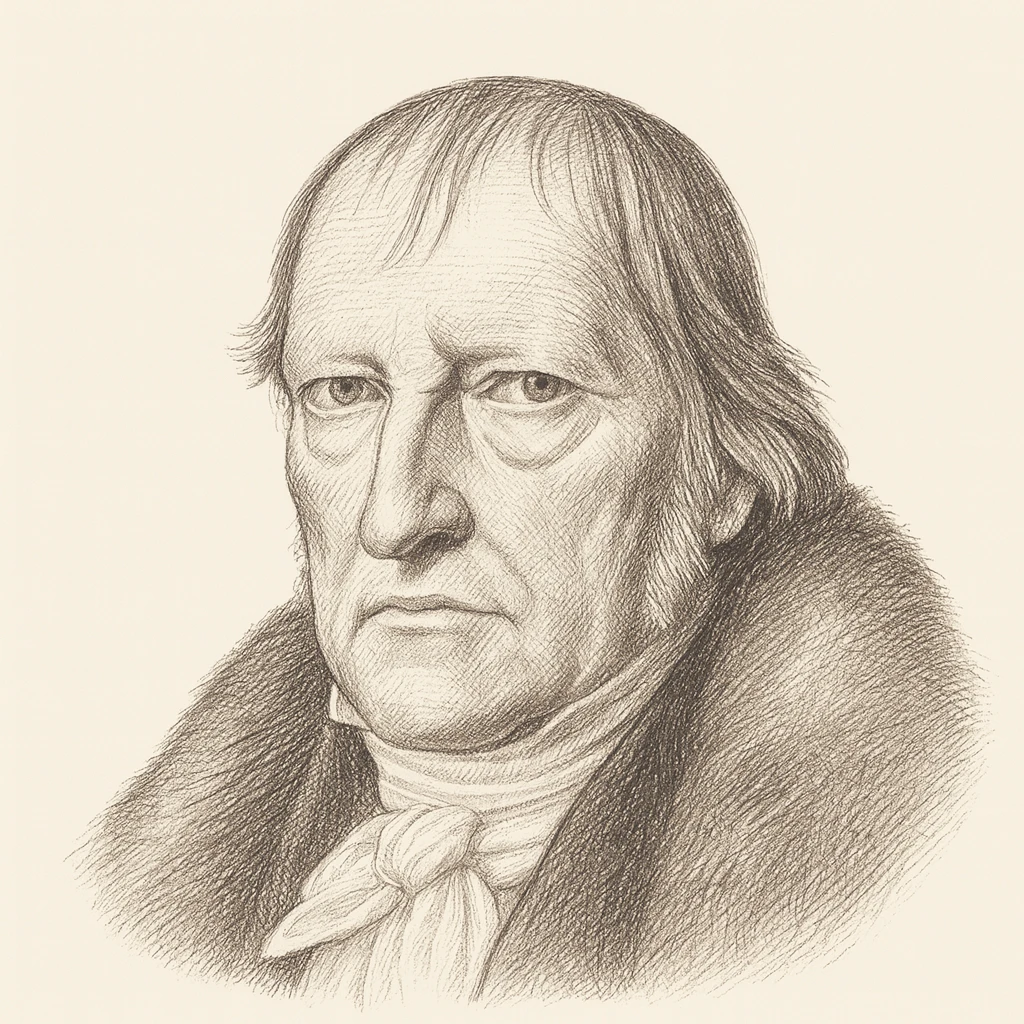
Georg Wilhelm Friedrich Hegel is one of the most influential philosophers in the history of Western thought, and one of the most difficult to read. His prose is famously dense, his vocabulary is technical and self-referential, and his arguments are organized according to a dialectical method that requires patience and goodwill from anyone trying to follow them. The reward for the difficulty is a body of work that almost no major political tradition of the last two centuries has been able to ignore. Marxists, conservatives, liberals, fascists, communitarians, and theologians have all found things in Hegel they could use, and they have used him in directions Hegel himself would have found contradictory.
Hegel was born in Stuttgart in 1770. He studied theology at the University of Tübingen alongside two other students who would also become major figures in German intellectual life — the poet Friedrich Hölderlin and the philosopher F.W.J. Schelling. The three were close friends and intellectual collaborators in their student years, and they all watched the French Revolution unfold across the border with the kind of excitement that defined their generation. Hegel reportedly planted a "liberty tree" with his friends to celebrate the Revolution. The Revolution and its aftermath — the rise of Napoleon, the wars that followed, the eventual restoration of monarchy across Europe — shaped Hegel's lifelong attempt to understand history as a process with a meaning and a direction.
Hegel's central insight, the one that runs through everything he wrote, was that reality and thought develop through a dialectical process. Every concept, every social arrangement, every stage of history contains internal contradictions that drive it to develop into something more complete. The traditional textbook summary of this — thesis, antithesis, synthesis — is too simple, and Hegel himself didn't use those terms in that schematic way. The actual process is messier and more interesting: ideas and institutions reveal their limitations through their own development, what was hidden in them comes to the surface, contradictions force movement to higher stages, and what was lost at earlier stages is recovered and transformed at later ones. Hegel called this process the development of "Spirit" (Geist), which he understood as something like the collective consciousness of humanity coming gradually to know itself across history.
The Phenomenology of Spirit (1807) is Hegel's most famous work — a massive book that traces the development of human consciousness from the most basic forms of awareness to the highest forms of philosophical self-knowledge. It contains the famous master-slave dialectic, in which Hegel analyzes how self-consciousness emerges from the struggle between two beings each seeking recognition from the other. The dialectic became one of the most influential passages in 19th and 20th century philosophy, shaping everything from Marx's theory of class struggle to existentialist accounts of intersubjective recognition. The Philosophy of Right (1821) is Hegel's mature work on political philosophy, arguing that the modern constitutional state is the highest form yet achieved of the dialectical development of freedom — that genuine freedom isn't the abstract liberty of the individual but the substantive freedom of citizens whose lives are organized through rational institutions.
The political legacy of Hegel is contested precisely because his framework is so flexible. The "Right Hegelians" of the mid-19th century used him to defend the existing Prussian state and the conservative restoration. The "Left Hegelians" — Feuerbach, Bruno Bauer, the young Marx — used him to critique religion, the state, and existing social arrangements. Marx famously claimed to have "stood Hegel on his head," keeping the dialectical method but grounding it in material conditions rather than the development of Spirit. Liberal Hegelians like T.H. Green used Hegel to ground a conception of positive freedom that could justify the welfare state. The British idealists at Oxford and Cambridge built much of late-19th century English political philosophy on Hegelian foundations.
Hegel died in Berlin in 1831, probably of a stomach disease, possibly cholera. His students at the University of Berlin had treated him as one of the great philosophers of the age, and the generation that came after him spent decades fighting over what he had actually meant. The fights have never really stopped. To read Hegel today is to encounter a thinker whose framework is too productive to be settled and too ambiguous to be reduced to any single political conclusion.
G.W.F. Hegel is associated with Vanguard Collectivist. See the archetype